By Investigative Desk
October 8, 2026
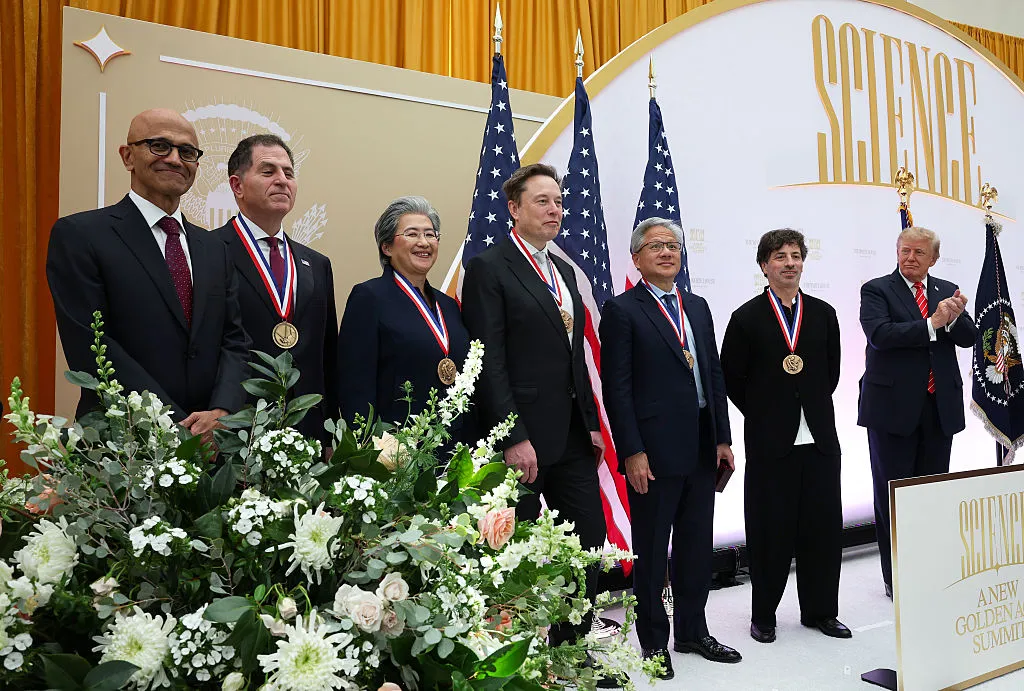
In a high-profile ceremony held this Thursday at the Golden Age of American Innovation Summit, the White House conferred the nation’s highest scientific and technological honors upon a cohort of Silicon Valley’s most influential titans. President Trump presented the National Medal of Science and the National Medal of Technology and Innovation to a group of executives whose companies define the modern digital landscape. However, the prestige of the event has been shadowed by growing scrutiny regarding the financial entanglement between these industry leaders and the current administration.
The Honorees: A Who’s Who of Silicon Valley
The ceremony recognized individuals whose contributions to artificial intelligence, semiconductor manufacturing, and global infrastructure have fundamentally altered the trajectory of the 21st century.
Recipients of the National Medal of Science included:
- Elon Musk: Cited for his advancements in aerospace engineering and autonomous transit.
- Jensen Huang: Recognized for his foundational work in GPU architecture and the acceleration of AI processing.
- Sergey Brin: Honored for his pioneering role in information retrieval and the development of large-scale search algorithms.
- Lisa Su (AMD): Celebrated for her transformative leadership in semiconductor engineering and high-performance computing.
Additionally, the National Medal of Technology and Innovation was awarded to:
- Michael Dell (Dell Technologies): Recognized for his contributions to global supply chain logistics and personal computing hardware.
- Satya Nadella (Microsoft): Awarded for his role in cloud computing infrastructure and the integration of enterprise-grade artificial intelligence.
President Trump, speaking to the assembly, characterized the honorees as the architects of a new American hegemony. “These individuals have pioneered an incredible future for America,” the President stated. “Because of their vision, their grit, and their genius, we will always be on top. No one else can compete with us.”
A Chronology of the 2026 Summit
The summit was meticulously choreographed to project an image of national strength through technological superiority.
- October 8, 9:00 AM: The Golden Age of American Innovation Summit opens with a keynote address focused on domestic manufacturing and the repatriation of supply chains.
- October 8, 12:30 PM: A series of closed-door "Tech Policy Roundtable" discussions occur, involving the eventual awardees and senior White House advisors.
- October 8, 3:30 PM: The formal medal presentation ceremony commences in the East Room, broadcast to a global audience.
- October 8, 5:00 PM: News reports emerge detailing the substantial financial contributions linked to the awardees, triggering immediate public discourse regarding the selection criteria.
Financial Ties and the "Pay-to-Play" Narrative
The distribution of these medals has reignited a fierce debate regarding political donations and the potential for regulatory capture. Investigative reporting has unveiled that the collective financial footprint of these honorees—and their respective organizations—in relation to the Trump administration is substantial, totaling nearly $6 billion.
The figures are striking. Alphabet and Microsoft have previously directed significant capital toward presidential inauguration funds and the renovation of White House infrastructure. AMD, under the leadership of Lisa Su, has provided financial support to pro-Trump Super PACs. Perhaps most notably, Michael and Susan Dell pledged $6.25 billion to the "Trump Accounts," a signature administration initiative marketed as a savings and investment program for American children.
Critics argue that the proximity of these donations to the awarding of national honors suggests a blurring of lines between public service and private political patronage. Supporters of the administration, conversely, maintain that these individuals were selected based on their objective contribution to the U.S. economy, noting that their philanthropic efforts are aligned with the administration’s stated policy goals of long-term economic growth.
The Nadella Paradox: A Case Study in Policy Friction
The ceremony was marked by a peculiar irony regarding Microsoft CEO Satya Nadella. While he stood on stage to accept the National Medal of Technology and Innovation, it was revealed that the administration had just days prior enacted a major policy shift affecting his company: the indefinite suspension of Microsoft from the H-1B visa program.

The H-1B program, which allows U.S. companies to hire skilled foreign workers, has been a cornerstone of the tech industry’s talent acquisition strategy. By suspending Microsoft’s participation, the administration has introduced a significant operational hurdle for the software giant. This move has left industry analysts confused: how can the administration simultaneously honor the head of a company while actively restricting its ability to function as it has for decades?
Some policy analysts suggest this is part of a "pressure-cooker" strategy—using federal honors to signal alignment while using regulatory levers to force domestic hiring and compliance with administration-specific mandates.
Implications for the Tech Sector and Governance
The events of October 8 represent a turning point in the relationship between Silicon Valley and Washington D.C. Several key implications have emerged from the fallout of the summit:
1. The Consolidation of Corporate and Political Power
The event signals a shift toward a more corporatist model of governance, where the leaders of the tech sector are treated as state-adjacent partners rather than merely private entities. By tying the reputations of these executives to the administration’s success, the White House has created a unified front of "American Innovation."
2. The Weaponization of Regulatory Policy
The simultaneous awarding of medals and the suspension of H-1B privileges suggest that the administration is comfortable utilizing a "carrot and stick" approach. Regulatory agencies may become increasingly central to how the government manages tech giants, with policy decisions—such as visa quotas, antitrust enforcement, or subsidies—becoming bargaining chips in a larger geopolitical game.
3. Public Trust and Institutional Integrity
The optics of the ceremony have polarized the public. While many view the advancement of domestic technology as a vital national security priority, others worry that the "politicization of science" undermines the meritocratic nature of national awards. If the public perceives that the highest honors in science and technology are attainable through political donations rather than pure research breakthroughs, the symbolic value of the National Medals may be permanently diminished.
Official Responses and Looking Ahead
To date, the White House has dismissed claims of favoritism, reiterating that the selection process for the medals is rigorous and involves consultation with the National Science and Technology Council. A spokesperson for the administration stated that the financial contributions cited by the press were "acts of patriotism" rather than attempts to purchase political favor.
For their part, the companies involved have largely maintained a low profile regarding the controversy, focusing their public messaging on the honor of the award and their continued commitment to "American prosperity."
As the administration moves into the final months of the year, all eyes will be on whether the suspension of H-1B visas for Microsoft is a temporary tactical maneuver or a permanent policy shift. Furthermore, observers will be watching to see if other tech companies—especially those who did not receive awards—begin to align their own political spending more closely with the White House to avoid regulatory backlash.
The 2026 Golden Age of American Innovation Summit has succeeded in one regard: it has laid bare the complex, often uncomfortable reality of the relationship between capital, technology, and the state. As the U.S. strives to maintain its technological lead in an increasingly competitive global landscape, the question remains whether this new model of partnership will catalyze true innovation or merely entrench a new era of state-sanctioned corporate influence.