In the modern digital economy, the architecture of a successful software product extends far beyond the lines of code visible to an end-user. It is a symphony of creation and sustainment—where the act of building an application is merely the opening movement, and the process of ensuring that software reaches the user reliably and scales under pressure forms the rest of the performance. This duality is captured in the professional distinction between Software Engineers and DevOps Engineers. While both are pillars of the tech industry, their philosophies, toolkits, and daily mandates differ significantly.
The Evolution of Roles in the Software Lifecycle
To understand the difference, one must look at the chronology of the software development lifecycle (SDLC). Traditionally, the "silo" model separated developers (who wrote the code) from operations teams (who managed the servers). This led to friction—often summarized as "it works on my machine" syndrome.
Software Engineering evolved as the discipline of applying systematic, quantifiable approaches to the development, operation, and maintenance of software. Meanwhile, DevOps emerged as a cultural and technical movement intended to break those silos. It introduced the concept of "Infrastructure as Code" (IaC) and Continuous Integration/Continuous Deployment (CI/CD), merging the development and operations mindset into a single, cohesive workflow.
Defining the Software Engineer: The Architect of Logic
A software engineer is the primary architect of the digital experience. Using a deep understanding of computer science fundamentals, mathematics, and complex algorithms, these professionals transform abstract requirements into functional digital solutions.

Core Responsibilities
- Design and Development: Crafting the application’s architecture, choosing appropriate frameworks, and writing the source code that powers the product.
- Problem Solving: Debugging complex logic errors and optimizing algorithms to ensure the application performs efficiently.
- Lifecycle Management: From feature ideation to deployment, they ensure the product aligns with user requirements.
- Collaboration: Working closely with product managers and UX designers to iterate on features based on user feedback.
Defining the DevOps Engineer: The Architect of Reliability
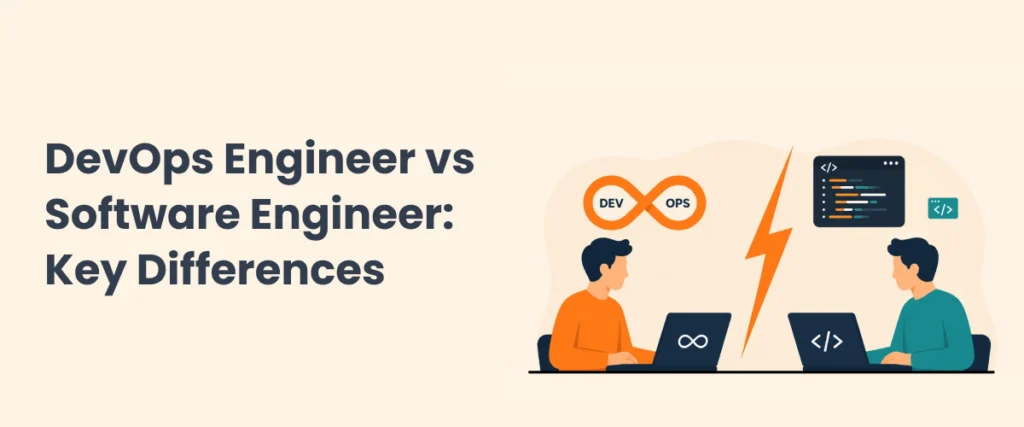
If the software engineer builds the "car," the DevOps engineer builds the "factory" and the "highway." They are the bridge between the development team and the IT operations department. Their goal is to maximize the speed, efficiency, and stability of software delivery.
Core Responsibilities
- Automation: Eliminating manual tasks through scripting and CI/CD pipelines to ensure code can be deployed at scale without human error.
- Infrastructure Management: Provisioning and managing cloud resources (AWS, Azure, Google Cloud) so the application has the compute power it needs.
- Monitoring and Observability: Implementing tools to track system health, ensuring that downtime is minimized and security is baked into the infrastructure.
- Reliability Engineering: Ensuring the system can handle traffic spikes and recover gracefully from failures.
Supporting Data: The Talent Gap and Market Demand
The industry landscape currently favors those who can navigate the complexities of cloud-native development. According to insights from industry analysts at Taggd, while India holds a staggering 16% of the global AI talent pool, the nation is grappling with a 55–60% talent shortage in specialized cloud-native and DevOps skills.
This scarcity has driven a 75% surge in specialized job postings over the last two years. As companies rush to digitize their operations, the demand for professionals who can manage the "plumbing" of software—the DevOps engineer—is reaching a premium. Simultaneously, software engineering remains the bedrock of the industry, with constant demand for specialists in AI, mobile, and backend systems.
Comparative Analysis: Key Differences in Focus
| Factor | Software Engineer | DevOps Engineer |
|---|---|---|
| Primary Goal | Feature delivery and product quality | Deployment speed and system reliability |
| Daily Toolset | IDEs, Git, Programming Frameworks | Kubernetes, Terraform, Jenkins, Cloud Providers |
| Mindset | "How can I build this feature?" | "How can I scale and secure this?" |
| Output | Executable application code | Automated pipelines and infrastructure |
The Overlapping Skillset: Where Roles Converge
Despite their differences, the two roles share a profound common ground. Both require:

- Version Control Proficiency: Mastery of Git is non-negotiable for both roles.
- Debugging Skills: Whether it is a logic bug in a Java application or a network misconfiguration in a Kubernetes cluster, both roles are fundamentally "problem-solving" professions.
- Security Mindset: Modern software development demands that security be a shared responsibility (DevSecOps).
- Continuous Learning: Both roles exist in a state of perpetual change; staying updated with new libraries, cloud services, and security threats is mandatory.
Economic Implications: Salary Trends in India
The market compensates these roles based on the complexity of their contributions. While software engineering offers a wide entry point, high-end roles like Platform Engineering and Site Reliability Engineering (SRE)—which fall under the DevOps umbrella—often command higher premiums due to the business-critical nature of the work.
- Software Development: Roles like Backend Developers (average ₹10.7–11.8 LPA) and Full-Stack Developers (average ₹9.2–10.2 LPA) remain stable, high-growth tracks.
- DevOps/SRE: Specialized roles such as Platform Engineers (₹15.7–17.4 LPA) and DevSecOps Engineers (₹15.3–16.9 LPA) reflect the high market value of professionals who can safeguard and automate enterprise-grade infrastructure.
Official Industry Perspective: The Future of the "T-Shaped" Engineer
Industry leaders and CTOs are increasingly pushing for the "T-shaped" professional—individuals who have deep expertise in one area (e.g., software development) but a broad understanding of the other (e.g., cloud operations).
Many organizations are finding that the most efficient teams are not those with rigid boundaries, but those where software engineers understand the infrastructure they deploy to, and DevOps engineers understand the code they are supporting. This "shift-left" approach, where developers take on more responsibility for their own deployments, is the current gold standard in agile organizations.
Which Path Should You Choose?
Choosing between these two paths requires a self-assessment of your professional interests:

Pursue Software Engineering if:
- You are passionate about writing code and creating user-facing features.
- You enjoy the creative process of building an application from scratch.
- You are fascinated by algorithms, data structures, and the logic of software design.
Pursue DevOps Engineering if:
- You enjoy optimizing systems and solving complex infrastructure puzzles.
- You find satisfaction in automation—making a manual, boring task happen automatically with a script.
- You are curious about cloud architecture, security, and the "behind the scenes" of how software survives in the real world.
Conclusion
The distinction between a software engineer and a DevOps engineer is not a matter of hierarchy, but of specialization. Software engineers provide the creative spark and the functional logic, while DevOps engineers provide the sturdy foundation and the high-speed delivery mechanisms that allow that code to thrive.
In the final analysis, both roles are essential to the modern digital ecosystem. Whether you choose to focus on the intricate logic of an application or the expansive architecture of the cloud, you are participating in the essential work of modern civilization: building the tools that define the future. As you embark on your career, remember that the most successful engineers are those who respect the complexity of both disciplines, acknowledging that in the world of software, we are all part of the same team.