New Delhi: The Union Budget 2025, presented today, has ushered in a wave of much-anticipated relief for the Indian middle class, primarily through a substantial overhaul of the income tax structure. Key among the announcements are revised tax slabs, more favorable tax rates, and a significant enhancement of the tax rebate under Section 87A, effectively making annual incomes up to Rs 12 lakh tax-free for eligible individuals. This move is projected to inject significant purchasing power back into the hands of a large segment of the population, potentially boosting consumption and economic growth.
The Finance Minister, in a statement following the budget presentation, highlighted the government’s commitment to easing the tax burden on salaried individuals and the middle-income group. "Our aim with these changes is to provide tangible financial relief and encourage greater participation in the formal economy," the Minister stated. "By simplifying the tax structure and increasing disposable income, we believe this budget will act as a catalyst for broader economic prosperity."
Key Changes in the New Tax Regime: A Detailed Breakdown
The most impactful changes are evident within the "New Tax Regime," which has become the default option for taxpayers. The budget has significantly revised the income tax slabs and their corresponding rates, offering a more progressive and beneficial structure for a wider income bracket.
Revised Tax Slabs under the New Tax Regime:
| Existing Tax Slabs (New Regime) | Existing Rate | Proposed Tax Slabs (New Regime) | Proposed Rate |
|---|---|---|---|
| Upto Rs 3 lakhs | NIL | Upto Rs 4 lakhs | NIL |
| Rs 3 lakhs to Rs 7 lakhs | 5% | Rs 4 lakhs to Rs 8 lakhs | 5% |
| Rs 7 lakhs to Rs 10 lakhs | 10% | Rs 8 lakhs to Rs 12 lakhs | 10% |
| Rs 10 lakhs to Rs 12 lakhs | 15% | Rs 12 lakhs to Rs 16 lakhs | 15% |
| Rs 12 lakhs to Rs 15 lakhs | 20% | Rs 16 lakhs to Rs 20 lakhs | 20% |
| Above Rs 15 lakhs | 30% | Rs 20 lakhs to Rs 24 lakhs | 25% |
| Above Rs 24 lakhs | 30% |
Enhancement of Tax Rebate under Section 87A:
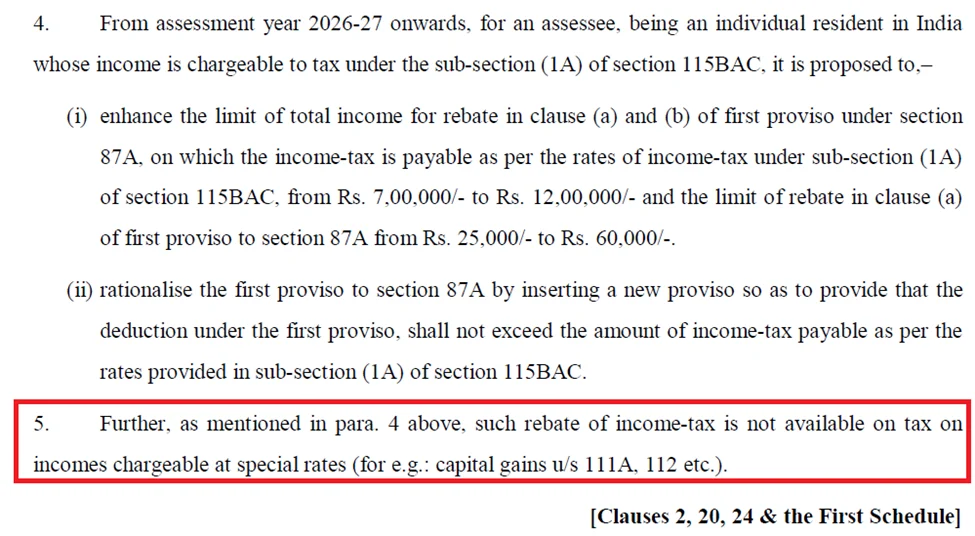
Crucially, the eligibility threshold for the tax rebate under Section 87A has been significantly enhanced. Previously capped at Rs 7 lakh of total income, this rebate is now extended to individuals with a total income of up to Rs 12 lakh. This means that for individuals falling within this income bracket, their entire income tax liability will be offset by the rebate, resulting in zero tax payable. The maximum potential tax saving under this provision can reach up to Rs 1.1 lakh, a substantial boost for middle-income households.
Table Illustrating Tax Savings:
The following table demonstrates the impact of these changes on net tax liability across various income levels, assuming the standard deduction of Rs 50,000 is applicable.
| Income After Standard Deduction | Existing Net Tax Liability | After Union Budget 2025 Net Tax Liability | Difference (Savings) |
|---|---|---|---|
| Rs 3,00,000 | NIL | NIL | NIL |
| Rs 4,00,000 | NIL | NIL | NIL |
| Rs 5,00,000 | NIL | NIL | NIL |
| Rs 7,00,000 | Rs 20,000 | NIL | Rs 20,000 |
| Rs 10,00,000 | Rs 50,000 | NIL | Rs 50,000 |
| Rs 12,00,000 | Rs 80,000 | NIL | Rs 80,000 |
| Rs 14,00,000 | Rs 1,20,000 | Rs 90,000 | Rs 30,000 |
| Rs 15,00,000 | Rs 1,40,000 | Rs 1,05,000 | Rs 35,000 |
| Rs 18,00,000 | Rs 2,30,000 | Rs 1,60,000 | Rs 70,000 |
| Rs 20,00,000 | Rs 2,90,000 | Rs 2,00,000 | Rs 90,000 |
| Rs 24,00,000 | Rs 4,10,000 | Rs 3,00,000 | Rs 1,10,000 |
| Rs 25,00,000 | Rs 4,40,000 | Rs 3,30,000 | Rs 1,10,000 |
| Rs 30,00,000 | Rs 5,90,000 | Rs 4,80,000 | Rs 1,10,000 |
| Rs 50,00,000 | Rs 11,90,000 | Rs 10,80,000 | Rs 1,10,000 |
Understanding the "Tax-Free" Income Threshold
A common point of inquiry is how an income of up to Rs 12 lakh can be considered tax-free when the initial tax slab starts at Rs 4 lakh. This is primarily achieved through the enhanced tax rebate under Section 87A.
Section 87A: The Key to Tax-Free Income
Section 87A of the Income Tax Act provides a rebate on income tax liability for resident individuals. The budget’s significant enhancement of this rebate to cover incomes up to Rs 12 lakh means that if your total taxable income (after deductions) falls within this limit, your entire tax liability will be extinguished by the rebate.
It is crucial to differentiate between a tax rebate and a tax refund. A tax refund is issued by the Income Tax Department when a taxpayer has paid more tax than their actual liability. A tax rebate, on the other hand, is a reduction applied directly during the calculation of the tax liability itself.
Implication for Employers and TDS:
This substantial increase in the rebate limit has a direct implication for employers. For individuals earning up to Rs 12 lakh annually, employers will no longer be required to deduct Tax Deducted at Source (TDS) from their salaries. This simplifies the payroll process and ensures that individuals receive their full salary without any upfront tax deductions.
Important Note for Non-Residents:
It is important to note that the enhanced rebate under Section 87A is exclusively available to resident individuals. Non-Resident Indians (NRIs) will not be eligible for this specific rebate. Consequently, for NRIs, the tax liability will commence beyond the Rs 4 lakh income threshold, as per the revised tax slabs.
Beyond the Rebate: Tweaked Tax Slabs Benefit Higher Earners
While the Rs 12 lakh tax-free threshold is a major highlight, the budget’s impact extends to those earning above this amount as well. The revised tax slabs and rates ensure that even individuals with higher incomes will benefit from reduced tax outgo. Notably, the highest tax rate of 30% will now be applicable only to incomes exceeding Rs 24 lakh, a significant increase from the previous threshold of Rs 15 lakh. This adjustment provides considerable relief to the upper-middle and higher-income segments.
Navigating the Marginal Relief: Ensuring Fairness at the Threshold
A potential point of concern for taxpayers lies in the scenario where their income slightly exceeds the threshold for the Section 87A rebate. For instance, an individual earning Rs 12 lakh would pay zero tax due to the rebate. However, earning just Rs 10,000 more, i.e., Rs 12.1 lakh, would have previously resulted in a substantial tax liability, negating the benefit of the increased income.
The Role of Marginal Relief:
To address this, the concept of "marginal relief" plays a crucial role. Marginal relief ensures that a taxpayer’s increase in tax liability does not exceed the increase in their income above a specific threshold. This provision is designed to prevent a sharp jump in tax burden at the boundaries of tax brackets or rebate limits.

Mechanism of Marginal Relief:
In essence, if an individual’s income crosses the Rs 12 lakh mark, they lose the eligibility for the Section 87A rebate. However, marginal relief ensures that their tax liability does not increase by more than the amount by which their income exceeds Rs 12 lakh. This is technically considered a form of rebate under Section 87A, ensuring a smoother transition across income levels.
Illustrative Example of Marginal Relief:
Consider an individual with a total income (after standard deduction) of Rs 12.25 lakh.
- Income Tax Calculation (without marginal relief): Based on the revised tax slabs, the calculated income tax would be Rs 63,750.
- Rebate Eligibility: Since the income exceeds Rs 12 lakh, the Section 87A rebate is not applicable.
- Marginal Relief Application: The income exceeds the Rs 12 lakh threshold by Rs 25,000. Therefore, the tax liability cannot exceed this Rs 25,000.
- Calculated Marginal Relief: Rs 63,750 (Calculated Tax) – Rs 25,000 (Excess Income) = Rs 38,750.
- Final Tax Liability: Rs 25,000.
This means that even with an income of Rs 12.25 lakh, the individual’s tax liability is capped at Rs 25,000, ensuring that the additional Rs 25,000 earned results in a net increase of only Rs 25,000 in their tax burden. This principle extends up to an income of approximately Rs 12.7 lakh, beyond which the full tax slab rates will apply.
Limitations of Section 87A Rebate: Capital Gains and Special Rates
While the Section 87A rebate offers significant benefits, it is crucial to understand its limitations. The rebate is generally not applicable to income taxed at special rates, most notably capital gains.
Ineligibility for Capital Gains Tax:
The rebate under Section 87A is primarily intended for tax on income from salary, interest, rental income, and other regular income sources taxed at slab rates. It does not extend to taxes levied on capital gains, which are often taxed at specific, preferential rates.
Key Capital Gains Scenarios:
- Short-Term Capital Gains (STCG) on Equity/Equity Funds: Taxed at 20%. Not eligible for Section 87A rebate.
- Long-Term Capital Gains (LTCG) on Equity/Equity Funds: Taxed at 12.5% (with an exemption of Rs 1 lakh annually). Not eligible for Section 87A rebate.
- STCG on Debt Funds, Gold, Real Estate: Not taxed at special rates, but at slab rates. Therefore, eligible for Section 87A rebate if the overall income is within the prescribed limit.
- LTCG on Debt Funds, Gold, Real Estate: Taxed at 12.5%. Not eligible for Section 87A rebate.
Illustrative Examples:
- Scenario 1 (Salary + LTCG on Equity): An individual earns Rs 8 lakh from salary and Rs 3 lakh from LTCG on equity funds. While the salary income would benefit from the Section 87A rebate, the LTCG tax would still be payable. Even with an overall income of Rs 11 lakh, tax will be due on the capital gains after considering the Rs 1 lakh exemption.
- Scenario 2 (Salary + STCG on Equity): Similar to Scenario 1, the salary income benefits from the rebate, but the STCG on equity funds, taxed at 20%, will attract tax liability.
- Scenario 3 (Salary + STCG on Debt Funds): Here, both salary income and STCG on debt funds are taxed at slab rates. Since the total income is Rs 11 lakh, and both components are eligible for slab rate taxation, the Section 87A rebate will apply, rendering the entire income tax-free.
Broader Economic Implications and Future Outlook
The Union Budget 2025’s tax reforms are poised to have a significant impact on the Indian economy. By increasing disposable incomes for a large segment of the population, the government aims to stimulate consumer spending, which is a major driver of economic growth. The simplified tax structure is also expected to encourage greater compliance and reduce the burden of tax administration.
Boosting Consumption and Investment:
The enhanced purchasing power is likely to translate into increased demand for goods and services, benefiting various sectors. Furthermore, with more disposable income, individuals may have greater capacity to save and invest, potentially leading to increased capital formation.
Simplification and Compliance:
The move towards a more straightforward tax regime, particularly the increased adoption of the new tax regime as the default, is expected to simplify tax filing for millions. This simplification, coupled with the significant tax savings, could encourage more individuals to come into the tax net and ensure better compliance.
Challenges and Way Forward:
While the budget presents a positive outlook, the government will need to closely monitor the implementation of these changes and their impact on revenue collection. The long-term sustainability of these tax benefits will depend on the overall economic performance and the government’s fiscal management. Further clarity on specific provisions and potential adjustments in subsequent budgets will be crucial for taxpayers to plan their finances effectively.
The Union Budget 2025 marks a significant stride towards making the Indian tax system more equitable and pro-middle class. The comprehensive changes to tax slabs and rebates are expected to provide substantial financial relief and foster a more robust and consumption-driven economy.
Disclaimer: This article is for informational purposes only and does not constitute financial or tax advice. Tax laws are complex and subject to change. Readers are strongly advised to consult with a qualified Chartered Accountant or tax professional for personalized advice based on their specific circumstances.