The landscape of professional productivity is undergoing a seismic shift. As generative AI moves beyond simple text generation and chatbots, the spotlight has turned toward AI agents—software entities capable of autonomous decision-making and task execution. According to a 2026 survey by Menlo Ventures, which polled 5,000 U.S. adults, the adoption curve is steepening: one in four AI users now regularly employs an agent to handle complex, multi-step workflows.
For marketing, sales, and customer service teams, the promise is clear: move away from manual, repetitive data management and toward a model where software acts as a partner. However, building an effective agent is not as simple as flipping a switch. It requires a disciplined approach to architecture, data integrity, and human oversight.

The Architecture of Autonomy: What Defines an AI Agent?
An AI agent is distinct from traditional rules-based automation or standard chatbots. While a chatbot serves as an interface for conversation and a rule-based workflow follows a rigid "if-then" decision tree, an AI agent operates with a goal-oriented mindset. It is given a mission, authorized access to specific tools, and the autonomy to evaluate data and determine the sequence of actions required to reach a conclusion.
For instance, a marketing agent tasked with "optimizing campaign performance" does not simply follow a script. It must synthesize channel metrics, contrast them against campaign objectives, diagnose potential bottlenecks, and synthesize a recommended path forward.

The Four Pillars of Agent Construction
To transform a theoretical concept into a functional tool, developers and team leads must focus on four foundational building blocks:
- Repeatable Work: AI thrives on consistency. The best tasks for agents are those that occur frequently and follow a standard logic—such as analyzing closed-lost deals to identify recurring customer concerns.
- High-Quality CRM Data: Agents are only as effective as the data they access. CRM records—including sales notes, customer conversations, and deal properties—provide the critical context needed for the agent to make informed decisions.
- Strategic Triggers: An agent must know when to act. Whether initiated by a manual request, a scheduled interval, or a specific change in a CRM record, the trigger dictates the agent’s lifecycle.
- Measurable Outcomes: Success must be quantifiable. Teams must define exactly what a "correct" result looks like—such as a report citing specific metrics and providing a clear, actionable recommendation.
Chronology of Implementation: From Concept to Deployment
Successfully deploying an AI agent is a multi-phase engineering process that emphasizes safety, testing, and iteration.

Phase 1: Definition and Scoping
The process begins with a "mission statement" for the agent. Before writing a single line of instructions, teams should document the goal, the scope of work, and the criteria for success. A best practice for initial deployment is to limit the agent to a single test case—such as one closed-lost deal—to allow for high-fidelity evaluation.
Phase 2: Instruction Engineering
The "instructions" field is the brain of the agent. It must be written in precise, plain language that outlines the agent’s role, its approach to analyzing evidence, and, crucially, how it should handle missing information. A well-written instruction set explicitly tells the agent to flag when evidence is insufficient, preventing the system from "hallucinating" or making assumptions when data is absent.

Phase 3: Tooling and Guardrails
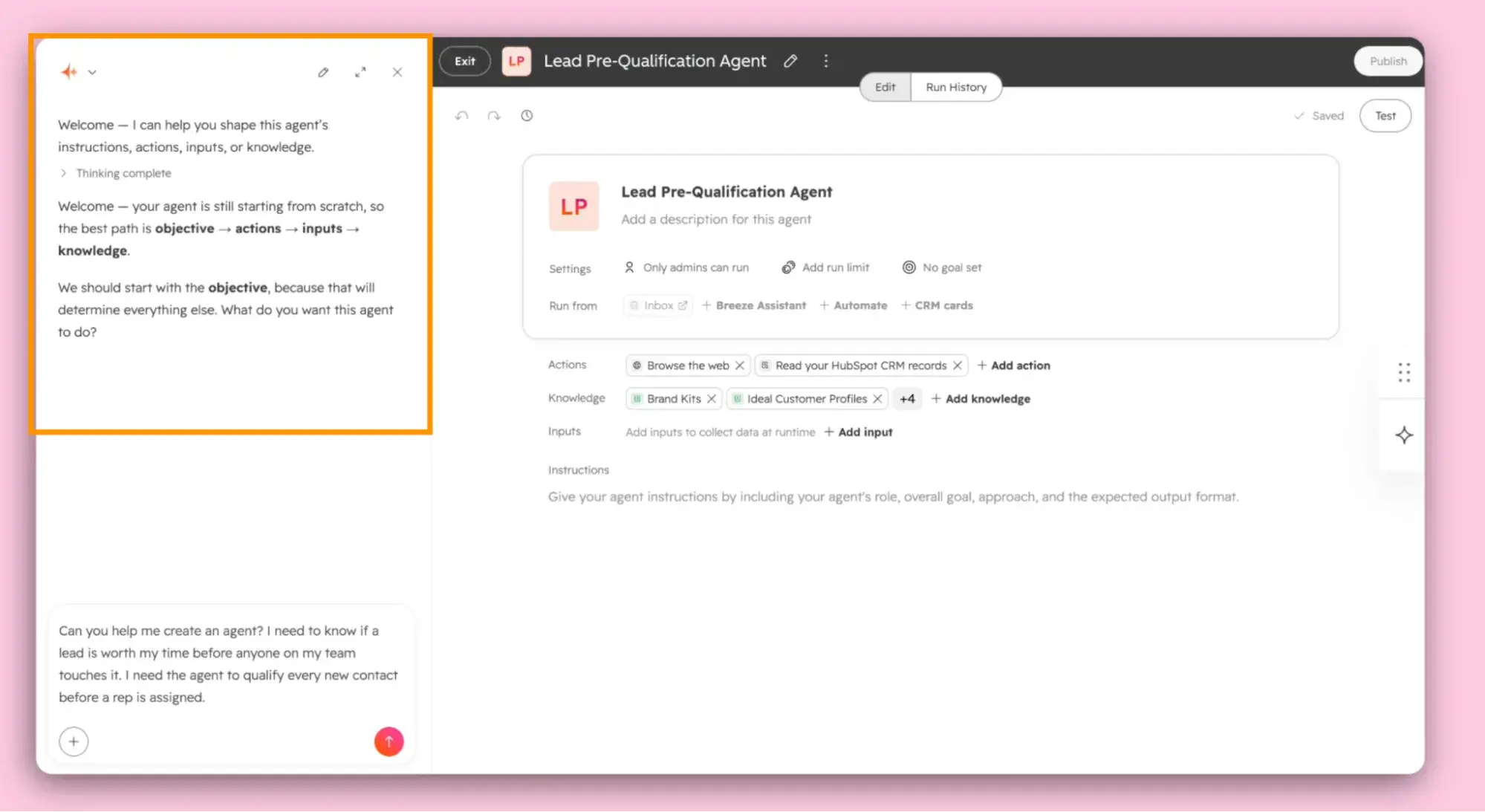
In platforms like HubSpot’s Agent Builder, teams can integrate knowledge vaults—reusable reference materials like PDF reports, blog articles, and spreadsheets—to give the agent industry-specific expertise. Furthermore, setting rigorous guardrails is non-negotiable. Guardrails define the "boundaries of operation," ensuring the agent cannot access unauthorized data or execute high-stakes actions, such as mass data deletion or financial transactions, without human intervention.
Phase 4: The Pilot and Iteration
Once configured, the agent should be tested against a "test set" of representative scenarios. Teams should keep a failure log, categorizing mistakes as they arise. This is an opportunity for iterative improvement: if an agent fails to extract the correct data, the instruction set is refined; if it fails to interpret a nuance, the knowledge vault is updated.

Supporting Data and Performance Metrics
The value of an agent is measured by its impact on human productivity. Organizations should maintain a "test spreadsheet" that compares the time a human takes to perform a task versus the time taken by the agent, adjusted for the time required to review the agent’s output.
Key metrics include:

- Correction Rate: How often does the agent’s output require human intervention?
- Run Cost: The consumption of credits or compute resources per task.
- Time Savings: The delta between manual execution and AI-assisted execution.
If an agent requires 20 minutes of review for every 5 minutes of work saved, it is not yet "production-ready." The goal is to reach a state where the agent acts as an force multiplier, allowing humans to focus on the high-level strategy that AI cannot replicate.
Official Perspectives: The Role of Multi-Agent Systems
Industry experts, including those from Anthropic and HubSpot Academy, suggest that the future lies in "multi-agent systems." Instead of building one massive, complex agent, teams are encouraged to build specialized agents that perform discrete tasks and "hand off" their findings to one another.

For example, one agent might be responsible for gathering research from a LinkedIn API, while a second agent synthesizes that research into a report. This modularity makes it easier to troubleshoot errors. If the report is incorrect, the team knows exactly which agent (the synthesizer) failed, rather than having to debug a monolithic system.
Implications for the Workforce
The shift toward AI-agent-led workflows has profound implications for corporate structures. It necessitates a new role within the team: the AI Operations Manager. This individual is responsible for the health of the agent fleet, the auditing of agent logic, and the maintenance of data sources.

Ethical Considerations and Human-in-the-Loop (HITL)
The most critical implication is the necessity of the "Human-in-the-Loop." For any action involving sensitive data or financial consequences, the agent should never be granted unilateral authority. Instead, the agent prepares a proposal, and the human provides the "final sign-off." This hybrid approach mitigates risk while allowing for the speed and scalability that AI offers.
Real-World Applications
Marketing: Influenced Deal Identification
Filippo Irdi, a senior demand marketing manager at Unmuted, has successfully utilized AI agents to cross-reference LinkedIn ad impression data with HubSpot closed-won deals. By automating the matching of "hidden" influence—customers who saw an ad but never clicked—the agent provides a granular view of marketing ROI that was previously invisible.

Sales: Commission Clarity
Driven, a sales commission platform, has deployed an agent that interprets complex compensation documents. By allowing reps to ask natural language questions about their payouts, the agent provides instant, grounded explanations that save HR and sales operations teams hours of manual verification.
Service: Support Issue Discovery
By connecting HubSpot to ChatGPT, service teams can investigate thousands of support tickets to group recurring issues. This allows product teams to focus on the most frequent pain points, turning reactive support into proactive product development.

Conclusion: Starting Small, Scaling Wisely
The path to integrating AI agents is not a sprint; it is a discipline. The most successful teams start with a singular, well-understood problem, build an agent to solve it, and rigorously evaluate the results. As the technology matures, these agents will become the backbone of the digital enterprise. By focusing on clear instructions, robust data, and, most importantly, consistent human oversight, marketers and sales professionals can move beyond the hype and begin building the autonomous future of work.