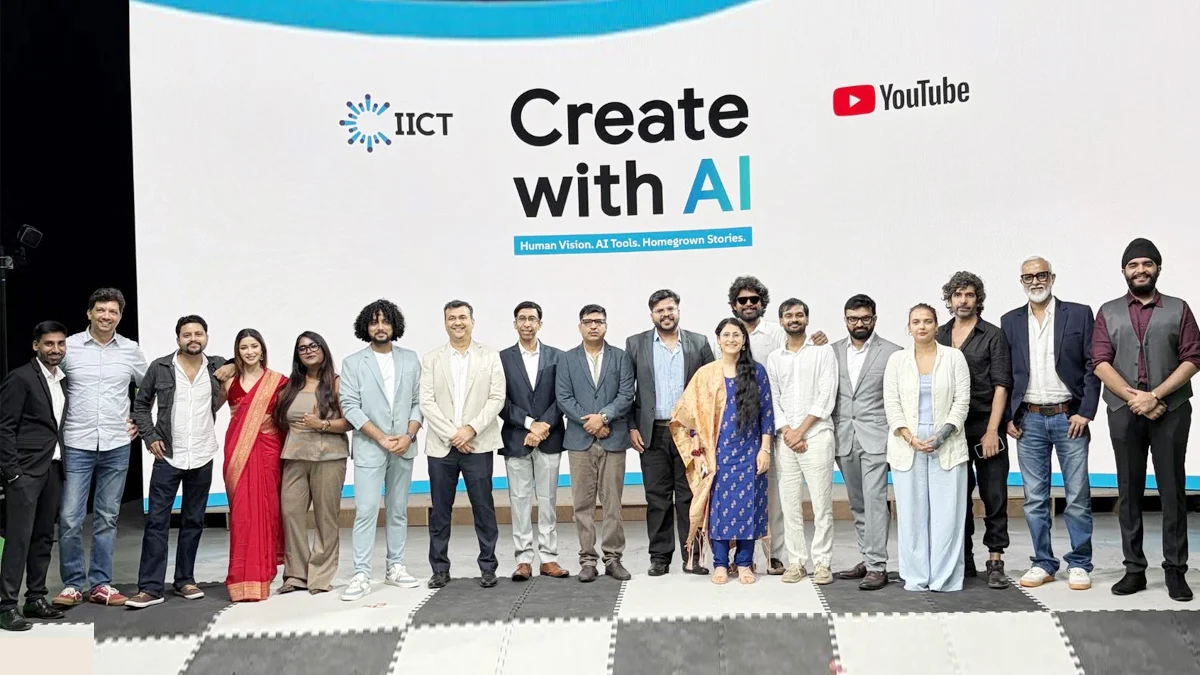
MUMBAI — The landscape of Indian cinema is undergoing a profound metamorphosis, one where the traditional clapboard and camera are increasingly accompanied by the silent, rapid calculations of artificial intelligence. In a landmark showcase held in Mumbai, the Indian Institute of Creative Technologies (IICT) and YouTube unveiled the fruits of their collaborative "Create with AI" programme. The event featured the premiere of four ambitious short films that traversed the vast spectrum of human storytelling: from the divine manifestations of Hindu mythology to the cold vacuum of space, the visceral intensity of historical warfare, and the cerebral intricacies of ancient political strategy.
This initiative serves as a litmus test for the industry, positioning AI not as a replacement for the filmmaker’s soul, but as an expansive canvas for the human imagination.
The Four Pillars: A Chronology of Innovation
The showcase was structured to highlight the versatility of generative AI across different narrative genres. Each project, helmed by a distinct studio, demonstrated a unique workflow in integrating modern technology with classic storytelling tropes.
1. DEVI: The Nine Astras (Kalpanik Films LLP)
The screening opened with DEVI, an ambitious action-mythology project that reimagines the nine manifestations of Goddess Durga. Founders Vishal Yoman and Ayushi Anand utilized a sophisticated blend of Puranic research and generative tools. By ingesting ancient texts into Google’s NotebookLM, the team was able to streamline scripting and character development. The visual grandeur was achieved through Google Vids and Google Veo, while actor Nyra Banerjee served as the emotional anchor, with her performances digitally integrated to bridge the gap between silicon and spirit.
2. Laika (Karthik Kult Kreations)
Shifting from the divine to the existential, Laika—produced by Karthik Sabareesh—brought the audience into the heart of space exploration. While science fiction typically demands astronomical budgets for VFX and set design, Laika focused on the intimate, emotional bond between human and animal, proving that AI can effectively render complex environments while allowing the director to focus on character-driven emotional stakes.
3. Chekavar (Avium Studios)
Perhaps the most technically daunting project, Chekavar recreated the 1741 Battle of Colachel. Director Gijo Uthuppu and his team faced the challenge of simulating large-scale combat involving over 100 individuals—a task that, in traditional production, would require an army of extras, exhaustive costume departments, and massive logistical coordination. Through AI, the team successfully captured the visceral scale of historical warfare, asserting that independent studios can now compete with the visual fidelity of major blockbusters.
4. CHANAKYA – The Mind of an Empire (Eleventh Door Studio)
The final film, led by producer Nishith Dayal, explored the intellectual landscape of ancient India. CHANAKYA moved away from the spectacle of the other films to focus on the strategic genius of the Mauryan architect. It highlighted how AI can assist in the period reconstruction of environments and the nuanced portrayal of historical figures, emphasizing political and philosophical storytelling over raw action.
Supporting Data: The Economic Engine of Generative AI
The integration of AI into Indian cinema is not merely a creative experiment; it is an economic imperative. During the event, presentations highlighted the findings of a Gen Media report by Publicis First and Google, which paints a transformative picture for the Indian creative economy.
According to the report, generative media tools have already delivered a nearly 20 per cent productivity boost to Indian creative professionals. In practical terms, this translates to approximately 10 additional weeks of productive time per year for the average creator. Looking forward, the report estimates that these efficiency gains could contribute a staggering Rs 750 billion to India’s GDP over the next decade. Furthermore, the industry is projected to support nearly 400,000 additional jobs, driven by the democratization of production tools that allow smaller teams to execute large-scale visions.
However, the report clarifies that efficiency is only the entry point. The true value lies in the removal of logistical bottlenecks, allowing creators to overcome language barriers, reach global audiences, and experiment with ambitious concepts that were previously considered "unproduceable" due to financial constraints.
Official Perspectives: Creativity at the Helm
A recurring sentiment throughout the Mumbai event was the insistence that technology must remain a servant to the story. A YouTube representative, in their opening address, underscored the platform’s philosophy: "Our conviction in YouTube is super clear. We truly believe that creativity always begins and ends with human imagination."
The representative emphasized that AI’s role is to act as a "collaborative partner," augmenting human capability rather than replacing the essence of artistic expression. This sentiment was echoed by the participating filmmakers, who were quick to point out that prompting an AI is a far cry from directing a film.
"It’s not like you go and prompt to make a film," noted a spokesperson from the Chekavar team. They stressed that cinematography, lighting, sound design, and, most importantly, the emotional resonance of the performances, remain strictly human domains. For the DEVI team, the involvement of actress Nyra Banerjee was the "bridge where AI and human were connected," ensuring that the final output possessed the depth required for genuine audience engagement.
Implications: The Future of the "Indie" Filmmaker
The IICT-YouTube partnership suggests a paradigm shift in the definition of an independent studio. By equipping emerging storytellers with the infrastructure to use generative tools, the programme is fostering a new ecosystem where talent, rather than capital, dictates the scope of a project.
Breaking the Resource Barrier
Traditionally, the "scale" of a film was directly proportional to its budget. Chekavar and DEVI prove that this rule is being rewritten. With AI tools handling background assets, complex crowd simulations, and environmental rendering, the barrier to entry for high-concept storytelling has been lowered significantly.
A New Pedagogical Approach
The collaboration is not just about the films; it is about education. The IICT-YouTube initiative is designed to build "institutional infrastructure." This includes teaching students how to weave generative AI into the standard filmmaking pipeline—from pre-production script analysis with NotebookLM to post-production visual synthesis. The goal is to produce a generation of filmmakers who are as comfortable with algorithms as they are with lenses.
Preserving Human Nuance
Despite the enthusiasm for technology, the event maintained a sober perspective on the limitations of AI. As the industry matures, the value of the human "creative discipline"—the ability to make artistic choices regarding tone, pacing, and emotional intent—is becoming even more critical. AI can generate a thousand variations of a scene, but it is the human director who must choose the one that moves an audience to tears.
Conclusion: A Collaborative Future
The "Create with AI" showcase in Mumbai was more than just a presentation of four short films; it was a manifesto for the future of Indian cinema. By demonstrating that technology can coexist with mythology, history, and science fiction, the participants have laid the groundwork for a new era of storytelling.
As the industry looks ahead, the success of these projects will likely serve as a blueprint for studios across the nation. The message from the event was clear: the technology is ready, the tools are accessible, and the stories—the ancient, the futuristic, and the human—are waiting to be told. The next chapter of Indian cinema will not be defined by the rise of the machine, but by the rise of the filmmaker who knows how to harness the machine to tell a story that is, in every way, undeniably human.