
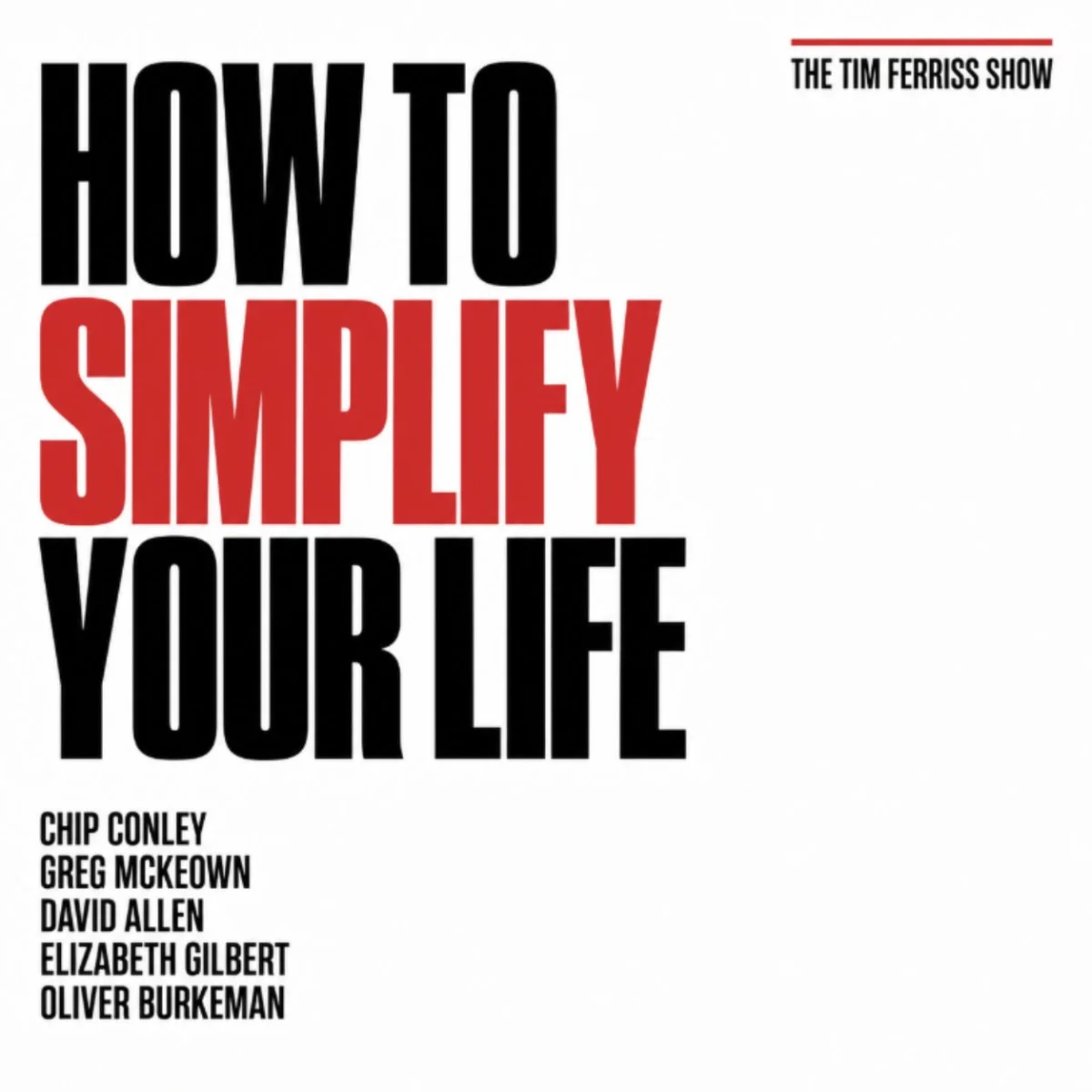
In an era defined by relentless digital connectivity, "hustle culture," and the creeping expansion of personal and professional obligations, the quest for simplicity has shifted from a lifestyle trend to a psychological necessity. A recent special compilation episode of The Tim Ferriss Show brought together a cohort of renowned thinkers—including Chip Conley, Greg McKeown, David Allen, Elizabeth Gilbert, and Oliver Burkeman—to dismantle the myth that more is better.
The consensus among these experts is clear: true simplicity is not a matter of organizing your clutter; it is a fundamental restructuring of your relationship with your own time, identity, and obligations.
The Philosophy of Distillation: Core Insights on Simplification
The central premise of the episode is that while "knowledge" is about accumulation, "wisdom" is about distillation. Chip Conley, founder of the Modern Elder Academy (MEA), draws a sharp distinction between the two, noting that wisdom is the act of subtracting the unnecessary to reveal the essential—akin to a mathematical square root rather than an additive process.
For many high-achievers, the complexity of their lives is often a byproduct of a fragile identity. Conley recounts his own "wake-up call" after a medical crisis in his late 40s, which forced him to transition from the high-status identity of a CEO to a "previously important person." His experience underscores a recurring theme: we often complicate our lives to maintain an external image, only to find that this identity acts as a barrier to authentic growth.
Chronology of Transformation: From Overwhelm to Clarity
The experts mapped out a trajectory for how individuals typically reach—and eventually escape—the state of chronic overwhelm.
Phase 1: The Accumulation Trap
As Greg McKeown, author of Essentialism, explains, individuals often fall victim to the "Endowment Effect." We value things—and opportunities—more simply because we possess them. This cognitive bias turns our lives into "museums" of past interests, such as the metaphorical stormtrooper costume McKeown once considered purchasing simply because the idea had sat in his mind for 30 years.
Phase 2: The Cognitive Load
David Allen, the architect of the Getting Things Done (GTD) methodology, points to the "psychological open loops" that plague the modern professional. When we hold onto commitments without an external system to manage them, our brains attempt to track them 24/7. This lack of a "past or future" perspective in our subconscious is what leads to 3:00 a.m. anxieties.
Phase 3: The Purge
The path to simplicity involves a radical "capturing" process. Allen suggests that sitting down to list every open agreement you have with yourself—no matter how trivial—is the first step toward relief. This act creates a "tabula rasa," allowing individuals to see the reality of their workload and begin the process of renegotiating or dropping commitments that no longer serve them.
Supporting Data: Why We Struggle to Let Go
Psychological research, such as that conducted by Laura Carstensen at the Stanford Center on Longevity, supports the experts’ anecdotal findings. Her work suggests that as individuals perceive their time on earth as finite—whether due to age or a health diagnosis—their focus naturally shifts from long-term accumulation to present-moment satisfaction.
This shift is not merely philosophical; it is a biological imperative. The experts argue that when we "holy-urgency" our way through life, we become manic. The transition from "manic" to "magic" requires a deliberate slowing down. For Chip Conley, this means integrating "Sunday sabbaticals" and radical periods of disconnection to protect the nervous system.
Official Strategies: How to Say "No" and Mean It
The most actionable advice in the episode centered on the social and professional difficulty of setting boundaries.
The "Simple No" (Elizabeth Gilbert)
Elizabeth Gilbert, author of Big Magic, advocates for a blunt, unadorned refusal. She suggests that adding explanations—even polite ones—to a "no" provides manipulators with leverage. Her preferred method, learned from teacher Byron Katie, is the "Simple No":
- Start with "Thank you."
- Follow with a clear, direct "No."
- Avoid the word "but," which she characterizes as cruel.
- If pushed further, repeat: "I hear you, and no."
The Endowment Reversal (Greg McKeown)
To combat the Endowment Effect, McKeown suggests a mental exercise: "If I did not own this item or this opportunity, would I pay to acquire it today?" If the answer is no, the item is merely clutter—a "stormtrooper" in your life that needs to be discarded.
Implications: The Psychological Cost of Minimalism
While many seek simplicity through external organization—minimalist furniture, rigid time-blocking, or "work uniforms"—Oliver Burkeman offers a cautionary perspective. He argues that systems designed to simplify often carry high "overhead" costs. If the effort required to maintain a simple system becomes a source of stress, the system has failed.
The Zen Perspective
Burkeman posits that true simplicity is an internal attitude rather than an external environment. It is the ability to "not mind what happens." By loosening our "claws" on how we think reality should look, we gain the flexibility to act vigorously on what matters without being paralyzed by the messiness of life.
The Integrity Check
David Allen emphasizes that the most significant implication of simplifying one’s life is the restoration of self-esteem. Every unkept agreement—from "I need to buy cat food" to "I need to change careers"—is a minor betrayal of the self. When we clear the clutter, we aren’t just making our schedules lighter; we are repairing the trust we have in ourselves.
Conclusion: The Path Forward
The overarching lesson from this compilation is that simplicity is a practice, not a destination. It requires:
- Radical honesty regarding our current obligations (The "Capture" phase).
- The courage to offend by saying a clean "no" (The "Boundary" phase).
- The wisdom to accept that reality does not require our constant management (The "Attitude" phase).
As Chip Conley concludes, wisdom is the art of division and the square root. In a world that constantly demands we add more to our plates, the most radical act of success is the disciplined, intentional, and unapologetic subtraction of everything that does not contribute to a meaningful life. By embracing the "atrium" of our lives—that space of light, air, and emptiness—we create the necessary conditions for something truly valuable to emerge.