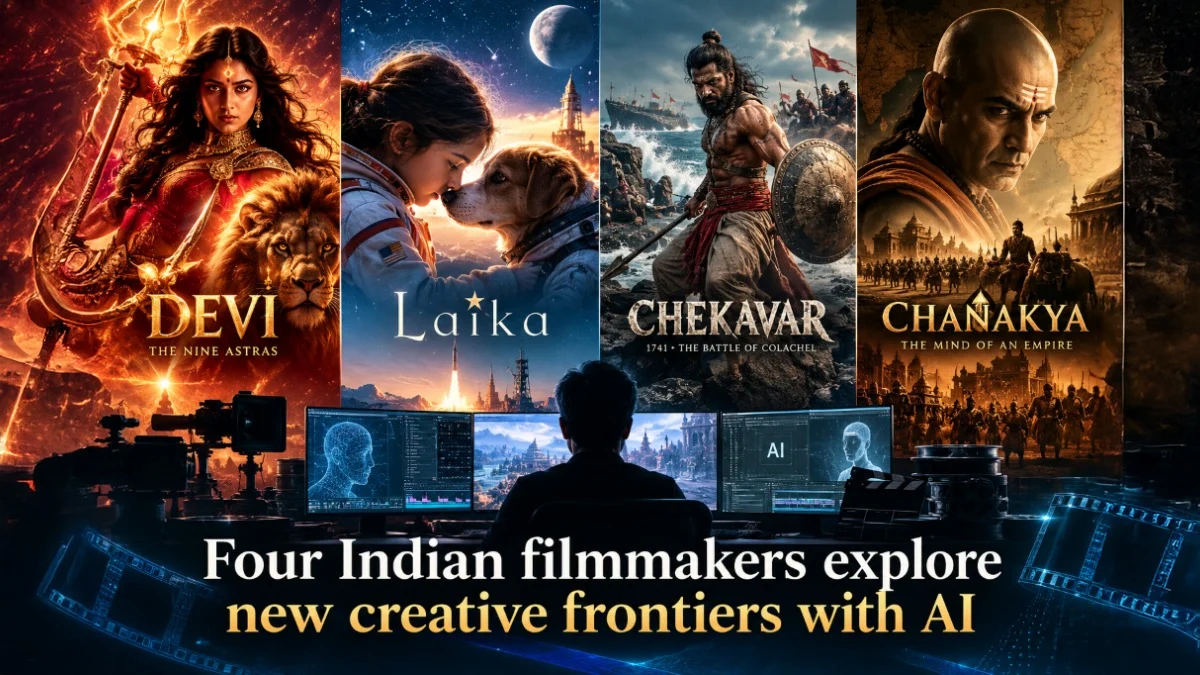
In the high-stakes, high-cost world of modern Indian cinema, the traditional "human-only" production model is undergoing a radical metamorphosis. While the heart of storytelling—the script—remains firmly in human hands, the toolkit used to bring those visions to life is becoming increasingly futuristic. A significant milestone in this transition was recently achieved in Mumbai, where the Indian Institute of Creative Technologies (IICT) and YouTube premiered four groundbreaking short films produced under the "IICT–YouTube Create with AI" initiative.
This showcase was not merely a screening; it was a manifesto for a new era of Indian filmmaking, where mythology, space exploration, history, and ancient wisdom converge through the lens of artificial intelligence.
The Showcase: A Quartet of AI-Powered Narratives
The event presented four distinct projects, each demonstrating a unique application of generative AI while balancing it with the irreplaceable nuance of conventional filmmaking.
1. DEVI: The Nine Astras (Kalpanik Films LLP)
Directed by Vishal Yoman and Ayushi Anand, DEVI explores the divine manifestations of Shakti. The studio utilized AI to tackle the immense visual complexity required to depict the nine forms of Goddess Durga. By employing "AI casting," they enabled actress Nyra Banerjee to embody these multiple manifestations across the series without the need for constant location changes. The team leveraged tools like Google’s NotebookLM for research and scripting, while Google Vids and Veo handled the cinematic visuals.
2. Laika (Karthik Kult Kreations)
Founder Karthik Sabareesh took the audience into the vastness of space. Laika explores the emotional bond between humans and animals, drawing inspiration from the historical narrative of the first canine in orbit. For this project, AI acted as a democratizing force, allowing an independent team to realize a high-concept, visually ambitious space epic that would typically be restricted by budget and crew limitations.
3. Chekavar (Avium Studios & Garuda X Media)
Directed by Gijo Uthuppu, this historical piece revisits the 1741 Battle of Colachel. Uthuppu, a veteran of traditional cinema, utilized the IICT’s AI infrastructure to produce a 30-minute film in just two months—a timeframe that would have been impossible using conventional methods. Critically, the film maintained a hybrid approach, incorporating real Kalaripayattu practitioners to ensure that the martial arts sequences retained an authentic, visceral human element.
4. CHANAKYA – The Mind of an Empire (Eleventh Door Studio)
This project serves as a "proof of concept" for a planned feature-length historical epic. CEO Harshit explained that the 30-minute film was a strategic test run. By utilizing the IICT’s post-production facilities, the studio was able to iterate and visualize a massive narrative at a fraction of the cost, proving that AI is a powerful tool for pre-production planning and financial de-risking.
Institutional Vision: Bridging the Talent Gap
The partnership between IICT and YouTube, which began a year ago, is rooted in a desire to professionalize and scale India’s creative talent. Dr. Vishwas Deoskar, CEO of IICT, views the current landscape of Indian creators as immense but uncurated.
"India’s position is such that we have many creators, storytellers, and writers working. There is a lot of talent, but it is not curated," Dr. Deoskar noted. He emphasized that a significant portion of this untapped potential resides in Tier 2 and Tier 3 cities. The IICT’s mission is to provide the infrastructure and training to polish this raw talent into world-class output.
"In the creative world, it’s not like 1 + 1 = 2; 1 + 1 can also be 11," Deoskar stated, summarizing the institute’s philosophy. By integrating imagination with advanced technology, the institute aims to unlock exponential creative possibilities.
Supporting Data and Strategic Expansion
The IICT is not merely an educational institution; it is positioning itself as a cornerstone of the national AVGC-XR (Animation, Visual Effects, Gaming, Comics, and Extended Reality) and AI sector.
- Infrastructure Growth: The Government of Maharashtra has allocated 10 acres of land in Mumbai’s Film City for a dedicated campus. With design and tender processes concluded, final approvals are expected by December.
- Affordability: One of the primary barriers to entry for creative tech is cost. While comparable private animation courses in India can range between Rs 16 lakh and Rs 18 lakh, the IICT has successfully developed similar, high-quality programs at a price point of Rs 3.5 lakh. This strategy is designed to make high-end technology education accessible to students in regions like Bhopal, Udaipur, Yavatmal, and Itanagar.
- Industry Integration: The institute currently collaborates with 74 major industry players, including tech giants like Nvidia, Google, Microsoft, Adobe, and Netflix. Additionally, 18 companies are engaged in startup incubation at the facility, and active discussions are underway with Korean firms to facilitate co-production models for K-series content and other international markets.
The Human Element: Why AI Needs the Filmmaker
Despite the technological spectacle, a recurring theme throughout the showcase was the permanence of the human creator. The filmmakers were unanimous: AI is a powerful assistant, but it cannot replicate the emotional intelligence, intent, or decision-making processes of a director.
Ayushi Anand of Kalpanik Films highlighted that the emotional resonance in DEVI came from the human actors, not the generated visuals. "People think, how will emotion come through AI? It will come through our actresses and actors," she asserted.
This sentiment is echoed by the industry’s shift toward a "hybrid" methodology. The Chekavar production team’s choice to film real martial artists, despite having the capability to generate them, underscores that technology is used to enhance reality rather than replace it. AI is the brush, but the filmmaker remains the artist.
Implications for the Future of Indian Cinema
The success of these four short films signals a paradigm shift in how Indian stories will be told. The implications are three-fold:
- Democratization of Scale: High-budget production value is no longer the exclusive domain of established, resource-rich studios. Independent creators now have the ability to manifest high-concept science fiction, complex historical dramas, and mythological epics with limited budgets.
- Increased Pre-production Viability: The CHANAKYA proof-of-concept model will likely become the industry standard for securing funding. By visualizing the scale of a film before production begins, creators can significantly reduce the financial risks inherent in large-scale filmmaking.
- Global Competitiveness: By establishing a National Center of Excellence, India is preparing its workforce to compete on a global stage. The ability to blend traditional storytelling with cutting-edge AI-enabled post-production places Indian studios in a strong position to handle international outsourcing and co-production opportunities, particularly in the growing markets for animation and streaming content.
Conclusion: A Larger Toolbox
The premiere at the Indian Institute of Creative Technologies marks the beginning of an era where "man versus machine" is replaced by "imagination working with a much bigger toolbox." The four films showcased were not just technological experiments; they were evidence that India’s narrative tradition—vast, diverse, and ancient—has found a new, powerful medium of expression.
As the IICT continues to build its ecosystem, the focus remains on giving creators the "wings to fly." By lowering the barriers to entry and providing world-class infrastructure, the institute is ensuring that the next generation of storytellers won’t be defined by the limitations of their resources, but by the ambition of their vision. The future of Indian cinema is being written in code, captured on camera, and, most importantly, imagined by humans who understand that the most compelling stories are the ones that resonate with the human heart.