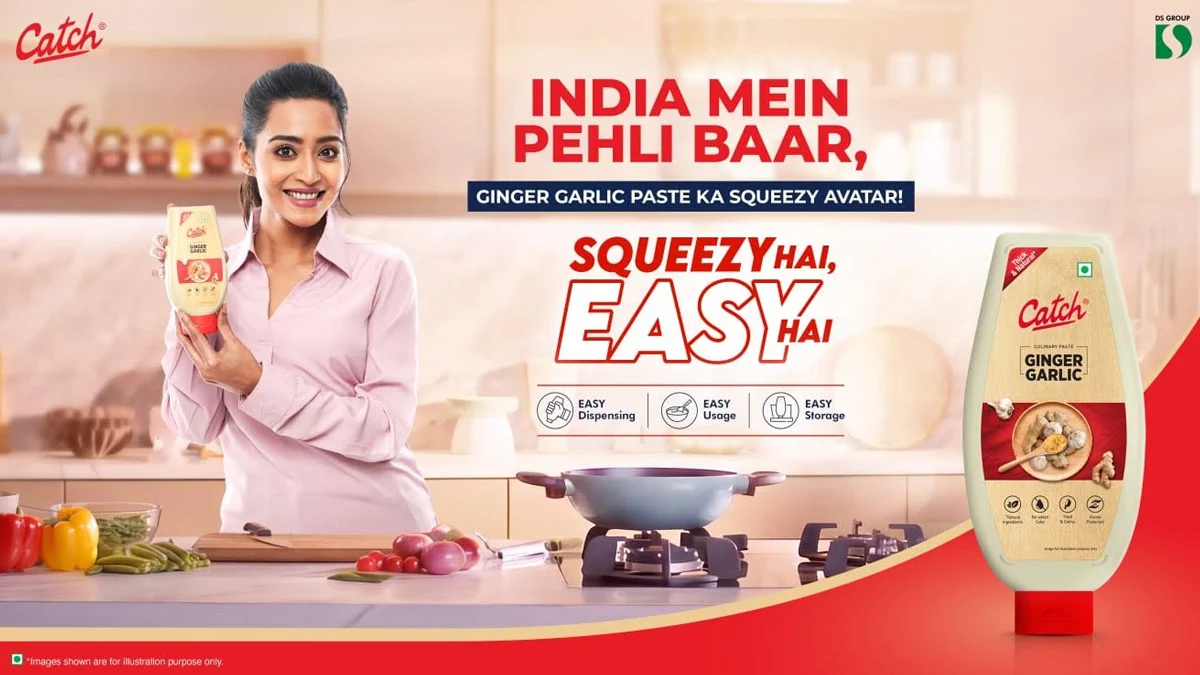
In the fast-paced landscape of modern Indian households, the intersection of traditional culinary habits and the demand for time-saving convenience has become the primary battleground for FMCG brands. Catch Salt & Spices, a flagship brand under the DS Group, has stepped into this arena with a significant product innovation: India’s first-ever squeezy bottle for Ginger Garlic Paste.
Supported by a high-octane campaign titled "Squeezy Hai, Easy Hai," the brand is aiming to disrupt a category long dominated by either laborious home preparation or standard jar-based packaging. By addressing the "friction points" of the kitchen—messy spills, time-consuming peeling, and the storage woes of fresh paste—Catch is positioning itself as the essential partner for the time-strapped Indian professional.
Main Facts: The "Squeezy" Revolution
The core of the initiative is a shift in packaging form factor. While ginger garlic paste is a ubiquitous staple in Indian kitchens, its preparation is notoriously tedious. It requires sourcing fresh ginger and garlic, cleaning, peeling, and grinding—a process that is not only time-consuming but often leaves a lingering odor and a cluttered workspace.
Catch’s new offering is designed to mitigate these challenges. The squeezy bottle is not merely a change in aesthetics; it is a functional upgrade. By moving from a jar to a tube-like squeezy format, the brand has introduced a level of portion control and cleanliness previously unseen in this category. The product promises a "thick, grainy" consistency that replicates the sensory experience of homemade paste, ensuring that convenience does not come at the cost of authentic culinary results.
The campaign, conceptualized by VML India, is currently rolling out across a multi-channel ecosystem, spanning traditional television, digital platforms, and social media, ensuring maximum penetration into urban and semi-urban households.
Chronology: From Kitchen Mishap to Market Strategy
The narrative arc of the campaign reflects a calculated effort to humanize the product. The story follows a relatable protagonist: a working woman balancing the pressures of a corporate career with the domestic responsibility of preparing a nutritious breakfast.
The Catalyst: The film begins with a moment of high tension—the morning rush. As the protagonist prepares a meal, a bowl of homemade ginger garlic paste slips, creating a messy spill that ruins her schedule. This "kitchen disaster" is the pivotal moment that introduces the viewer to the problem.
The Solution: The Catch Ginger Garlic Paste squeezy bottle is introduced not as a luxury item, but as a survival tool for the modern kitchen. The transition from the frustration of a spill to the ease of a "squeeze" serves as the campaign’s central thesis.
The Rollout: Following the conceptual phase, the product has been strategically positioned across retail channels. Catch has ensured that the product is available through general trade outlets, modern trade supermarkets, and, crucially, quick-commerce platforms—where the target demographic is most likely to shop. The campaign is further bolstered by aggressive point-of-purchase (POP) visibility, ensuring the product catches the consumer’s eye at the shelf-edge.
Supporting Data and Market Context
The Indian packaged food sector has seen a seismic shift toward "convenience-based" consumption. According to industry analysts, the demand for pre-prepped ingredients is rising at a compound annual growth rate (CAGR) that outpaces traditional raw ingredients.
Several factors contribute to this:
- Urbanization: As more households move into nuclear structures with dual-income earners, the time available for "from-scratch" cooking has plummeted.
- The Rise of Quick-Commerce: Platforms like Blinkit, Zepto, and Swiggy Instamart have conditioned the Indian consumer to expect instant solutions to culinary needs.
- Consistency Concerns: While homemade is often viewed as the gold standard, the inconsistency of manual grinding—resulting in varying textures—has opened a gap for brands that can promise a "homemade-like" texture.
Catch’s research indicates that ginger garlic paste is among the fastest-growing categories in the kitchen essentials segment. By targeting the "pain points" of storage—such as the risk of cross-contamination in jars or the difficulty of scraping out the last bit of product—Catch is leveraging structural design to secure brand loyalty.
Official Responses: The Philosophy Behind the Squeeze
The leadership at both the DS Group and VML India view this launch as a fusion of sensory authenticity and operational efficiency.
Arnab Ghatak Choudhury, Senior General Manager of Marketing at Catch Salt & Spices, DS Group, emphasized that the brand did not want to sacrifice quality for the sake of the new format. "Packaged ginger garlic paste is among the fastest-growing kitchen categories," he noted. "Consumers are seeking convenience, but they refuse to compromise on taste. Our goal was to create a texture that is thick and grainy, mirroring what one would achieve with a traditional mortar and pestle."
Choudhury further clarified the strategic intent behind the "Squeezy Hai, Easy Hai" tagline. "The campaign is designed to communicate the practical benefit of the bottle through a familiar kitchen situation. We wanted to show that even a small, seemingly insignificant kitchen mishap can be avoided with the right tool."
Babita Baruah, CEO of VML India, provided the agency perspective, noting that the campaign is built on "everyday friction." She remarked, "Our creative approach was rooted in the real-life struggles that consumers encounter daily. The squeezy format is more than just packaging; it is a design innovation meant to simplify a routine task. We wanted to demonstrate that you can have convenience and authentic flavour working in tandem."
Implications: A New Standard for Kitchen Essentials
The implications of Catch’s move are twofold: it sets a new baseline for the ginger garlic paste category and reflects a broader trend in FMCG branding.
1. Changing Consumer Expectations
For decades, the "homemade" narrative was synonymous with "manual labor." Brands that now effectively market themselves as "convenience-first" are successfully challenging the stigma that store-bought equals processed. By focusing on the consistency of the paste, Catch is effectively arguing that their product is not a "shortcut," but an "optimized version" of the traditional method.
2. The Power of "Design-Led" Marketing
The campaign demonstrates that packaging is not just a container; it is a marketing vehicle. By highlighting the ergonomic benefits of the squeezy bottle, Catch is effectively differentiating itself from competitors who remain tethered to traditional glass or plastic jars. In the crowded retail space, the visual of a squeezy bottle acts as a silent salesperson, indicating a "modern" and "mess-free" experience.
3. The Future of the Kitchen
As the Indian kitchen continues to evolve, we can expect to see more "squeezy" and "ready-to-use" formats for other traditional spices and pastes. The success of this campaign will likely be measured by the adoption rates in quick-commerce platforms, where convenience is the primary driver of purchase decisions.
4. Competitive Dynamics
For competitors, the challenge is clear: how does one compete with a brand that has successfully solved a "messy" problem? If Catch successfully captures a significant share of the market, we may see a domino effect where other major players in the spice and condiment category are forced to pivot their packaging strategies to match this level of functional utility.
Conclusion: The "Squeezy" Future
Catch Salt & Spices has managed to transform a mundane household chore into a compelling marketing story. By focusing on the high-stress, time-sensitive environment of a modern morning, they have made the squeezy bottle feel like a necessary component of the contemporary kitchen.
Whether it is the busy professional or the time-pressed homemaker, the promise of "less mess, less preparation" is a powerful value proposition. As the brand continues to push its "Squeezy Hai, Easy Hai" message across digital and traditional media, the real test will be whether this packaging innovation can sustain the brand’s growth in a market that is increasingly valuing time as the most precious commodity of all.
For now, the message is clear: the era of the messy jar is facing a serious challenge. With this latest move, Catch is betting that the future of Indian cooking will be defined not just by the ingredients we use, but by how easily we can use them.