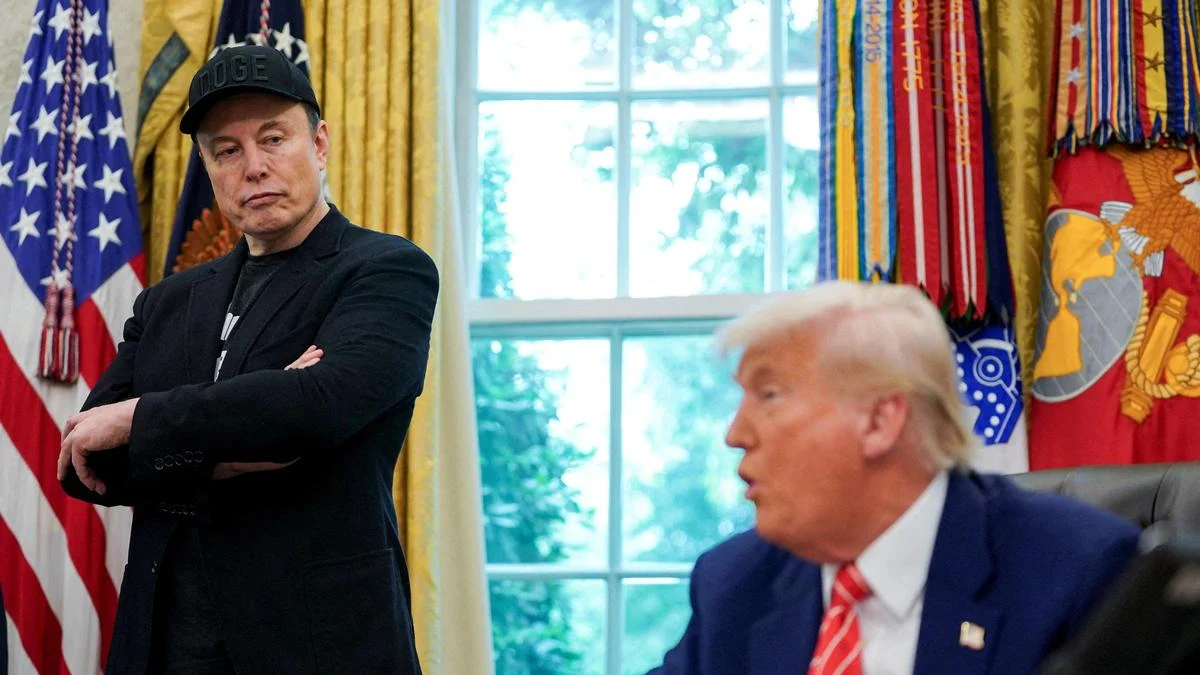
WASHINGTON, D.C. — In a moment that underscores the unprecedented intersection of private enterprise and global warfare, President Donald Trump announced on Friday, October 23, 2026, that he is prepared to personally intervene with tech billionaire Elon Musk regarding ongoing service disruptions to "Starshield"—the military-grade satellite communication system vital to Ukraine’s defense.
Speaking to a gaggle of reporters in the Oval Office, President Trump sought to downplay concerns over the reliability of the system while simultaneously positioning himself as the ultimate arbiter of the complex relationship between the U.S. government, its allies, and the world’s wealthiest individual.
"If there is a problem, I will get it straightened out," Trump stated, responding to reports from Kyiv that frontline units are experiencing critical "black zones" in satellite coverage. "I have not spoken to him [Musk] yet. I might have to, but I have not. I’ve heard it was fixed, but if it’s not, I’ll speak to him."
The statement comes at a precarious time for the Ukraine-Russia conflict, now grinding through its fifth year, and highlights the fragile nature of a modern battlefield that is increasingly dependent on the whims and assets of private corporations.
The Chronology of a Tech-Diplomatic Crisis
The current friction regarding Starshield—a specialized version of SpaceX’s Starlink designed specifically for government and military use—follows a week of conflicting reports and high-stakes confusion.
The October Outage
On Tuesday, October 20, 2026, Ukrainian military officials reported a sudden degradation of Starshield services along the eastern front, specifically in the Donbas region. The disruption reportedly hampered drone operations and real-time intelligence sharing, leading to a temporary tactical retreat in certain sectors.
The Presidential Assurance
On Thursday, October 22, President Trump told a press conference that the issue had been resolved. He suggested that Elon Musk, whose SpaceX corporation operates the satellite constellation, had "flipped the switch" back on following a brief "technical misunderstanding." Trump’s confidence, however, was quickly met with skepticism from the ground.
The Friday Contradiction
By Friday morning, October 23, the Ukrainian General Staff issued a rare public statement clarifying that while some connectivity had returned, the service remained "intermittent and unreliable" in active combat zones. This prompted the afternoon exchange in the Oval Office, where Trump pivoted from his previous day’s claim of a total fix to a promise of future intervention.
The Trump-Musk Relationship Arc
The backdrop to this crisis is the volatile relationship between the President and the CEO of SpaceX and Tesla. In early 2025, during the first year of Trump’s second term, Musk was appointed to lead the Department of Government Efficiency (DOGE), an initiative aimed at slashing federal spending. However, the partnership soured by late 2025 following public disagreements over trade tariffs and federal subsidies for electric vehicles.

The "frenemy" dynamic appeared to shift toward a thaw in September 2026, when Musk attended a high-profile state banquet for Chinese President Xi Jinping at the White House. Friday’s comments suggest that while they are back on speaking terms, the professional distance remains wide enough that Trump has not yet made a direct call regarding the Ukrainian military’s lifeline.
Supporting Data: The Strategic Necessity of Starshield
To understand the weight of Trump’s promise to "straighten it out," one must look at the data regarding Ukraine’s reliance on SpaceX infrastructure. As the war entered its fifth year in 2026, the nature of the conflict shifted from traditional artillery duels to a war of "autonomous attrition."
Battlefield Statistics
- Drone Integration: Approximately 92% of Ukrainian reconnaissance and "kamikaze" drones are directed via Starshield or Starlink links.
- Response Time: Units equipped with Starshield report a 60% faster response time for medical evacuations and artillery support compared to units using traditional radio or local cellular networks.
- Infrastructure Coverage: With much of Ukraine’s terrestrial fiber-optic and cellular infrastructure destroyed by long-range Russian strikes, satellite internet is the only remaining backbone for the Ukrainian Ministry of Defense.
The Evolution from Starlink to Starshield
While the early years of the war saw Ukraine using commercial Starlink terminals (often donated or crowdfunded), the transition to Starshield in 2024-2025 was intended to provide a more robust, encrypted, and Pentagon-funded solution. Unlike the commercial version, Starshield is supposed to be immune to the "geofencing" restrictions that Musk famously applied in 2022 to prevent Ukrainian strikes on Crimea. However, recent reports suggest that "administrative throttling" or technical glitches are mimicking the effects of those earlier restrictions.
Official Responses and the "Power" Debate
The situation has reignited a fierce debate in Washington regarding whether a single private citizen should hold such significant leverage over national security interests.
The President’s Defense of Musk
When asked by reporters if Musk possessed too much power over a vital military system, President Trump was unequivocal in his defense of the billionaire.
"I don’t think he does [have too much power]," Trump said. "Elon will never do anything wrong. I know him very well; he is a fair person. He’s done a great job for this country, and he’s done a great job for the world."
Trump’s rhetoric reflects his broader philosophy of "corporate-state synergy," where he views high-performing American companies as extensions of national power rather than entities that need strict regulation.
Silence from SpaceX and Kyiv
SpaceX has yet to issue an official technical report regarding the "black zones." Elon Musk, usually active on his social media platform, X, has remained uncharacteristically silent on the Starshield issue over the last 48 hours, focusing his posts instead on Mars exploration and domestic policy.
In Kyiv, the tone is one of measured desperation. A spokesperson for President Volodymyr Zelenskyy stated, "We are in constant communication with our American partners. We trust that the contractual obligations regarding Starshield will be honored, as the lives of our soldiers depend on the transparency of our communications."

Geopolitical Implications: The Risks of Privatized Warfare
The Starshield saga of October 2026 serves as a case study for the future of global conflict. There are three primary implications that experts believe will resonate long after this specific outage is resolved.
1. The Erosion of Sovereign Control
The fact that the President of the United States must "speak to a friend" to ensure a military system functions correctly highlights a shift in the traditional hierarchy of power. Traditionally, military hardware (like F-35s or Abrams tanks) is sold to allies with clear, treaty-backed service agreements. Starshield, however, operates as a "Service-as-a-Software" (SaaS) model, where the provider retains the ability to adjust performance in real-time.
2. The "Musk Factor" in Diplomacy
Musk’s unique position allows him to conduct a form of "shadow diplomacy." His interactions with foreign leaders—such as his presence at the Xi Jinping banquet—combined with his control over critical infrastructure, make him a wildcard in Trump’s "America First" foreign policy. If Musk’s personal views on the war in Ukraine shift, the hardware on the ground could reflect that shift faster than any State Department memo.
3. The Precedent for Future Tech Moguls
The Trump-Musk dynamic sets a precedent for other tech giants in the fields of AI, quantum computing, and autonomous robotics. If the U.S. government continues to outsource its most critical defense innovations to a handful of "super-producers," the line between the Commander-in-Chief and the CEO will continue to blur.
Conclusion: A Test of the "Deal-Maker"
As the sun sets on Washington this Friday, the eyes of the world are on the phone on the Resolute Desk. President Trump has staked his reputation as a "deal-maker" on his ability to manage Elon Musk. For the Ukrainian troops in the muddy trenches of the Donbas, the "straightening out" of this problem is not a matter of political optics—it is a matter of survival.
Whether the fix comes through a technical patch from SpaceX engineers or a personal phone call from the President, the incident has exposed the fragile circuitry of 21st-century alliances. In the fifth year of the Russia-Ukraine war, the most decisive factor on the battlefield may not be the caliber of the shells or the bravery of the soldiers, but the stability of a satellite link and the rapport between two of the world’s most powerful and unpredictable men.
The White House has not yet confirmed if a call has been scheduled for the weekend, but as Trump noted, "If it’s not [fixed], I’ll speak to him." In the world of 2026, that single conversation could change the map of Europe.