
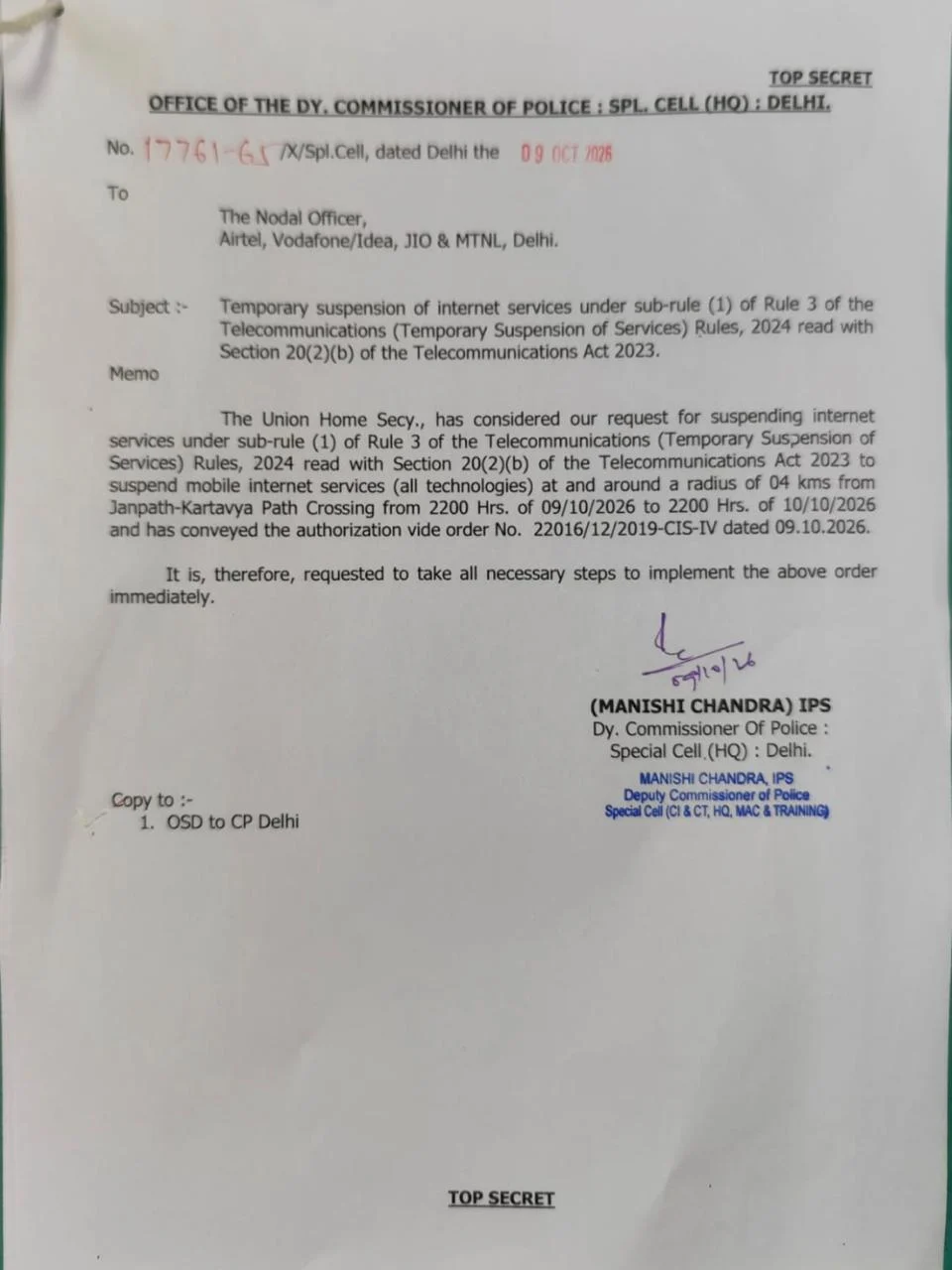
NEW DELHI – In a move that has reignited concerns regarding digital rights and civil liberties, the Ministry of Home Affairs (MHA) has issued a "top secret" directive mandating a 24-hour suspension of mobile internet services in the heart of the national capital. The order, which affects a 4-km radius around the Janpath–Kartavya Path crossing, represents a significant escalation in the government’s reliance on communication blackouts to manage public demonstrations.
The directive, issued on October 9, compels major telecom service providers—including Reliance Jio, Airtel, Vodafone Idea, and MTNL—to sever connectivity from 10:00 PM on October 9 to 10:00 PM on October 10. While the government has remained largely silent on the specific justifications for this measure, the timing aligns with a planned protest by the Cockroach Janata Party (CJP), which is calling for the resignation of Chief Election Commissioner Gyanesh Kumar.
The Scope of the Shutdown
The latest order is notable not only for its brevity of notice but for its expanded geographic footprint. Covering a 4-km radius, this shutdown is roughly 2.5 times larger than the 1.5-km radius imposed around Jantar Mantar on October 2. By implementing the suspension on the same night the order was issued, authorities have left local residents, business owners, and commuters with virtually no time to prepare for a day without mobile data.
Digital rights activists argue that such "blanket" shutdowns disproportionately affect non-protesting citizens. In a high-traffic area like Janpath and Kartavya Path, the lack of internet access disrupts banking services, ride-hailing apps, navigation, and emergency communications for thousands of people who have no connection to the political gathering.
Chronology of Escalating Digital Restrictions
The October 9 shutdown is merely the latest chapter in a series of restrictive measures taken by the government to stifle dissent and control the flow of information during political protests.
- July 2026: A wave of protests led to initial, localized disruptions, setting a precedent for the government’s current strategy of using internet blackouts as a primary crowd-control mechanism.
- October 2, 2026: The MHA enforced a 12-hour internet blackout (9:00 AM to 9:00 PM) within a 1.5-km radius of Jantar Mantar. The protest focused on alleged irregularities in the Special Intensive Revision (SIR) of electoral rolls and demands for the resignation of CEC Gyanesh Kumar.
- October 4, 2026: Demonstrating the government’s focus on the digital infrastructure of dissent, the Ministry of Electronics and Information Technology (MeitY) invoked Section 69A of the Information Technology Act to force the removal of "BitChat" from the Apple App Store and Google Play Store. The application, which protesters had utilized for secure communication during July demonstrations, was effectively wiped from the Indian digital landscape.
- October 9, 2026: The MHA issues the "top secret" notice to telecom operators, imposing a 24-hour blackout around the Janpath–Kartavya Path crossing.
The Nexus of Protest and Permission
The political tension centers on the Cockroach Janata Party’s (CJP) allegations regarding the SIR process, which they claim has compromised the integrity of electoral rolls. The party’s attempt to organize a protest on October 10 was met with a formal denial from the Delhi Police.

Police officials cited procedural lapses, specifically noting that applications for such protests must be submitted at least 10 days in advance. Despite the denial of permission, the CJP maintained its intent to protest, prompting the MHA’s preemptive strike against communication channels. By targeting the vicinity of the protest site, the government aims to prevent the coordination of demonstrators and the live-streaming of events. However, critics point out that these measures do little to address the underlying political grievances and instead serve to isolate the protest from public and media scrutiny.
The "Top Secret" Policy Framework
A concerning aspect of this recent order is the lack of transparency. The notice was not officially published by the MHA, forcing the public to rely on leaks and secondary reporting by news agencies like ANI.
The Indian government’s use of internet shutdowns is governed by the Temporary Suspension of Telecom Services (Public Emergency or Public Safety) Rules, 2017. Under these rules, a suspension must be based on a "public emergency" or "public safety" concern. However, legal experts frequently note that the government’s interpretation of these terms has become increasingly broad. The failure to provide a specific, public-facing justification for the October 9 order raises questions about whether the threshold for a "public emergency" is being met or if the tools are being misused to suppress political dissent.
Broader Implications for Democracy and Digital Rights
The decision to block apps like BitChat and enforce recurring internet shutdowns suggests a government that views digital communication as a threat to public order rather than a fundamental right.
1. Economic Impact
For a city like New Delhi, which functions on a hyper-connected gig economy, a 24-hour shutdown in a high-traffic area incurs significant economic costs. Small businesses, delivery workers, and daily-wage earners who rely on digital platforms are forced to halt operations. When aggregated across multiple days and varying locations, the cumulative impact on the local economy is substantial.
2. The Right to Information
By preventing protesters and journalists from accessing the internet, the state effectively creates an information vacuum. In the absence of live updates, rumors often spread, and the narrative of events becomes heavily reliant on state-issued statements. This lack of transparency undermines the public’s right to be informed about how protests are handled and how the government responds to civil unrest.

3. The "Chilling Effect"
The constant threat of being "cut off" creates a chilling effect on political participation. When citizens fear that their primary means of coordination and communication will be severed, they are less likely to participate in peaceful protests. This, in turn, weakens the democratic process, as the ability to assemble and voice dissent is a cornerstone of a functional democracy.
Legal and Judicial Context
While the government has broad powers under the IT Act and the Telegraph Act, the judiciary has previously expressed concern over the indiscriminate use of internet shutdowns. In the landmark Anuradha Bhasin v. Union of India case, the Supreme Court of India emphasized that the suspension of internet services is a drastic measure that must be necessary and proportionate. The Court held that indefinite shutdowns are impermissible and that the government must adhere to the principle of proportionality.
Whether the current, recurring, and geographically expanding shutdowns meet this judicial standard is a subject of intense debate. As the CJP continues to challenge the electoral roll revisions and the government continues to rely on the "top secret" issuance of blackout orders, the tension between state security and digital freedom is likely to intensify.
Conclusion
The events of October 9 and 10 in New Delhi highlight a worrying trend: the normalization of internet shutdowns as a default tool for managing political dissent. As the government continues to treat the "off switch" as a legitimate policy instrument, the consequences—both for the democratic rights of citizens and the digital health of the capital—remain severe. Until there is greater transparency, a clearer legal framework for defining "emergency," and a commitment to protecting the digital connectivity of the populace, these blackouts will remain a dark mark on the state of civil discourse in India.
As of now, the internet remains dark in the heart of Delhi, leaving the capital waiting for the restoration of its digital pulse.