New Delhi: The Union Budget 2025, presented today by the Finance Minister, has ushered in a wave of welcome changes for the middle-income demographic, primarily through a substantial overhaul of the personal income tax structure. Key among these reforms are the upward revision of tax slabs and a significant enhancement of the tax rebate limit, promising considerable savings for a large segment of the Indian workforce. The most impactful change allows individuals with an annual income of up to Rs 12 lakh to potentially pay zero income tax, a move projected to put up to Rs 1.1 lakh back into the pockets of eligible taxpayers.
The budget’s focus on easing the tax burden on the middle class signals a strategic intent to stimulate consumption and boost economic growth. While the broad strokes of these reforms have been met with widespread approval, a deeper dive into the specifics reveals nuances and implications that warrant closer examination. This report aims to dissect the new tax regime, clarify potential areas of confusion, and analyze the far-reaching consequences of these fiscal adjustments.
The Cornerstone of Relief: Redesigned Tax Slabs and Enhanced Rebate
The most significant alteration lies in the modification of the New Tax Regime’s income tax slabs and the enhanced eligibility for the tax rebate under Section 87A. The previous regime, which had a tax-free threshold of Rs 3 lakh and a rebate limit of Rs 7 lakh, has been significantly liberalized.
Revised Tax Slabs under the New Tax Regime:
| Existing Tax Slabs (New Regime) | Existing Tax Rate | Proposed Tax Slabs (New Regime) | Proposed Tax Rate |
|---|---|---|---|
| Up to Rs 3 lakh | NIL | Up to Rs 4 lakh | NIL |
| Rs 3 lakh to Rs 7 lakh | 5% | Rs 4 lakh to Rs 8 lakh | 5% |
| Rs 7 lakh to Rs 10 lakh | 10% | Rs 8 lakh to Rs 12 lakh | 10% |
| Rs 10 lakh to Rs 12 lakh | 15% | Rs 12 lakh to Rs 16 lakh | 15% |
| Rs 12 lakh to Rs 15 lakh | 20% | Rs 16 lakh to Rs 20 lakh | 20% |
| Above Rs 15 lakh | 30% | Rs 20 lakh to Rs 24 lakh | 25% |
| Above Rs 24 lakh | 30% |
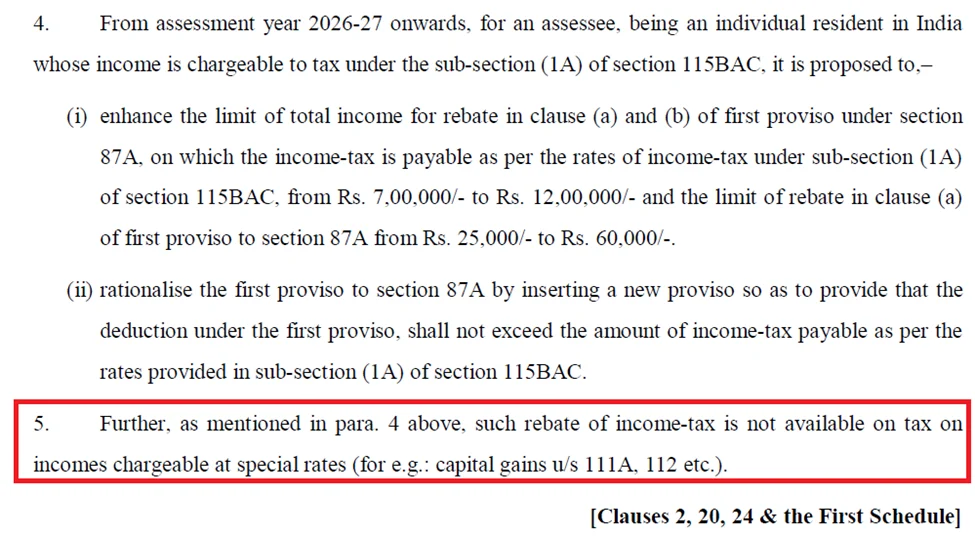
Key Enhancement: The most transformative change is the enhancement of the tax rebate under Section 87A from Rs 7 lakh to Rs 12 lakh. This means that resident individuals whose total taxable income, after considering all deductions and exemptions applicable under the New Tax Regime, does not exceed Rs 12 lakh will now have their entire tax liability neutralized.
This dual approach – widening the tax-free bracket and extending the rebate – is designed to provide immediate and tangible financial relief to a broad spectrum of middle-income earners. The government’s intention is to ensure that a larger portion of an individual’s earnings remains in their hands, thereby potentially boosting discretionary spending and contributing to economic momentum.
Understanding the "Tax-Free Up to Rs 12 Lakh" Phenomenon
A common point of inquiry is how an income of up to Rs 12 lakh can be considered tax-free when the initial tax slab begins at Rs 4 lakh. The answer lies in the crucial mechanism of the tax rebate under Section 87A.
Tax Rebate vs. Tax Refund: It is vital to distinguish between a tax rebate and a tax refund. A tax refund occurs when the Income Tax Department returns excess tax already paid by an assessee. In contrast, a tax rebate is a direct concession applied during the tax calculation itself, effectively reducing or eliminating the tax liability.
Under the revised provisions, for resident individuals with an annual income up to Rs 12 lakh, the calculated income tax liability, as per the new slabs, will be entirely offset by the rebate under Section 87A. This means that if your total income (after standard deduction and any other eligible deductions within the New Tax Regime) falls within this Rs 12 lakh threshold, your net tax payable will be zero. Consequently, employers will no longer be required to deduct Tax Deducted at Source (TDS) from the salaries of such individuals, further simplifying their financial management.
Important Caveat for Non-Residents: It is crucial to note that the enhanced tax rebate under Section 87A is exclusively available to resident individuals. Non-Resident Indians (NRIs) will not be eligible for this benefit. Therefore, for NRIs, income tax liability will commence beyond the Rs 4 lakh tax-free bracket, aligning with the new slab rates without the shield of the extended rebate.
Beyond the Rebate: Tapered Tax Rates for Higher Incomes
Even for individuals whose income exceeds the Rs 12 lakh threshold, the Union Budget 2025 offers significant advantages. The government has not only expanded the tax-free income bracket but has also rationalized the higher tax brackets. The top marginal tax rate of 30% will now be applicable only to incomes exceeding Rs 24 lakh, a substantial increase from the previous threshold of Rs 15 lakh. This adjustment ensures that a broader range of individuals in the higher middle-income segment also benefit from reduced tax outgo.
Illustrative Savings Table (Post Standard Deduction):
| Income After Standard Deduction | Existing Net Tax Liability | After Union Budget 2025 Net Tax Liability | Difference (Savings) |
|---|---|---|---|
| Rs 3,00,000 | NIL | NIL | NIL |
| Rs 4,00,000 | NIL | NIL | NIL |
| Rs 5,00,000 | NIL | NIL | NIL |
| Rs 7,00,000 | Rs 20,000 | NIL | Rs 20,000 |
| Rs 10,00,000 | Rs 50,000 | NIL | Rs 50,000 |
| Rs 12,00,000 | Rs 80,000 | NIL | Rs 80,000 |
| Rs 14,00,000 | Rs 1,20,000 | Rs 90,000 | Rs 30,000 |
| Rs 15,00,000 | Rs 1,40,000 | Rs 1,05,000 | Rs 35,000 |
| Rs 18,00,000 | Rs 2,30,000 | Rs 1,60,000 | Rs 70,000 |
| Rs 20,00,000 | Rs 2,90,000 | Rs 2,00,000 | Rs 90,000 |
| Rs 24,00,000 | Rs 4,10,000 | Rs 3,00,000 | Rs 1,10,000 |
| Rs 25,00,000 | Rs 4,40,000 | Rs 3,30,000 | Rs 1,10,000 |
| Rs 30,00,000 | Rs 5,90,000 | Rs 4,80,000 | Rs 1,10,000 |
| Rs 50,00,000 | Rs 11,90,000 | Rs 10,80,000 | Rs 1,10,000 |
This table vividly illustrates the substantial tax savings individuals can achieve across various income levels due to the revised tax structure and enhanced rebate.
Navigating the "Marginal Relief" Scenario
A crucial aspect of tax policy is ensuring fairness at income thresholds. The budget addresses a potential anomaly where an individual earning slightly over the rebate limit might face a disproportionately higher tax burden compared to someone earning just below it. This is where the concept of "Marginal Relief" becomes paramount.
The Problem: Consider an individual earning Rs 12 lakh. With the full rebate under Section 87A, their tax liability is zero. Now, imagine someone earning Rs 12.10 lakh. Due to exceeding the Rs 12 lakh threshold, they lose the full rebate. Under the new tax slabs, their calculated tax liability could jump significantly, potentially exceeding the additional Rs 10,000 earned. This would lead to a situation where earning more actually results in less disposable income, a scenario that fiscal policy aims to avoid.

The Solution: Marginal Relief: Marginal relief ensures that the increase in tax liability due to earning a little more than the threshold does not exceed the additional income earned. In essence, if your income slightly crosses a tax threshold where a rebate or a lower tax rate applies, your tax liability will not increase by more than the excess income.
Mechanism of Marginal Relief: For incomes slightly above Rs 12 lakh, where the rebate under Section 87A is no longer fully applicable, marginal relief is automatically provided. The principle is that the tax payable cannot exceed the amount by which the total income exceeds the upper limit of the tax-free income bracket (Rs 12 lakh in this case).
Illustrative Example:
- Income: Rs 12.25 lakh
- Calculated Income Tax (as per slabs): Rs 63,750
- Rebate under Section 87A: Not applicable as income exceeds Rs 12 lakh.
- Excess Income over Rs 12 lakh: Rs 25,000
- Marginal Relief Calculation: The tax liability cannot exceed this excess income of Rs 25,000.
- Final Tax Liability: Rs 25,000.
This mechanism effectively smooths out the tax liability at the threshold, preventing sharp jumps and ensuring that incremental earnings translate into higher net income. The budget’s inclusion and clear explanation of marginal relief are vital for ensuring taxpayer confidence and preventing unintended financial disincentives.
Marginal Relief Table for Clarification:
| Income After Standard Deduction | Calculated Income Tax (A) | Tax Rebate (B) | Marginal Relief (C) | Net Tax Liability (A-B-C) |
|---|---|---|---|---|
| Rs 12,00,000 | Rs 60,000 | Rs 60,000 | NIL | NIL |
| Rs 12,10,000 | Rs 61,500 | NIL | Rs 51,500 | Rs 10,000 |
| Rs 12,25,000 | Rs 63,750 | NIL | Rs 38,750 | Rs 25,000 |
| Rs 12,50,000 | Rs 67,500 | NIL | Rs 17,500 | Rs 50,000 |
| Rs 12,60,000 | Rs 69,000 | NIL | Rs 9,000 | Rs 60,000 |
| Rs 12,70,000 | Rs 70,500 | NIL | Rs 500 | Rs 70,000 |
| Rs 12,75,000 | Rs 71,250 | NIL | NIL | Rs 71,250 |
Limitations of the Section 87A Rebate: Capital Gains Exclusion
While the tax rebate under Section 87A offers broad relief, it is crucial to understand its limitations. The rebate is specifically designed for tax on income from salary, interest, rental income, and other similar sources that are taxed at the individual’s slab rates.
Exclusion of Special Rate Incomes: The rebate is not applicable to income that is taxed at special, lower rates. The most prominent examples include capital gains. This means that if an individual has capital gains, the tax liability arising from these gains will not be offset by the Section 87A rebate, even if their total income falls within the Rs 12 lakh limit.
Budget Memorandum Clarification: The official Budget memorandum for Union Budget 2025 explicitly states this exclusion. Section 111A (short-term capital gains on listed equity/equity funds), Section 112 and 112A (long-term capital gains) are taxed at special rates (e.g., 20% for STCG on equities, 12.5% for LTCG on most assets). Consequently, the tax on these gains is ineligible for the Section 87A rebate.
Nuances in Capital Gains Taxation:
- Short-Term Capital Gains (STCG) on Equity Funds: Taxed at 20%. Not eligible for Section 87A rebate.
- Long-Term Capital Gains (LTCG) on Equity Funds: Taxed at 12.5% (after an exemption of Rs 1 lakh annually). Not eligible for Section 87A rebate.
- STCG on Debt Funds, Gold, Real Estate: Taxed at the individual’s slab rate. Eligible for Section 87A rebate.
- LTCG on Debt Funds, Gold, Real Estate: Taxed at 12.5% (or slab rate if higher). Not eligible for Section 87A rebate.
Illustrative Scenarios:
- Illustration 1: An individual earns Rs 8 lakh from salary and Rs 3 lakh from LTCG on equity funds. While their salary income is covered by the rebate, the Rs 3 lakh LTCG (after the Rs 1 lakh exemption, tax on Rs 1.75 lakh at 12.5%) will still attract tax, as it’s not eligible for the rebate.
- Illustration 2: An individual earns Rs 8 lakh from salary and Rs 3 lakh from STCG on equity funds. Similar to the above, the STCG will be taxed at 20% and is ineligible for the rebate.
- Illustration 3: An individual earns Rs 8 lakh from salary and Rs 3 lakh from STCG on debt funds. Since both income components are taxed at slab rates, the entire Rs 11 lakh income is eligible for the Section 87A rebate, resulting in zero tax liability.
These illustrations highlight the critical importance of understanding the nature of income when assessing tax liability, particularly concerning capital gains.
Implications and Outlook
The Union Budget 2025’s tax reforms are poised to have a multi-faceted impact on the Indian economy and its citizens:
- Boost to Consumption: By leaving more disposable income in the hands of the middle class, the budget is expected to stimulate consumer spending, a significant driver of economic growth.
- Increased Investment Potential: With reduced tax burdens, individuals may have greater capacity to invest in financial instruments, potentially leading to increased capital formation.
- Simplification of Tax Compliance: The enhanced rebate and clearer slab structures aim to simplify tax calculations and compliance for a large segment of taxpayers.
- Focus on New Tax Regime: The significant improvements to the New Tax Regime signal a governmental push towards its wider adoption, potentially phasing out the older, more complex regime over time.
- Addressing Inequality: While primarily benefiting the middle class, the tapering of higher tax rates also provides some relief to those in higher income brackets, albeit to a lesser extent proportionally.
The government’s proactive approach in revising tax policies reflects a commitment to fostering a more equitable and growth-oriented economic environment. The successful implementation of these reforms and their subsequent impact on individual finances and the broader economy will be closely watched in the coming fiscal year.
Disclaimer: This article is intended for informational purposes only and does not constitute financial or tax advice. Tax laws are complex and subject to change. Individuals are strongly advised to consult with a qualified Chartered Accountant or tax professional for personalized advice based on their specific financial situation.