Digital Public Relations has long been defined by its ability to secure coverage in spaces where paid advertising cannot reach. For decades, the industry standard for success was measured through vanity metrics: placement volume, domain authority (DA), and estimated circulation reach. However, as the digital landscape shifts toward a paradigm dominated by Answer Engine Optimization (AEO), the definition of "showing up" has undergone a fundamental transformation.
Today, when potential buyers research a category, they are increasingly turning to AI-powered search engines and chatbots rather than traditional blue-link search results. The brands that appear within these AI-generated responses have secured a form of influence that traditional press releases and broad media lists were never designed to deliver. This is the new era of PR, where earned media that appears in AI results carries exponentially more weight than traditional coverage alone.
The Paradigm Shift: From Reach to Relevance
The core objective of PR remains the same: influencing the audience and building brand authority. However, the mechanism of that influence has evolved. In the past, a mention in a top-tier publication was a victory in its own right. Today, a mention is only as valuable as its ability to be ingested and cited by the large language models (LLMs) that power the modern research journey.
The PR teams currently pulling ahead are those that treat AI visibility not as a happy accident or a downstream side effect of their work, but as a primary, measurable outcome. They are moving away from traditional metrics that fail to capture the nuance of AI-driven discovery, shifting instead toward a data-backed strategy that optimizes for machine-learning relevance.

Chronology of a Disruption: How PR Evolved
To understand where we are, one must look at the transition from search to "answer" engines.
- The Era of the Blue Link (2000–2020): PR success was determined by how many high-authority backlinks a campaign could generate. The goal was to boost SEO through link equity.
- The Rise of Generative AI (2022–2024): As tools like ChatGPT, Perplexity, and Google’s AI Overviews entered the mainstream, the "middleman" of the search result page disappeared. Users began expecting summarized, authoritative answers rather than a list of websites to visit.
- The AEO Mandate (2025–Present): Forward-thinking marketing and PR departments began to realize that their existing media relationships were not necessarily translating into AI citations. The industry began a pivot toward "Answer Engine Optimization" as a prerequisite for digital presence.
This transition has rendered many legacy PR tactics obsolete. If your team is still optimizing solely for domain authority, you are missing the forest for the trees.
Supporting Data: The Impact of Targeted Outreach
The relationship between earned media and AI visibility is complex and far from uniform. Research indicates that placement in a prestigious, high-authority outlet does not automatically guarantee a citation in an AI response. Certain publications and specific content types—such as "best of" lists, comparative analyses, and in-depth educational articles—generate citations at a significantly higher rate than standard news features.
The Case for Evidence-Based Pitching
HubSpot’s own marketing team provides a compelling case study on this shift. By leveraging AI-driven citation analysis, the team shifted their focus from volume-based outreach to high-impact, citation-prone content. The results were stark:

- 642% increase in citations for comparison-based articles.
- 58% increase in overall brand mentions within answer engines.
These figures illustrate that the "spray and pray" method of pitching is losing its efficacy. By identifying which publications are actually influencing AI, teams can concentrate their energy on the outlets that move the needle on their AI visibility score.
Official Insights: Bridging the Gap in Measurement
The gap between traditional PR measurement and AI visibility is where accountability often gets murky. When a CMO asks, "What is the ROI of this PR campaign?", a list of clippings is no longer sufficient.
Tools of the Trade: AEO Analysis
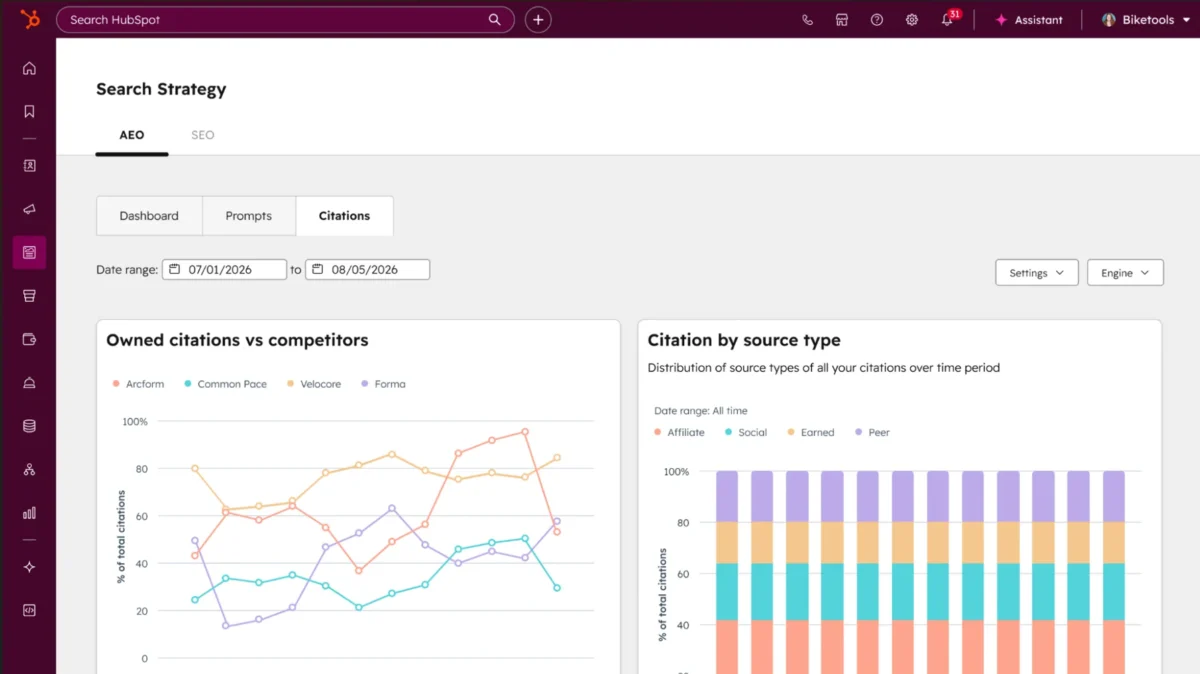
HubSpot’s AEO tools are designed to fill this void by surfacing which specific publications and content categories are generating citations in answer engines. This allows PR professionals to:
- Evaluate Priority: Determine which third-party publications are contributing to brand visibility and which are effectively "dead weight."
- Close the Loop: Connect earned media activity directly to visibility outcomes.
- Refine Strategy: Use the Brand Visibility Dashboard to track share of voice, citation frequency, and visibility scores over time.
This shift moves PR from a "soft" department to a "hard" data-driven operation. By providing concrete evidence of how a specific placement led to an AI citation, PR teams can make a much stronger case to stakeholders for increased investment.

The Strategic Pivot: Identifying High-Influence Outlets
Not all media outlets are created equal in the eyes of an LLM. Some publications are cited consistently because their content is structured in a way that AI models find highly trustworthy and easily extractable. Others, despite having massive readership, may fail to trigger a mention.
How to Rebuild Your Media List
PR teams must rethink their pitching strategies based on three key pillars:
- Citation Mapping: Instead of looking at a publication’s traffic, look at its "citation frequency." Which outlets does your target audience’s preferred AI tool reference most often?
- Content-Type Alignment: Does your brand have a presence in the comparative and educational content that AI models favor? If not, this should be the focus of your next outreach campaign.
- Relationship Building: Once you identify the "citation-heavy" outlets, prioritize these for long-term partnerships. Treat these editors and writers as essential allies in your effort to be the "source of truth" in your industry.
Implications: The Future of PR as a Competitive Advantage
The implications of this shift are profound for the future of the communications profession.
The Death of "Vanity" PR
We are entering a time where "vanity metrics" are being stripped away. A high domain authority is useless if the AI engine doesn’t recognize your brand as an authority on a specific topic. The new competitive advantage is not just being mentioned—it is being cited.

A New Standard for Accountability
PR teams that embrace this change will be the ones that survive the AI transition. By connecting PR activity to AI visibility outcomes, these teams will be able to prove their value in a way that is transparent, quantifiable, and tied directly to the business bottom line.
The Human Element Remains Essential
Despite the machine-centric nature of AEO, the role of the PR professional has never been more vital. Machines do not build relationships; humans do. The best PR strategies will always involve human intuition, storytelling, and the ability to foster genuine connections with journalists and editors. The only difference is that today, those relationships are being leveraged to ensure that when a potential customer asks a machine for a recommendation, your brand is the only logical answer.
Conclusion
The digital PR landscape has shifted, and with it, the definition of success. No longer satisfied with the passive accumulation of media hits, the modern PR team must become a data-driven entity that understands the mechanics of machine learning and answer engine algorithms.
By tracking which placements drive citations, targeting the right publications, and measuring success through the lens of AI visibility, professionals can transform their PR programs from cost centers into growth engines. The tools exist, the data is available, and the path forward is clear: in the age of AI, you don’t just want to be seen—you want to be the answer.