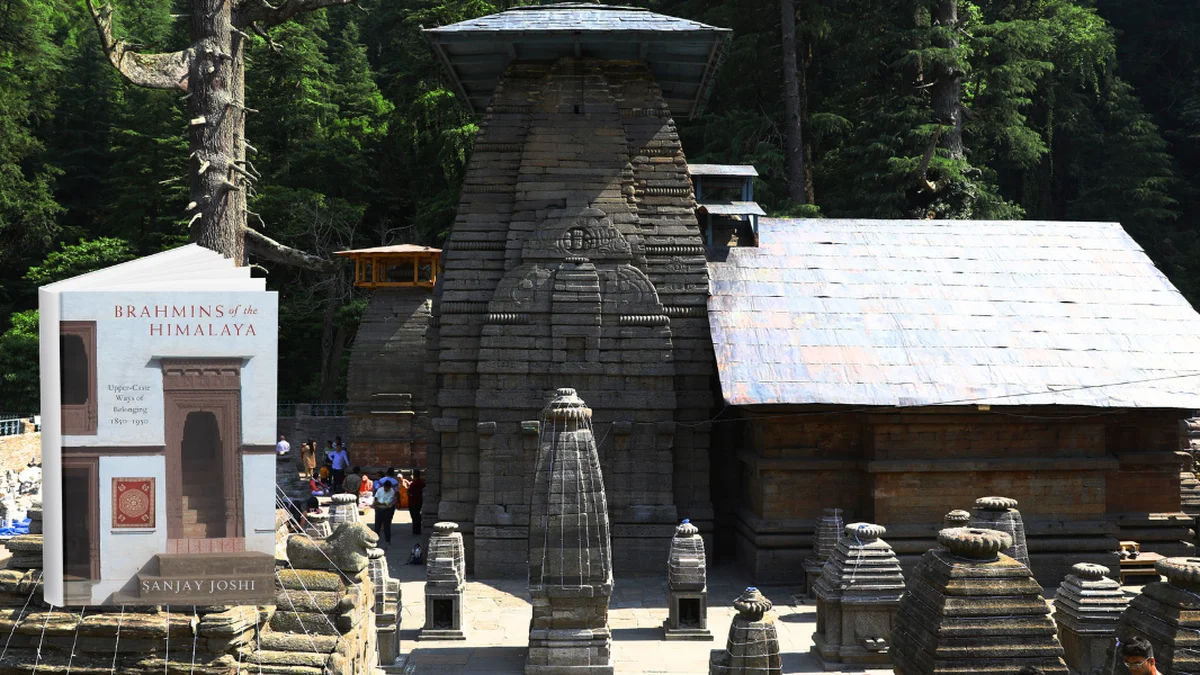
Deep within the folds of the Himalayas, hidden from the sweeping narratives of imperial history, lie "cultural republics"—microcosms of tradition that have silently shaped the Indian social landscape for centuries. A recent scholarly contribution, Brahmins of the Himalaya: Upper-Caste Ways of Belonging, 1850–1950 by historian Sanjay Joshi, excavates the history of one such enclave: the Brahminical stronghold of Almora, Uttarakhand. Through a blend of rigorous archival research and deeply personal introspection, Joshi offers a multifaceted examination of identity, caste, and modernity in a region that has long operated on the periphery of mainstream Indian consciousness.
A Dual Perspective: The Historian as Insider
Sanjay Joshi, a professor of history at Northern Arizona University, occupies a unique position in this narrative. As a scion of one of the closely intermarried Brahmin clans he documents, Joshi brings an "insider-outsider" gaze to the subject. His work is not merely an academic exercise; it is an investigation into the genealogy of his own people.
The migrant Brahmin clans—primarily the Pant, Pande, and Joshi families—began their migration into the Kumaon hills around the 12th century, fleeing the volatility of the plains. Over the subsequent five centuries, they established a distinct social order. Joshi’s perspective is occasionally at odds with the mainstream Sanatani Brahminism of the plains, reflecting a regional identity shaped by the rugged topography of the Himalayas. By applying the poise of a professional historian alongside the sardonic, self-deprecatory humor characteristic of the Pahadi Brahmin diaspora, Joshi elevates the text beyond elitist academic theorizing, grounding his analysis in the visceral human experiences of his ancestors.
Chronology of a "Little Republic"
The historical trajectory of these clans is inextricably linked to the shifts in power on the Indian subcontinent. As the Rajput kingdoms of the plains fell to successive waves of Turkic, Afghan, and eventually Mughal incursions, the Brahmin clans of Almora remained insulated by their mountain geography.
- 12th – 17th Century: The formative period of migration. The clans established themselves as the bridge between the remote hill communities and the Dilli Durbar, maintaining a relative autonomy that allowed for a closed, endogamous social structure.
- 1850 – 1900: The colonial encounter. As the British administration solidified its grip on India, the Kumaoni Brahmins began navigating the complexities of the Raj. The clans transitioned from being local power brokers to participants in the colonial bureaucracy.
- 1900 – 1950: The era of modernity. This period witnessed a rapid acceleration of change, marked by the rise of the educated elite, the impact of missionary activity, and the stirrings of the independence movement.
Joshi meticulously charts these decades using an eclectic array of sources: national repositories, the India Office Library in London, and, most uniquely, vernacular historical accounts penned by local Brahmins in Hindi. These sources reveal the internal fissures—the rivalries, the breaches of taboo, and the frantic efforts to maintain a self-image of "pure" Hindu guardianship amidst an increasingly Anglicized India.
Supporting Data: Tales of Taboo and Transformation
The book’s most compelling sections are its biographical vignettes, which challenge the rigid, monolithic image of the upper-caste Brahmin. Two stories in particular serve as anchor points for the book’s thematic exploration of change:
- The Transgression of Bhola Dutt Pandey: A pivotal figure who shattered the pervasive taboo against overseas travel. His journey represented the first of many ruptures in the traditional Brahminical code, signaling the beginning of a modern, outward-looking consciousness.
- The Apostasy of Tara Dutt Pant: Perhaps the most radical departure in the book’s narrative, Tara Dutt’s conversion to Christianity led to his immediate ostracization. Yet, his legacy was profound: his grandson, Daniel Pant, paved the way for his own daughter, Irene, to marry Liaquat Ali Khan, the first Prime Minister of Pakistan. This story illustrates the fluidity of identity that even the most insular communities could not prevent.
Contrastingly, the case of Victor Mohan Joshi provides a different arc. A convert who retained his Brahmin surname, he utilized his missionary-backed education to become a legendary freedom fighter against the British, illustrating that the "traditional" and "modern" were often deeply entangled rather than diametrically opposed.
Women’s Voices: The Rooted Silence
A significant contribution of this work is its recovery of the feminine perspective. By the mid-19th century, while men were migrating to urban centers to take up clerical, medical, or administrative roles in the British Raj, the women remained firmly rooted in the ancestral homes.
Through surviving correspondence, Joshi reconstructs the lives of these women. While their husbands and sons rose through the ranks of the civil service, the women bore the brunt of family management, child-rearing, and the maintenance of ritual purity. Their lives were often defined by a cycle of multiple pregnancies and the harsh demands of the Himalayan terrain. Joshi’s analysis highlights the irony of a patriarchal society where the "guardians of purity" were, in fact, the women whose own lives were often truncated by the very social structures the men were so desperate to preserve.
Implications: The Main Himalayan Thrust
The implications of Joshi’s work extend beyond the history of Uttarakhand. The book is structured into five thematic chapters that track the arc of Brahminical dominance, the "tsunami" of change between 1850 and 1930, the domestic reality of women, the performance of purity in the public sphere, and the inevitable collision with the constitutional reforms of post-colonial India.
The book discusses how the implementation of the Indian Constitution and the subsequent rise in the political agency of Scheduled Castes and Tribes shook the foundation of the Brahmin elite. This reaction—a mix of anxiety, resistance, and slow adjustment—mirrors broader pan-Indian fault lines. Joshi argues that these local histories are essential for understanding the "change and changelessness" of Indian culture.
Critical Assessment and Scope
While Brahmins of the Himalaya is a triumph of localized history, it is not without its limitations. Some critics have noted that the title is somewhat reductive. By focusing exclusively on the Kumaoni clans, the book glosses over the diverse Brahminical traditions of the wider Himalayan belt—from the distinct social histories of Himachal Pradesh to the Buddhist-Hindu syncretism of Nepal and Bhutan. The interaction of these cultures with Nath Panth traditions (which explicitly reject caste hierarchy) and Christianity creates a mosaic far more complex than the title suggests.
However, these omissions do not diminish the book’s achievement. By focusing on the "little republic" of Almora, Joshi successfully demonstrates how history is made not just in the corridors of power in Delhi or London, but in the town squares, the private letters, and the domestic spaces of the remote periphery.
Conclusion: Understanding the Ground Beneath Us
In the final analysis, Brahmins of the Himalaya serves as a poignant reminder that culture is not a static monolith, but a living, breathing, and often volatile entity. Just as the geological "Main Himalayan Thrust" can shift the physical landscape, the social fault lines of caste and gender continue to reshape the Indian identity.
Sanjay Joshi has provided more than a biography of his own people; he has provided a roadmap for understanding how tradition survives modernity by constantly negotiating with it. For students of Indian history, sociology, and those interested in the hidden geographies of the sub-continent, this work is an indispensable addition to the canon—a fascinating, sardonic, and deeply human account of a world that, until now, remained largely in the shadows.
Book Details:
- Brahmins of the Himalaya: Upper-Caste Ways of Belonging, 1850–1950
- Author: Sanjay Joshi
- Publisher: Permanent Black
- Price: ₹1,200