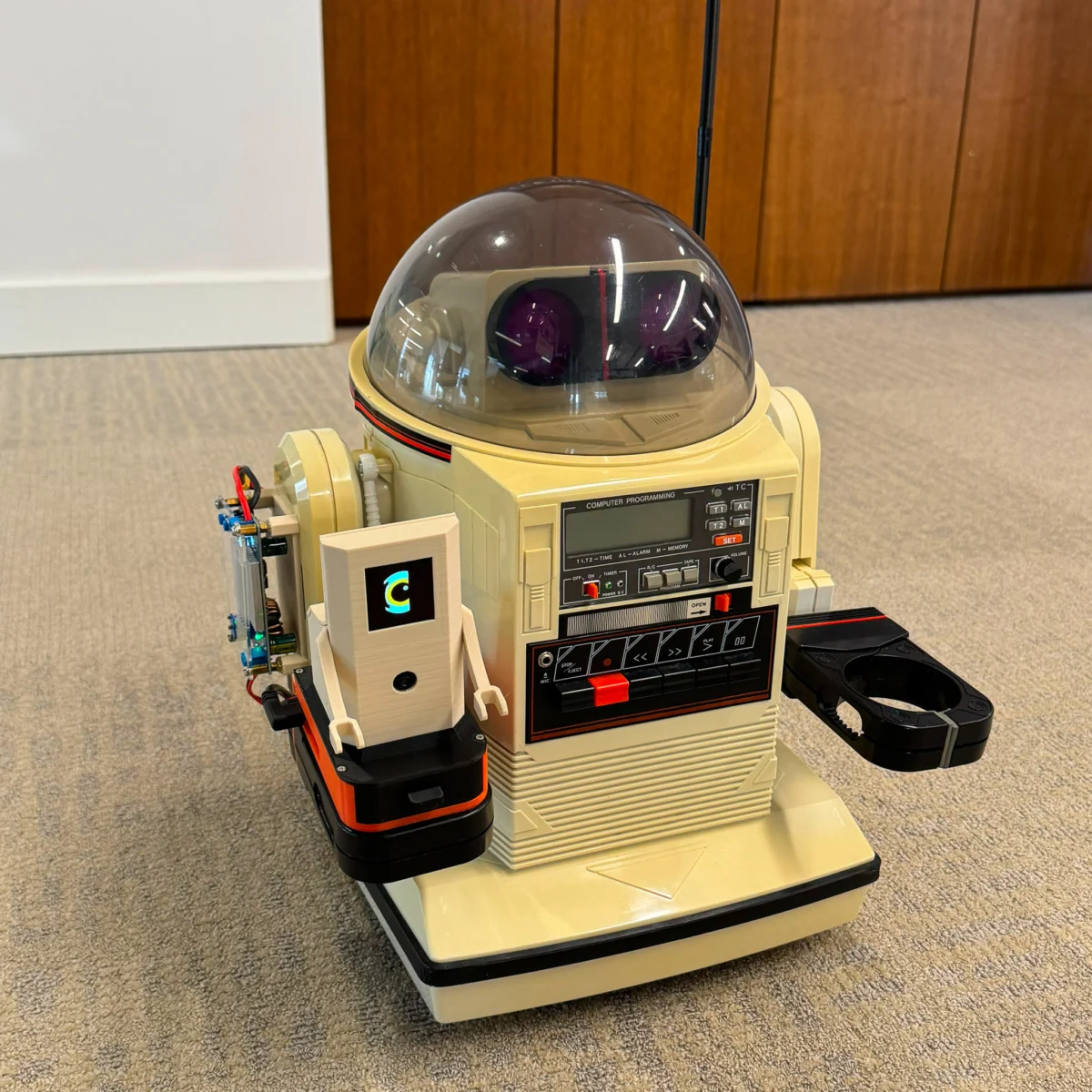
On a quiet workbench at the Moonlighter FabLab in Miami, a piece of mid-1980s history sits poised for a new life. It is a Tomy Omnibot, a relic of the Reagan era that once promised to be the domestic butler of the future. With its tank-style treads, a utilitarian serving tray, and a smoked-plastic dome that remains an iconic shorthand for "robot" in the cultural zeitgeist, the machine looks like a prop from a forgotten science fiction film. But beneath its vintage shell, the Omnibot is no longer a static relic. Mounted on its arm is a 3D-printed companion dubbed "Ring-O," a small, intelligent unit with a single, expressive cyan eye that tracks movement with uncanny focus.
This unlikely marriage of 1984 hardware and 2026 artificial intelligence represents more than just a clever maker project; it is the culmination of a four-decade-long technological arc, proving that while the hardware of the past may have been ahead of its time, the software of the present has finally caught up.
The Architecture of a Dream: 1984 to 2026
When Tomy released the Omnibot in 1984, it was marketed as a revolutionary domestic companion. It featured remote-control mobility, a programmable cassette deck, and the ability to record and replay messages. Retailing for $600—roughly $1,800 in today’s currency—it was a luxury toy for the aspiring futurist. However, the dream was short-lived for most. Leaking alkaline batteries, crumbling rubber, and the limitations of analog circuitry meant that the vast majority of Omnibots ended up in landfills.

The specific unit featured here was rescued from a donation bin, its circuit board scarred by the telltale crystalline bloom of battery acid. Restoring it required hours of meticulous cleaning and soldering, but the core challenge was the robot’s "brain." The original Omnibot functioned via an ingenious, if primitive, language of audio frequencies: 1614Hz signaled a forward command, while 2208Hz triggered a turn. It was, in essence, a machine that "listened" to the world in sine waves.
By integrating a Bluetooth-enabled cassette adapter and a Raspberry Pi 5, the restoration team successfully bypassed the defunct tape mechanism, allowing the robot to be controlled by modern devices. But the true leap forward occurred when the team decided to grant the robot autonomy through a $70 AI camera, effectively allowing the machine to see and react to its environment for the first time.
Chronology of a Maker Milestone
The evolution of the project followed a rigorous path of iteration and failure:

- The Restoration Phase (Months 1-3): The primary focus was mechanical salvage. After repairing the corroded logic boards, the team faced the immediate disintegration of the original rubber wheels. New components were 3D-printed, and the cassette-to-Bluetooth bridge was established, providing a modern interface for the legacy motors.
- The Integration of "Ring-O" (Months 4-5): To house the new compute stack—which included a Raspberry Pi 5, a cooling fan, and the camera—the team collaborated with Placitech, a Miami-based firm specializing in custom enclosures. Ring-O was born: a compact, anthropomorphic unit that sits atop the Omnibot, providing a "face" that users could instinctively interact with.
- The AI Experimentation (Month 6): The initial software architecture relied on a cloud-hosted Large Language Model (LLM) to interpret visual data. This phase was marked by failure; the latency was too high, and the model suffered from "hallucinations" of logic, often defaulting to simple commands like "turn right" regardless of the obstacle.
- The Pivot to Algorithmic Logic (Month 7): Realizing that LLMs were ill-suited for real-time spatial navigation, the team replaced the heavy neural reasoning with lightweight, high-speed geometric math. This pivot reduced latency from 15 seconds to near-instantaneous response times.
- Refinement for Public Interaction (Month 8): The final stage involved creating a "kid-friendly" web interface, implementing robust system diagnostics, and ensuring the robot could withstand the unpredictable environment of a public Maker Faire.
Supporting Data and Technical Specifications
The project succeeds because it bridges the gap between high-level AI and low-level mechanical execution. By offloading image recognition to the Sony IMX500 AI camera running YOLO11 (You Only Look Once), the system achieves a 17ms inference time—well within the threshold required for fluid movement.
| Component | Specification |
|---|---|
| Chassis | Tomy Omnibot (1984) |
| Compute | Raspberry Pi 5 (8GB RAM) |
| Vision | Sony IMX500 / YOLO11 Nano |
| Eye Display | 128×128 SSD1351 OLED |
| Decision Latency | ~0ms (Rules-based) |
| Connectivity | Bluetooth Audio (Command Bridge) |
The use of an OLED display for the "eye" is a stroke of design genius. While it provides no functional value to the navigation, it transforms the machine from a piece of equipment into a character. The eye dilates, blinks, and "sleeps," creating a psychological bridge that encourages human engagement.
The Lessons of Failure: LLMs vs. Simple Logic
Perhaps the most significant technical lesson from this project is the realization of the limitations of current generative AI. The team initially attempted to use an LLM to "reason" about the environment. When the camera detected a person at specific coordinates, the LLM was tasked with determining the robot’s next move.

The results were disastrous. The model would consistently overthink the data, resulting in a 15-second delay that left the robot spinning in circles long after the subject had moved. By replacing the LLM with fifty lines of basic arithmetic—calculating distance and trajectory—the robot achieved perfect accuracy. This underscores a vital takeaway for the robotics industry: AI should be used for recognition and classification, but traditional, deterministic code remains the gold standard for execution and navigation.
Implications for the Future of Domestic Robotics
The successful revival of the Omnibot has profound implications for how we view the lifecycle of consumer technology. We are currently in an era of "disposable" electronics, where devices are rendered obsolete by software updates or proprietary cloud-service shutdowns. The Omnibot project demonstrates that by keeping the hardware modular and the communication protocols open, we can bridge the gap between decades.
Furthermore, this project challenges the notion that domestic robots must be expensive, proprietary platforms. By utilizing open-source stacks and affordable, high-performance sensors, the team created a functional robot that outperforms the "futuristic" promises of the 1980s at a fraction of the cost.

Official Perspective and Community Response
At the 2026 Maker Faire Miami, the reaction from the public—particularly children—was the ultimate validation. For many, it was their first encounter with a robot that didn’t just move, but seemed to possess an internal life.
"The original Omnibot was a promise," said the project lead in a post-event reflection. "It was a promise that technology would eventually become a member of the household. It failed back then not because the vision was wrong, but because the tools weren’t ready. Today, the tools are everywhere. You can buy a camera for seventy dollars that is smarter than anything available in the entire world in 1984. We didn’t need to change the Omnibot to make the future happen; we just needed to give it a better set of eyes."
The project has since been released under an MIT license on GitHub, encouraging other makers to scavenge their local thrift stores for vintage hardware and give it a second life. The implications are clear: the "robot butler" of the future won’t necessarily come from a Silicon Valley boardroom. It will be built on the back of the past, patched together by enthusiasts who refuse to let the dreams of 1984 fade into obsolescence.

As we look toward the next decade of robotics, the Omnibot serves as a reminder that innovation is not always about inventing the new; often, it is about recognizing the latent potential in the old and providing the missing link that allows it to finally thrive.