As the winter chill descends upon the Indian subcontinent, a familiar and hazardous grey shroud envelops major metropolitan areas. From the National Capital Region (NCR) to the industrial hubs of the Indo-Gangetic plain, the "pollution season" has become a grim annual ritual. However, a dangerous misconception has taken root among consumers: the idea that air purifiers are seasonal appliances, meant to be activated only when the Air Quality Index (AQI) reaches "Severe" or "Hazardous" levels.
New data and environmental health research suggest that this reactive approach to air quality is insufficient. Indoor air quality (IAQ) is a complex, 365-day-a-year challenge that exists independently of outdoor atmospheric conditions. To understand why the air purifier must become a permanent fixture of the modern Indian household, one must look beyond the smoggy horizon and into the microscopic environment of the home.
Main Facts: The Reality of Indoor Pollution in India
The scale of the air quality crisis in India is unprecedented. According to the 2025 World Air Quality Report by IQAir, India remains at the epicenter of global respiratory health concerns, with 17 of the world’s 20 most polluted cities located within its borders. Delhi, the nation’s capital, recorded an annual average PM2.5 concentration of 99.6 µg/m³—nearly 20 times the World Health Organization’s (WHO) recommended annual guideline.
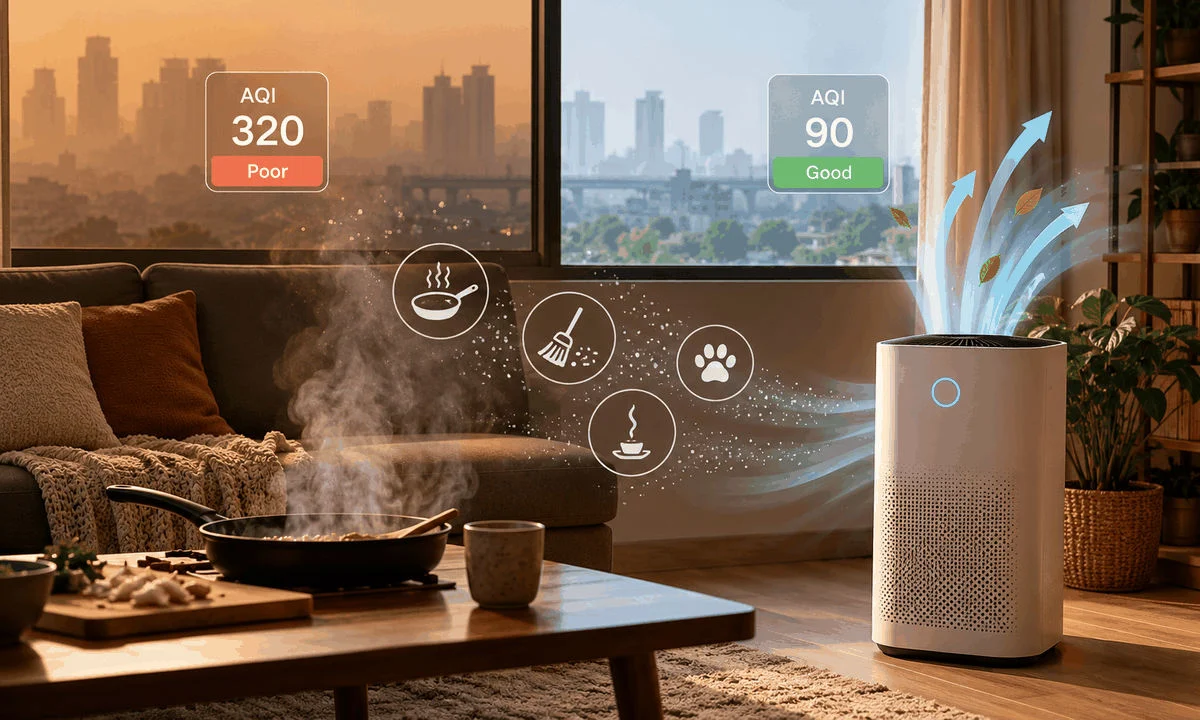
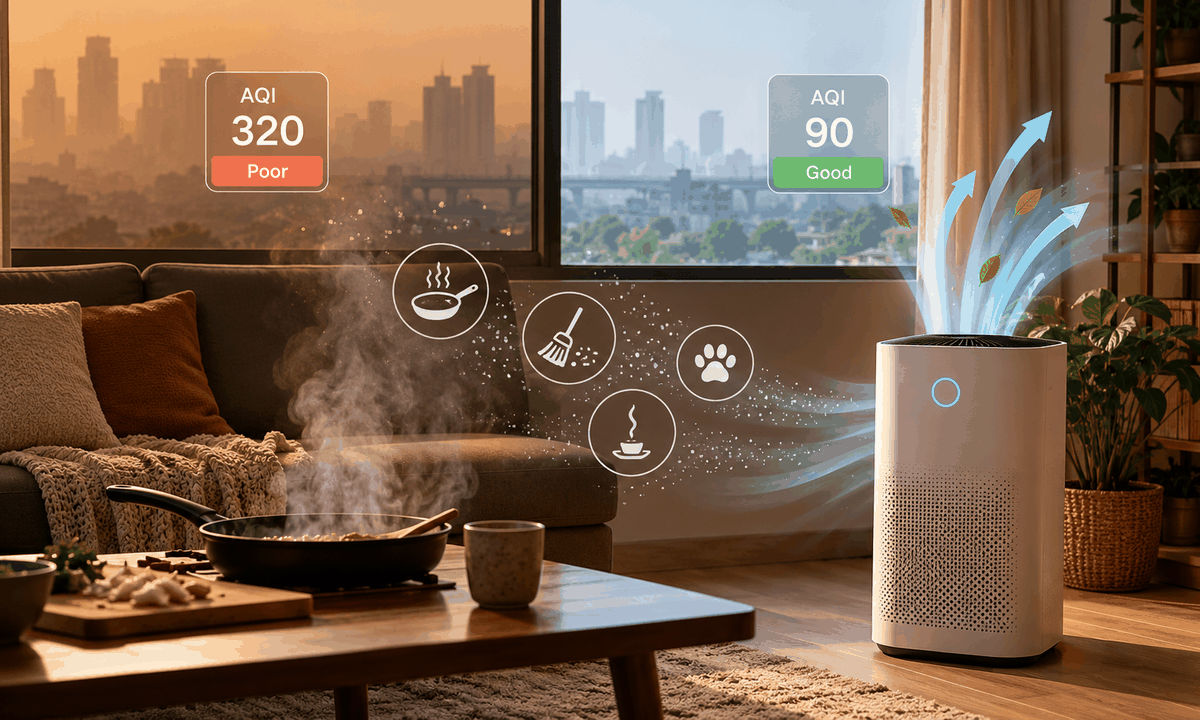
However, the "Main Fact" often ignored is that indoor air is frequently two to five times more polluted than outdoor air. While outdoor pollution is driven by vehicular emissions, industrial discharge, and stubble burning, indoor pollution is a cocktail of localized sources:
- Combustion Byproducts: Cooking (especially frying or using gas stoves) and the burning of incense sticks (agarbattis) or candles.
- Biological Contaminants: Pet dander, dust mites, mold spores, and pollen.
- Chemical Off-gassing: Volatile Organic Compounds (VOCs) released from paints, varnishes, new furniture, and cleaning agents.
- Particulate Resuspension: The simple act of walking across a carpet or sweeping a floor kicks settled dust back into the breathing zone.
The myth that "closing the windows keeps the pollution out" is only partially true. While sealed windows prevent some PM2.5 from entering, they simultaneously trap indoor-generated pollutants, leading to a "stagnation effect" where concentrations of harmful gases and particles build up to toxic levels.
Chronology: From Seasonal Niche to Essential Utility
The evolution of air purifier adoption in India follows a distinct timeline, reflecting the country’s worsening environmental health.
2010–2015: The Luxury Era
In the early 2010s, air purifiers were considered luxury items, found mostly in the homes of expatriates or high-net-worth individuals in Delhi. During this period, AQI monitoring was not yet a mainstream habit, and "smog" was often confused with "fog."
2016–2020: The Great Awakening
The 2016 post-Diwali "Great Smog" of Delhi served as a turning point. As PM2.5 levels shattered records, public awareness spiked. This period saw the entry of global tech giants like Dyson, Xiaomi, and Philips into the Indian market. However, consumer behavior remained strictly seasonal—sales and usage peaked in November and plummeted by February.
2021–Present: The Pandemic and the PM2.5 Shift
The COVID-19 pandemic forced a global re-evaluation of indoor environments. People spent more time indoors, leading to a heightened understanding of ventilation and airborne transmission. Despite this, the habit of "AQI-watching" persisted. Users began relying on smartphone apps to decide when to turn on their purifiers, unaware that these apps report outdoor data from stations that may be kilometers away, bearing little resemblance to the air inside a specific living room.
Supporting Data: The Science of Filtration and CADR
To understand why an air purifier needs to run consistently, one must look at the technical metrics that govern air cleaning: Clean Air Delivery Rate (CADR) and HEPA efficiency.
The HEPA Standard
High-Efficiency Particulate Air (HEPA) filters are the gold standard, rated to capture 99.97% of particles as small as 0.3 microns. This includes the notorious PM2.5, which is small enough to enter the bloodstream. Data shows that in a typical Indian household during winter, a HEPA filter can become saturated with particulate matter much faster than in European or American environments. Running a purifier only during "peak" pollution hours allows particles to settle into fabrics and carpets, where they are harder to remove later.
The CADR Equation
CADR measures the volume of filtered air a purifier delivers per minute. If a room is 300 square feet, a purifier needs to cycle the air at least five times per hour (ACH – Air Changes per Hour) to maintain a healthy environment. When a purifier is switched off because the outdoor AQI "looks better," the ACH drops to zero. Within minutes, indoor activities like cooking can cause PM2.5 levels to spike from 20 µg/m³ to over 200 µg/m³.
Power Consumption vs. Health Cost
A common deterrent to 24/7 usage is electricity cost. However, modern air purifiers are remarkably efficient. Most operate at 30–60 watts on high settings and as low as 5–10 watts on "Silent" or "Auto" modes—less than a standard ceiling fan. In contrast, the economic burden of respiratory illness, including medication, lost workdays, and long-term lung damage, far outweighs the few rupees spent on electricity.
Official Responses and Expert Insights
Medical professionals and environmental scientists are increasingly vocal about the "intermittent usage" trap.
Dr. Arvind Kumar, a renowned thoracic surgeon and founder of the Lung Care Foundation, has frequently noted that "there are no non-smokers in India," referring to the equivalent cigarette smoke inhaled by breathing polluted air. Experts argue that the human body does not have a "threshold" for pollution; even moderate levels of PM2.5 cause systemic inflammation.
The World Health Organization (WHO) updated its guidelines in 2021, slashing the "safe" limit of PM2.5 from 10 µg/m³ to 5 µg/m³. Under these stringent standards, almost every indoor environment in urban India is "unhealthy" year-round.

Furthermore, environmental engineers point out a flaw in "Auto Mode" sensors. Most consumer-grade air purifiers use infrared or laser sensors to detect particulate matter (PM2.5). However, they are often blind to:
- Nitrogen Dioxide (NO2): Common in kitchens with gas stoves.
- Carbon Monoxide (CO): A byproduct of incomplete combustion.
- Formaldehyde: Found in plywood and carpets.
Because the purifier’s sensor doesn’t "see" these chemicals, the "Auto Mode" may stay on a low, ineffective setting even when the air is chemically "heavy."
Implications: A New Standard for Urban Living
The implications of the current air quality data are clear: the air purifier can no longer be viewed as a seasonal appliance like a room heater. It must be treated like a refrigerator—an appliance that stays on to maintain a constant, healthy environment.
Long-term Health Implications
Chronic exposure to even "moderate" AQI (50–100) is linked to a higher incidence of asthma in children, cognitive decline in the elderly, and cardiovascular disease in adults. By maintaining a "Clean Air Bubble" indoors consistently, residents can significantly reduce their cumulative annual exposure, even if they must breathe polluted air during their commute.
The "Purifier Placement" Factor
To maximize the implications of continuous usage, placement is key. Experts suggest:
- Keeping it off the floor: Placing the unit on a small stool can help it pull in air from the "breathing zone."
- Centralized Location: Avoid corners or placing it behind curtains, which restricts airflow.
- Bedroom Priority: Since humans spend 7–9 hours sleeping, the bedroom is the most critical area for a 24/7 air purifier.
The Economic Shift
For the appliance industry, this shift in consumer behavior means a move toward "smart" integration. We are seeing the rise of purifiers integrated into HVAC systems and units that can be controlled via IoT (Internet of Things) to ramp up filtration 30 minutes before a user arrives home.
Conclusion
The 2025 World Air Quality Report is not just a collection of statistics; it is a warning. For those living in India’s urban centers, the air is a shared hazard, but the indoor environment is a controllable variable.
Waiting for the AQI to turn purple on a smartphone app before turning on an air purifier is akin to waiting for a house to catch fire before installing a smoke detector. True respiratory safety lies in consistency. By understanding that indoor air is a dynamic ecosystem influenced by everything from the frypan to the floor rug, consumers can make the vital transition from reactive "AQI watching" to proactive health management. The message is simple: switch it on, keep it on, and breathe.