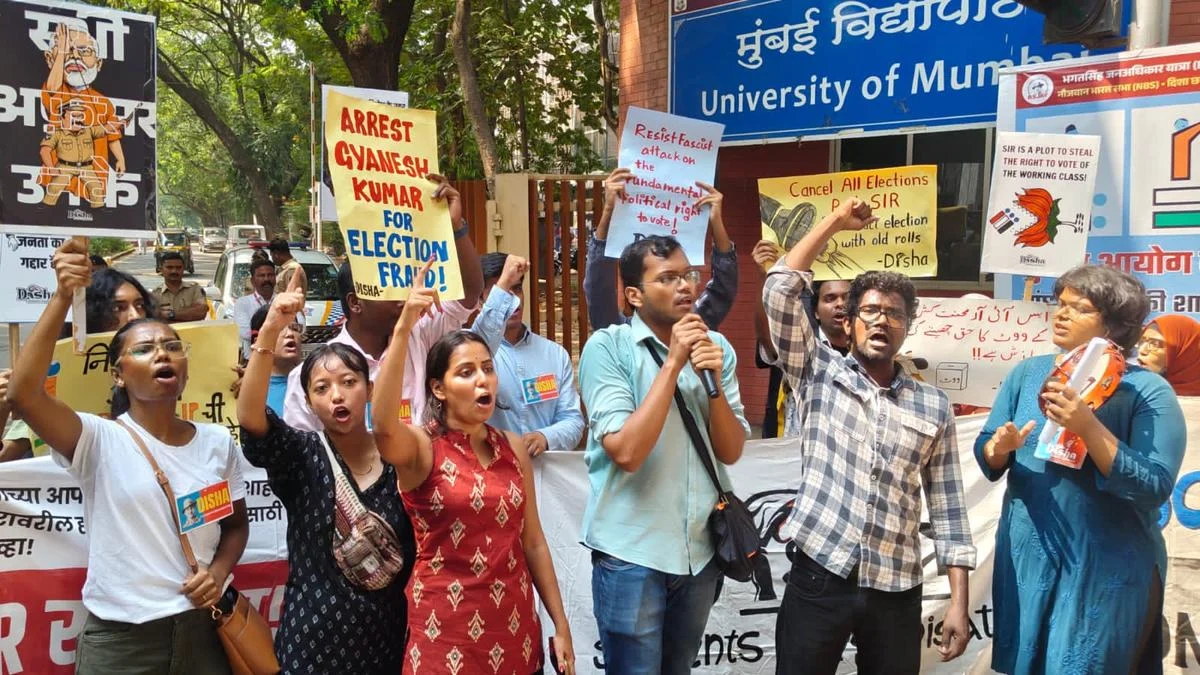
MUMBAI — Tensions surrounding India’s voter registration framework reached a flashpoint on Friday, October 23, 2026, as hundreds of students, political activists, and working professionals staged a high-decibel demonstration outside the Kalina campus of the University of Mumbai. Organized jointly by the Disha Students’ Organisation and the Bhagat Singh Jan Adhikar Yatra (BSJAY), the protest marked a significant escalation in public opposition to the Election Commission of India’s (ECI) Special Intensive Revision (SIR) of electoral rolls.
Demonstrators halted traffic outside the university gates, demanding an immediate scrap of the SIR exercise, the resignation and arrest of Chief Election Commissioner (CEC) Gyanesh Kumar, and the conduct of upcoming elections using unrevised, legacy voter lists. The protest also targeted the controversial 2023 law governing the appointment of Election Commissioners, which critics argue stripped the selection process of executive-independent oversight.
Amid a heavy police presence, the protest featured cultural expressions of dissent—including political rap performances, group choir renditions, and revolutionary slogans—interspersed with speeches calling for sustained, nationwide civil disobedience against what speakers characterized as systematic electoral disenfranchisement.
Overview of the Kalina Campus Demonstration
The October 23 mobilization outside Mumbai University’s Kalina campus brought together a broad coalition of youth organizations, civil rights groups, and labor unions. Central to the protest were four core demands:
- Scrapping the Special Intensive Revision (SIR): An immediate halt to all ongoing electoral roll updates conducted under the SIR protocol across the country.
- Resignation and Prosecution of CEC Gyanesh Kumar: The immediate removal and criminal investigation of Chief Election Commissioner Gyanesh Kumar over alleged structural irregularities, administrative mismanagement, and partisanship.
- Reversion to Pre-Revision Rolls: Reinstatement of voters deleted during recent revision drives, ensuring upcoming local, state, and national polls are conducted using established baseline voter registries.
- Repeal of the 2023 Appointment Act: Revocation of the Chief Election Commissioner and Other Election Commissioners (Appointment, Conditions of Service and Term of Office) Act, 2023, and the establishment of an independent selection tribunal.
Addressing the assembled crowd, Dr. Pooja, coordinator of the Bhagat Singh Jan Adhikar Yatra, asserted that the SIR framework disproportionately impacts India’s most vulnerable socioeconomic cohorts.
"The design of this revision is inherently discriminatory," Dr. Pooja said. "By placing arbitrary burdens of proof on voters, the SIR threatens to strip voting rights from working-class communities, Dalits, Adivasis, and religious minorities—particularly Muslims—who frequently lack continuous documentation or fixed housing due to economic displacement."
Dr. Pooja further criticized the statutory framework governing the ECI, alleging that CEC Gyanesh Kumar was utilizing institutional authority to further the political objectives of the ruling Bharatiya Janata Party (BJP).
Chronology: From the Bihar Mandate to Mumbai Streets
The demonstration at Mumbai University represents the latest chapter in a mounting national conflict over electoral administration that has unfolded throughout 2026.
       [May 27, 2026]
   Supreme Court upholds
   legality of SIR in Bihar,
   setting national precedent
            │
            ▼
     [Summer-Autumn 2026]
   ECI expands SIR nationwide;
   gaps & portal failures reported
            │
            ▼
      [October 10, 2026]
   Nationwide opposition protest
   demands resignation of CEC
   Gyanesh Kumar
            │
            ▼
      [October 23, 2026]
   Mass student-led protest
   outside Mumbai University
(Kalina) calls for sit-ins- May 27, 2026 — Supreme Court Benchmark Ruling: The Supreme Court delivered a landmark judgment upholding the legal validity of the SIR exercise as initially rolled out in Bihar. The apex court ruled that the ECI retains full constitutional authority under Article 324 to clean and update electoral rolls. However, the bench added a critical caveat: while the Commission can verify residency and eligibility, its scrutiny does not constitute a final legal determination of citizenship.
- Summer–Autumn 2026 — Nationwide Rollout and Administrative Friction: Following the judicial ruling, the ECI expanded the SIR protocol to multiple states and urban hubs. Rapid implementation brought widespread complaints regarding the deletion of names, portal glitches on the ECI’s digital platforms, and onerous field verification requirements.
- October 10, 2026 — National Day of Protest: Civil rights organizations and opposition factions launched coordinated demonstrations demanding CEC Gyanesh Kumar’s resignation over alleged roll manipulation and data discrepancies.
- October 23, 2026 — Campus Mobilization in Mumbai: Student organizations expanded the agitation into academic institutions, bringing hundreds to the gates of University of Mumbai’s Kalina campus to link youth movements with broader working-class resistance.
Technical Glitches, Form 6 Abuse, and Disenfranchisement Concerns
A major focus of the speeches at Kalina centered on the operational and technological mechanisms of the SIR. Organizers argued that the digital and bureaucratic tools deployed by the ECI act as systemic barriers rather than facilitators of democratic participation.
Technical Failures of ECINET
Abhinash Kumar, a key volunteer with the Disha Students’ Organisation, highlighted severe flaws in ECINET—the digital software framework used by the Election Commission to process voter submissions, verifications, and cross-indexing.
"The ECINET platform has repeatedly crashed, misallocated voter records, and generated algorithmic errors that flag legitimate, long-term residents as ‘doubtful’ or ‘shifted,’" Abhinash Kumar claimed. "Instead of fixing a broken system, the Commission is pushing the fallout onto citizens."
The "Form 6" Re-Enrolment Paradox
Protesters particularly disputed the procedural mandate requiring deleted voters to re-apply using Form 6—the standardized application reserved for new voter registrations.
+-----------------------------------------------------------------------+
|                       THE RE-ENROLMENT PARADOX                        |
+-----------------------------------------------------------------------+
|  [Long-Standing Registered Voter]                                     |
|           │                                                           |
|           ▼                                                           |
|  [Flagged/Deleted during SIR via ECINET algorithmic/field audit]      |
|           │                                                           |
|           ▼                                                           |
|  [Forced to file 'Form 6' (designed exclusively for first-time voters)]|
|           │                                                           |
|           ▼                                                           |
|  [Subjected to fresh documentary proof of residence & age]           |
|           │                                                           |
|           ▼                                                           |
|  [Risk of total exclusion due to lack of historical documentation]    |
+-----------------------------------------------------------------------+
"Why should an individual who has cast ballots in three consecutive general elections be forced to submit Form 6 as if they just turned 18?" asked Abhinash Kumar. "This process forces voters to prove their existence from scratch. If an uneducated worker or migrant laborer cannot produce decade-old utility bills or legacy identification, their name is permanently scrubbed."
Sahil Parsekar, a former Mumbai University student and volunteer with the Citizens for Justice and Peace (CJP), stressed that the documentation load disproportionately burdens urban poor households. "Voters in informal settlements are being asked to navigate complex paperwork hierarchies," Parsekar noted. "When activists step in to assist them, authorities respond with intimidation and detentions."

Legislative Framework and Judicial Oversight
The core grievances of the anti-SIR movement are tied to legislative changes and judicial rulings that have reshaped India’s electoral apparatus over the past three years.
The 2023 Selection Act Controvery
Protesters demanded the full repeal of the Chief Election Commissioner and Other Election Commissioners (Appointment, Conditions of Service and Term of Office) Act, 2023. Passed in December 2023, the statute replaced a prior mechanism suggested by the Supreme Court—which included the Chief Justice of India (CJI) on the selection panel—with a three-member committee comprising:
- The Prime Minister of India
- A Union Cabinet Minister (nominated by the PM)
- The Leader of the Opposition in the Lok Sabha
Critics contend that this structure gives the executive branch a permanent 2-to-1 majority over appointments, compromising the constitutional neutrality of the Election Commission.
       2023 EC SELECTION PANEL STRUCTURE
┌──────────────────────────────────────────────┐
│  • Prime Minister (Chair)                    │
│  • Union Cabinet Minister (PM Nominee)       │ ──► [Executive Majority: 2 Votes]
├──────────────────────────────────────────────┤
│  • Leader of Opposition (Lok Sabha)          │ ──► [Opposition Minority: 1 Vote]
└──────────────────────────────────────────────┘
The Supreme Court’s May 27 Mandate
While protesters maintain that the SIR exercise violates fundamental rights, the ECI’s legal defense relies on the Supreme Court’s May 27, 2026 judgment. The apex court affirmed that:
- Under Article 324, the ECI holds plenary powers to verify and maintain accurate voter rolls.
- Administrative revisions do not constitute an illegal usurpation of citizenship determination powers reserved for the Ministry of Home Affairs.
- Voters excluded during administrative drives retain rights to appeal through constitutional remedies.
However, student leaders argue that the practical application of the ruling falls far short of its constitutional intent. "The court stated that SIR is not a citizenship determination exercise," Abhinash Kumar told the crowd. "Yet on the ground, local election officials are demanding documents that function precisely like citizenship tests."
Official Responses and Law Enforcement Standpoint
Election Commission of India
The Election Commission of India has repeatedly rejected allegations of bias or illegal voter suppression. In statements addressing nationwide SIR concerns, official spokespersons maintained that:
- Integrity of Rolls: The revision process is essential to remove duplicate entries, deceased individuals, and permanently relocated voters from an increasingly mobile national population.
- Algorithmic Fairness: The ECINET framework relies on standard data-matching protocols that operate without demographic, political, or geographic bias.
- Due Process: Any citizen flagged for deletion receives written notice and an opportunity to appeal before official removal.
Law Enforcement and Police Deployment
Outside the Kalina campus, Mumbai Police deployed multiple companies of personnel, riot prevention vehicles, and barricades. Officers strictly regulated movement around the university entrance, citing public safety and the prevention of traffic disruption on major arterial roads.
Addressing allegations made by protesters regarding preventive detentions, senior police personnel stated off-camera that law enforcement acted strictly within legal mandates to maintain public order. Officers emphasized that while peaceful protest is permitted at designated grounds, blockades outside academic institutions require regulated oversight.
Socio-Political Implications and Movement Trajectory
The protest at Mumbai University reflects a growing political alignment between student unions, civil rights entities, and working-class organizations. Speakers drew explicit historical connections between contemporary civil disobedience and India’s independence movement.
      PROPOSED EXPANSION STRATEGY FOR ANTI-SIR MOVEMENT
┌─────────────────────────────────────────────────────────────┐
│  1. Academic Hubs: Mass student awareness & campus sit-ins  │
├─────────────────────────────────────────────────────────────┤
│  2. Labor Districts: Mobilization in working-class neighborhoods │
├─────────────────────────────────────────────────────────────┤
│  3. Indefinite Sit-ins: Urban center occupations nationwide │
└─────────────────────────────────────────────────────────────┘
Invoking the legacy of Indian freedom fighter Ashfaqulla Khan on his birth anniversary, Rahul, a representative of the Naujawan Bharat Sabha, urged demonstrators to build inter-community solidarity against divisive politics. "Freedom fighters like Ashfaqulla Khan stood against division to secure democratic rights for every citizen," Rahul said. "We must resist any attempt to fracture public unity through administrative disenfranchisement."
Dhananjay Tawde, a leader within the Disha Students’ Organisation, called for a strategic pivot from temporary rallies to indefinite urban occupations.
"We cannot confine our anger to permission-bound protest grounds or brief campus demonstrations," Tawde told the crowd. "We must take this movement into every university campus, factory gate, and working-class neighborhood across Mumbai. Our goal is to coordinate indefinite sit-ins across major cities until the Special Intensive Revision is withdrawn and electoral integrity is restored."
As afternoon turned to evening, the protest concluded with collective singing and vows to expand the campaign across Maharashtra and neighboring states, setting the stage for continued political and legal battles over the future of India’s voting systems.
Key Summary of Protest Demands
| Demand Category | Action Requested by Protesters | Institutional Target |
|---|---|---|
| Electoral Revision | Immediate cancellation of Special Intensive Revision (SIR) | Election Commission of India |
| ECI Leadership | Resignation and prosecution of CEC Gyanesh Kumar | Chief Election Commissioner |
| Voter Rolls | Conduct upcoming polls using baseline legacy registries | ECI / Ministry of Law |
| Appointments Act | Repeal 2023 Selection Act; restore independent selection panel | Parliament of India |
| Civil Liberties | Cease preventive detentions of voting rights activists | Ministry of Home Affairs / Police |