New Delhi, [Date] – For decades, the familiar 12% deduction on salary slips for Provident Fund (PF) contributions has been a silent cornerstone of retirement planning for millions of Indian employees. However, recent announcements and a flurry of often-misleading information across news channels and social media have sown considerable confusion and anxiety. Whispers of a complete overhaul of the Employees’ Provident Fund (EPF) law, with claims ranging from a capped contribution to restricted withdrawals, have left subscribers questioning the security of their hard-earned savings.
This report aims to cut through the noise and provide a clear, verified explanation of the EPF Scheme 2026, alongside its sister schemes for Pension (EPS) and Deposit-Linked Insurance (EDLI). Drawing directly from the official gazette notifications published on June 29, 2026, by the Ministry of Labour and Employment, this analysis demystifies the changes, clarifies what remains the same, and outlines the implications for EPF subscribers across India.
The Genesis of the 2026 Schemes: A Legal Evolution
The fundamental shift underlying the EPF Scheme 2026, EPS Scheme 2026, and EDLI Scheme 2026 is not a radical departure from established principles, but rather a significant legal upgrade. The decades-old Employees’ Provident Funds and Miscellaneous Provisions Act, 1952, has been subsumed under the broader framework of the Code on Social Security, 2020. The three newly notified schemes are the detailed regulatory rulebooks enacted under this overarching labour code, which the government has been implementing in phases.
Crucially, existing members of the EPF Scheme 1952 and EPS 1995 have been automatically transitioned to their corresponding 2026 counterparts. There is no need for new account openings, fresh applications, or any additional formalities. Subscribers’ existing balances, Universal Account Numbers (UANs), contribution histories, and accumulated benefits remain intact and carry forward without interruption. The core objective remains the same: ensuring retirement security through a multi-pronged approach encompassing provident fund savings, pension benefits, and life insurance cover.
Demystifying the EPF Contribution: Mandatory, Voluntary, and VPF Explained
A significant source of confusion stems from the terminology used in the EPF Scheme 2026, particularly the term "voluntary" in different contexts. The new scheme clarifies the distinction between mandatory EPF contributions, voluntary contributions on higher wages, and the Voluntary Provident Fund (VPF).
Mandatory EPF Contribution: The Non-Negotiable Foundation
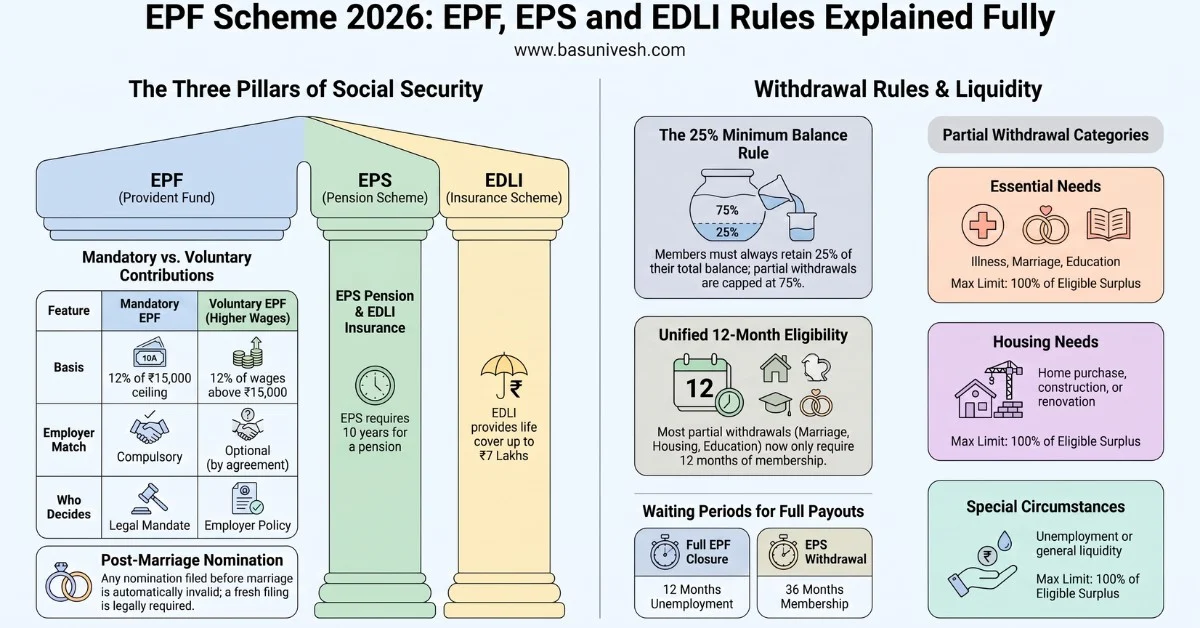
The mandatory EPF contribution is strictly tied to the statutory wage ceiling of ₹15,000 per month, irrespective of an employee’s actual salary. Under the EPF Scheme 2026, both the employee and the employer are legally obligated to contribute 12% of this ₹15,000 ceiling. This amounts to a mandatory ₹1,800 contribution from the employee and an equal ₹1,800 from the employer, totaling ₹3,600 per month. This minimum contribution cannot be refused by any employer.
Voluntary EPF on Higher Wages: A Mutual Agreement
For employees whose basic salary, plus dearness allowance, exceeds the ₹15,000 threshold, the EPF Scheme 2026 introduces the concept of "voluntary EPF on higher wages." If both the employee and employer agree to continue contributing at 12% of the full salary (e.g., ₹50,000), the portion exceeding the ₹15,000 ceiling is now formally classified as a voluntary contribution on higher wages.
It is imperative to note that the employer is under no legal obligation to match these voluntary contributions above the ₹15,000 ceiling. Employers have three options: they can continue contributing on the full higher wages as before, partially reduce their contributions above the ceiling, or restrict future contributions strictly to the statutory ₹15,000 limit. The scheme explicitly permits either party to reduce or discontinue these voluntary contributions at any time. Employees are strongly advised to consult their HR departments to understand their organization’s specific policy on this matter.
Voluntary Provident Fund (VPF): An Employee’s Personal Augmentation
Distinct from the above, the Voluntary Provident Fund (VPF) remains an avenue for employees to contribute an additional amount over and above their regular EPF contributions. This VPF amount is solely at the employee’s discretion, and the employer does not match it. For instance, if an employee contributes ₹6,000 towards their EPF and opts for an additional ₹10,000 as VPF, their total monthly contribution becomes ₹16,000. However, the employer’s contribution remains capped at their agreed-upon level, typically ₹1,800 (or lower depending on policy). VPF continues to be one of the most tax-efficient vehicles for building a substantial retirement corpus, benefiting from the same EPF interest rates and tax treatment, subject to the standard five-year continuous service condition for tax-free withdrawals.
| Feature | Mandatory EPF | Voluntary EPF on Higher Wages | Voluntary Provident Fund (VPF) |
|---|---|---|---|
| Contribution Basis | 12% of ₹15,000 wage ceiling | 12% of wages above ₹15,000, by mutual agreement | Additional employee contribution over and above EPF |
| Employee Contribution | Mandatory | Voluntary | Voluntary |
| Employer Contribution | Mandatory | Only if employer agrees | No employer matching |
| Who Decides | Law | Employer policy or mutual agreement | Employee alone |
Withdrawal Rules: Streamlined Categories and a Uniform Waiting Period
One of the most significant and genuinely simplifying changes under the EPF Scheme 2026 pertains to withdrawal rules. Previously fragmented into numerous specific reasons, all partial withdrawal categories have now been consolidated into three broad categories under Para 46 of the notified scheme. Each of these categories is capped at 100% of the "eligible member surplus," which is defined as the total EPF balance minus a mandatory 25% minimum balance that must always be retained.
Crucially, members who leave employment before completing even 12 months of membership are now eligible to apply for partial withdrawals. This is capped at their eligible surplus on the date of the claim (Para 46(5)). This provision offers a vital safety net, providing relatively immediate access to funds for individuals experiencing job loss early in their careers.
The Uniform 12-Month Membership Requirement
Dispelling a long-held misconception, the EPF Scheme 2026 has replaced the older, tiered service requirements (ranging from 5 to 7 years) for certain withdrawals like purchasing a house or funding a wedding. A uniform minimum of 12 months of EPF membership now applies to most partial withdrawal categories. This represents a significant relief for early-career professionals and individuals who frequently switch jobs, offering greater flexibility and liquidity.
The 25% Minimum Balance: A Safeguard for Retirement Security
While partial withdrawals have become more accessible, the EPFO has instituted a safeguard to ensure a baseline level of retirement savings. Members are now required to maintain at least 25% of their total EPF balance as a "minimum balance." This floor is applied across all three partial withdrawal categories. Consequently, the maximum amount an individual can ever withdraw through a partial withdrawal is effectively 75% of their total EPF balance.
For example, if an individual’s total EPF balance stands at ₹8 lakh, the minimum balance to be retained is ₹2 lakh (25% of ₹8 lakh). This leaves an eligible surplus of ₹6 lakh, which represents the absolute ceiling for any partial withdrawal, regardless of the reason.
Job Loss and EPF Withdrawal: Clarity from the Gazette Text
The implications of job loss on EPF accounts have been a frequent point of confusion. The gazetted text clearly delineates two distinct provisions governing full closure and partial withdrawals.
Full Account Closure: The 12-Month Bar
Para 49 of the EPF Scheme 2026 addresses complete withdrawal, or the full closure of an EPF account. While specific scenarios like retirement after age 55, permanent incapacity, permanent migration abroad, retrenchment, or mutually agreed voluntary retirement schemes have their own waiting periods (some as short as two months), the ordinary case of resignation or termination for reasons outside these specific categories is subject to a strict 12-month non-employment rule. This means individuals are not eligible to apply for full withdrawal unless they have remained continuously out of employment for at least 12 months immediately preceding their application. Women resigning specifically for marriage are an exception to this waiting period.
The Real Liquidity Option: Partial Withdrawal Post Job Loss
The widely circulated figure of "75% immediately" accessible after job loss stems from the general partial withdrawal ceiling under Para 46. This is available through the "Special Circumstances" category, which explicitly covers unemployment. This partial withdrawal can be availed at any time after job loss, irrespective of the duration of unemployment or the individual’s tenure as an EPF member. Therefore, while complete account closure requires a 12-month wait, a substantial portion of EPF savings remains accessible much sooner through the partial withdrawal route.
In essence, upon job loss, individuals can access up to 75% of their EPF balance almost immediately via a Special Circumstances partial withdrawal, while the full account closure necessitates the 12-month waiting period.
EPS 2026: Pension Rules Unveiled
The Employees’ Pension Scheme (EPS) operates under a separate set of rules from EPF, and understanding these distinctions is critical, particularly when transitioning between jobs.
What Remains Unchanged in EPS
The fundamental principles of the EPS remain largely consistent. The pensionable salary calculation continues to be based on the average of the last 60 months of pensionable service, capped at the statutory wage ceiling. The pension formula, pensionable service, and the age for claiming pension benefits (age 58) remain unchanged. The provision for early pension at age 50 with a reduced benefit also persists.
EPS Withdrawal Benefit: A Separate, Longer Wait
A significant point of divergence lies in the withdrawal benefit for individuals with less than 10 years of eligible EPS service upon leaving a job. Instead of a monthly pension, these individuals are entitled to a lump-sum withdrawal benefit calculated as per the Scheme’s Table IV. However, Para 13 of the EPS Scheme 2026 is explicit: eligibility to claim this withdrawal benefit arises only after a continuous period of 36 months has elapsed from the date the last contribution became due, or upon attaining superannuation, whichever is earlier. This represents a substantially longer waiting period compared to the EPF’s 12-month bar for full closure.
For those with EPS service exceeding 10 years, the withdrawal benefit is not available. They are solely entitled to a monthly pension from age 58 or a Scheme Certificate that preserves their pensionable service if they join another EPF-covered employer.
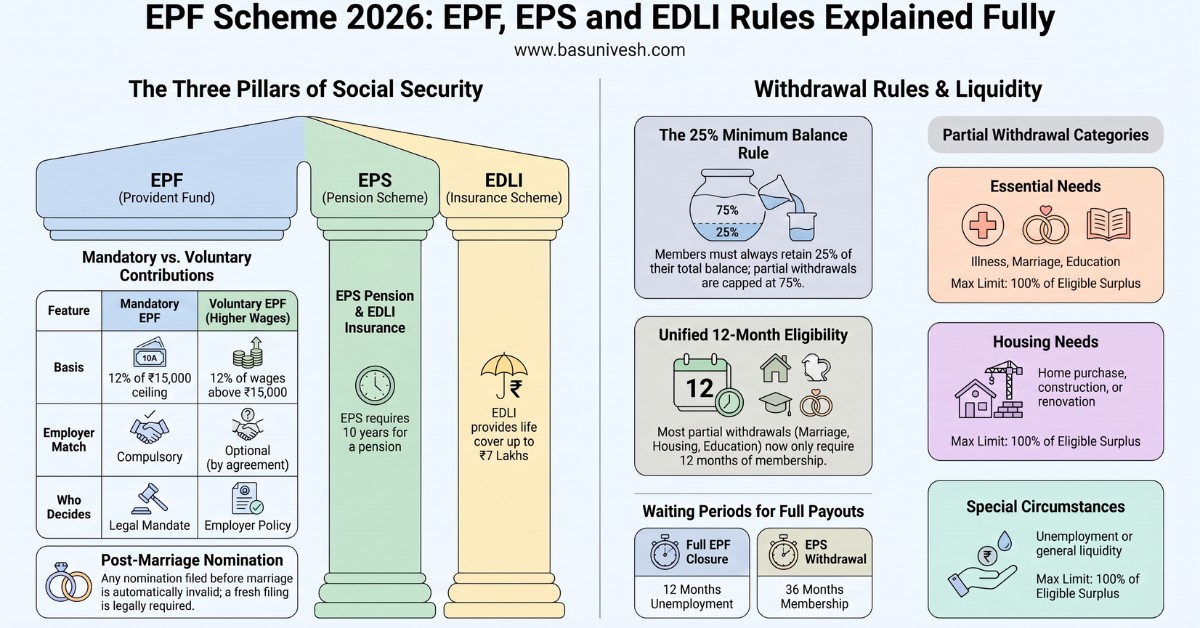
Therefore, after job loss, the EPF full balance is locked for 12 months (with partial withdrawal options earlier), while the EPS lump sum benefit, if applicable, is locked for 36 months. These are two distinct timelines operating independently.
Pension Claim Accountability
Para 17 of the EPS Scheme 2026 mirrors the accountability provision in the EPF Scheme, ensuring timely processing of claims. A complete pension claim must be settled within 20 days of receipt. Any deficiencies must be communicated to the applicant within the same timeframe. Failure by the Commissioner to settle a complete claim within 20 days without sufficient cause will attract penal interest at 12% per annum, recoverable from the Commissioner’s salary.
EDLI 2026: Enhanced Life Insurance Cover Formula
The Employees’ Deposit-Linked Insurance Scheme (EDLI) provides a life insurance-style payout to the families of EPF members in the event of their death while in service. This benefit is entirely funded by the employer at no cost to the employee. The EDLI Scheme 2026 introduces a more precise formula for calculating this payout, as detailed in Para 21.
The Base Benefit Calculation
The base EDLI benefit is calculated based on the average balance in the EPF account over the preceding 12 months, or the entire membership period if shorter. The payout is 50% of this average balance, capped at ₹1,00,000. A further 20% bonus is added specifically to this base benefit calculation.
The Enhanced Benefit for Continuous Service
For members in continuous employment for a full 12 months immediately preceding their death, a more generous formula applies. This involves multiplying the average monthly wages (capped at the notified wage ceiling) by 35, and adding 50% of the average EPF balance. The wage-linked component of this combined calculation is capped at ₹1,75,000. The EDLI Scheme guarantees that the total benefit under this enhanced formula will be no less than ₹2,50,000 and no more than ₹7,00,000. The family receives whichever is higher between this enhanced figure and the base benefit.
It is important to note that the 20% bonus applies only to the base benefit calculation and does not stack on top of the enhanced wage-linked formula. In cases of death within six months of the last contribution while still on the employer’s rolls, the family still qualifies for the assurance benefit, meaning a short recent gap in contributions does not necessarily disqualify the claim.
Nomination and Claims: Unified Process
A significant procedural update is that a separate nomination for EDLI is no longer required. The nomination filed for the EPF account automatically extends to the EDLI payout. This simplifies the process and underscores the importance of keeping EPF nominations current. EDLI claims adhere to the same 20-day settlement standard with a 12% penal interest for delays, ensuring uniform accountability across all three schemes.
Nomination Updates: A Critical Requirement Post-Marriage
One of the most crucial and potentially impactful changes under the EPF Scheme 2026 relates to nominations. Any nomination made before marriage is automatically rendered invalid the moment the individual marries. A fresh nomination is mandatory after marriage. This rule extends to the EDLI payout, making it imperative to keep nominations updated.
While the scheme does not mandate nominating a spouse specifically, it requires filing a new nomination. In the unfortunate event of a member’s death, an outdated or missing nomination can lead to significant delays and complications for the family in claiming EPF, EPS, and EDLI benefits. If an individual currently has no family, they can nominate any eligible person, but they must file a fresh nomination as soon as they acquire a family, whether through marriage or other means. Subscribers are strongly urged to log into the EPFO Unified Member Portal and utilize the e-Nomination facility to review and update their nominee details, especially if they have recently married, had a child, or experienced a family member’s death.
Digital Compliance and Record Keeping: Your Responsibility
The 2026 schemes emphasize digital compliance, pushing for greater efficiency and transparency. Subscribers must ensure their Aadhaar, PAN, and bank account details are accurately linked and KYC-verified against their UAN. Employers are now mandated to upload monthly electronic returns within 15 days of the month’s end. All claims, whether for withdrawal, advance, or transfer, are expected to be filed electronically through the designated portal. Incomplete or inaccurate digital records are a primary cause of claim delays, and maintaining correct KYC details is now squarely the subscriber’s responsibility.
Inoperative Accounts: Preventing Idle Funds
EPF accumulations become payable upon retirement after age 55, permanent migration abroad, or the member’s death. If no withdrawal claim is filed within 36 months of the amount becoming due, the account is marked "inoperative." Inoperative accounts cease to earn further interest. Therefore, individuals or families with dormant EPF accounts, especially after leaving India or following a family member’s demise, should prioritize filing their claims without delay to prevent their funds from lying idle and losing out on potential interest accrual.
Your Action Checklist: Navigating the New Schemes
To ensure a smooth transition and maximize the benefits of the EPF Scheme 2026 and its allied schemes, subscribers should take the following proactive steps:
- Verify Your KYC Details: Log in to the EPFO Unified Member Portal and ensure your Aadhaar, PAN, and bank account details are correctly linked and updated.
- Update Your Nomination: If you are married, have recently married, or have had significant family changes, update your e-Nomination on the EPFO portal. This is crucial for both EPF and EDLI benefits.
- Understand Your Employer’s Policy: Clarify your HR department’s stance on voluntary EPF contributions on higher wages.
- Review Withdrawal Scenarios: Familiarize yourself with the three broad categories for partial withdrawals and the 12-month membership requirement.
- Know Your Pension Rights: Understand the distinction between EPF withdrawal and EPS withdrawal benefits, especially the longer 36-month wait for the EPS lump sum.
- Stay Informed: Regularly check the EPFO website for any further circulars or clarifications.
Bottom Line: A Procedural Upgrade, Not a Revolution
The EPF Scheme 2026, alongside the EPS Scheme 2026 and EDLI Scheme 2026, represents a significant procedural and administrative upgrade rather than a fundamental revolution in retirement savings. Contribution rates, the wage ceiling, interest rates, pension formulas, and tax benefits remain largely unchanged. The core advancements lie in the simplification of EPF withdrawal categories, the introduction of a uniform 12-month eligibility period, the protective 25% minimum balance rule, longer waiting periods for full EPF and EPS settlements post-job loss, a precisely defined EDLI payout formula, mandatory accountability timelines for EPFO, and the dual-duty requirement for nominations.
These changes, when understood correctly, should not cause alarm. Instead, they necessitate a more engaged approach from subscribers. The era of passive PF holding is over. By actively verifying details, understanding withdrawal categories, and keeping nominations current, individuals can ensure their EPF and EPS corpus grows effectively for retirement, while the EDLI cover provides a vital safety net for their families. The emphasis is now on informed participation to ensure these essential social security schemes function optimally for every member.
Frequently Asked Questions
Q1: Has the EPF contribution rate changed under the EPF Scheme 2026?
A1: No. The mandatory contribution remains 12% of wages from both employee and employer, calculated on the statutory wage ceiling of ₹15,000, unless both parties mutually agree to continue contributing on higher wages.
Q2: Is my PF now limited to ₹1,800 per month?
A2: No. ₹1,800 represents only the mandatory minimum contribution based on the current wage ceiling. Higher contributions can continue if your employer agrees, though this is no longer automatic and depends on company policy.
Q3: How long do I have to wait to fully withdraw my EPF after losing my job?
A3: As per Para 49 of the gazetted EPF Scheme 2026, complete closure of your account outside of retirement, incapacity, or migration requires 12 months of continuous non-employment. However, you can access up to 75% of your balance almost immediately through a partial withdrawal under the "Special Circumstances" category (Para 46), which explicitly covers unemployment.
Q4: Is the waiting period the same for my EPS pension amount?
A4: No. EPS withdrawal (applicable only if your EPS service is under 10 years) requires 36 months from the date your last contribution was due, or superannuation, whichever is earlier. If your EPS service has crossed 10 years, you cannot withdraw it as a lump sum at all and must wait until age 58 for a monthly pension.
Q5: Do I need 5 years of service to withdraw for marriage or a house?
A5: No, not anymore. The EPF Scheme 2026 has introduced a uniform 12-month minimum membership requirement for most partial withdrawal categories.
Q6: Is it mandatory to nominate my spouse after marriage?
A6: No, it is not mandatory to nominate your spouse specifically. However, it is mandatory to file a fresh nomination after marriage, as any nomination made before marriage is automatically treated as invalid. This same nomination also determines who receives your EDLI insurance payout.
Q7: How much is the EDLI insurance benefit for my family?
A7: The base benefit is ₹50,000, rising to ₹50,000 plus 40% of your average balance above that, capped at ₹1,00,000, plus a 20% bonus on this base figure. If you had 12 months of continuous service before death, an enhanced formula applies instead, guaranteed to be between ₹2,50,000 and ₹7,00,000 (the 20% bonus does not apply to this enhanced figure). Your family receives whichever of the two calculations is higher.
Q8: Has the EPF or EPS interest and pension formula changed?
A8: No. The EPF interest rate framework and the EPS pension formula (Pensionable Wages multiplied by Pensionable Service, divided by 70) both remain unchanged. Any future revision will happen through separate EPFO announcements, exactly as before.