The allure of compounding is a siren song for investors, promising exponential growth and the realization of ambitious financial dreams. Yet, lurking in the shadows is its insidious counterpart: negative compounding. This silent saboteur, often invisible in its daily manifestations, can systematically erode a significant portion of your hard-earned wealth, transforming a promising financial trajectory into a story of missed opportunities. This in-depth analysis reveals how seemingly minor financial leaks, accumulating over time, can result in a staggering loss, often exceeding 30% of your final investment corpus, and outlines crucial strategies to safeguard your financial future.
The Compounding Mirage and the Shadow of Loss
The power of compounding is a cornerstone of long-term wealth creation. Financial advisors and media alike frequently highlight the transformative potential of even modest initial investments, illustrating how a sum like ₹10 lakh, through consistent growth, can blossom into ₹1 crore over two decades. This narrative, while inspiring and often true, paints only half the picture. It basks in the spotlight of positive returns, neglecting the equally potent, albeit destructive, force of negative compounding.
Negative compounding operates on the same mathematical principles as its benevolent twin, but with a devastating inversion. Instead of amplifying gains, it relentlessly shrinks capital. While positive compounding quietly builds your nest egg, negative compounding stealthily siphons it away, year after year, often without raising immediate alarm. The final outcome is not a triumphant ascent to your financial goals, but a disappointing shortfall, a testament to the silent erosion of wealth.
The Stark Reality: A ₹30 Lakh Disappearance
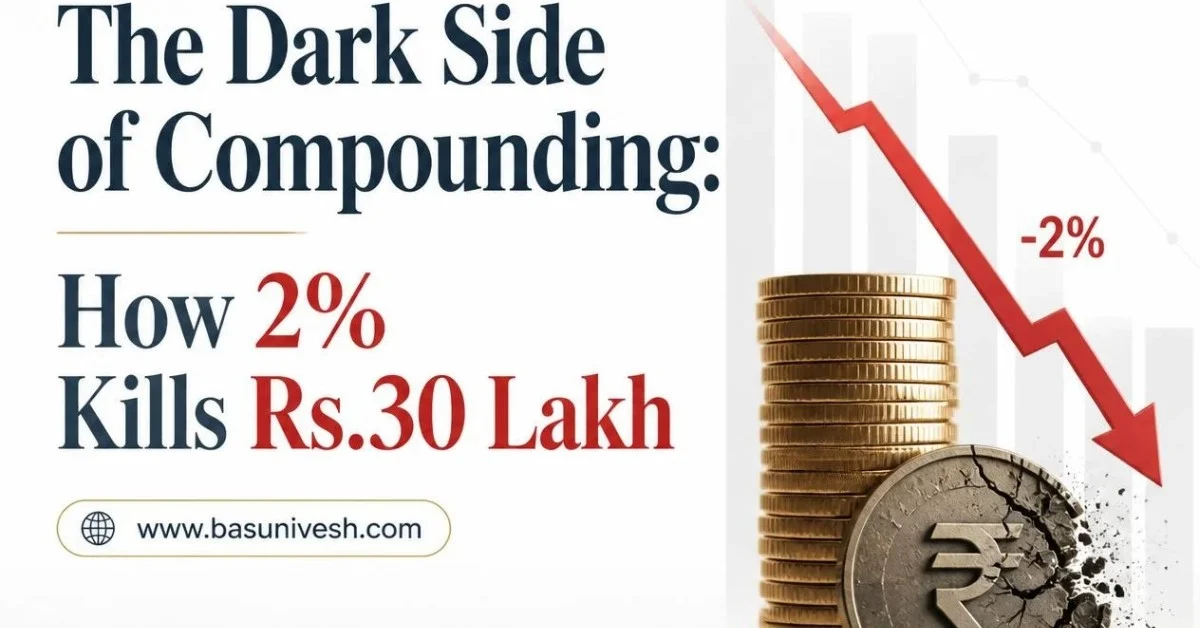
Consider a straightforward yet illustrative scenario: an investor commits ₹10 lakh to an investment for a period of 20 years. The only variable introduced is a seemingly minor difference in the annual rate of return – a mere 2%. This minuscule gap, often overlooked in the initial excitement of investment planning, carries a catastrophic consequence.
Scenario A: A 10% Annual Return
If this ₹10 lakh investment grows at a consistent 10% per annum for 20 years, the final corpus would be approximately ₹67,275,000 ( ₹6.72 crore).
Scenario B: A 8% Annual Return (a 2% deficit)
However, if the same ₹10 lakh investment, under identical conditions, yields a mere 8% per annum for the same 20-year period, the final corpus shrinks dramatically to approximately ₹43,179,000 ( ₹4.31 crore).
The difference between these two scenarios is not a trivial 2% of the final amount. Instead, it represents a staggering loss of approximately ₹24,096,000 (nearly ₹2.4 crore). This is a loss of nearly 30% of the potential final corpus. This stark illustration underscores a critical principle: negative compounding punishes even the smallest of errors with the same ferocity that positive compounding rewards minor advantages. The impact is not linear; it is exponential, and its effects become profoundly pronounced over extended investment horizons.
Tracing the Leaks: Where Does the Wealth Disappear?
The ₹30 lakh, or in our more detailed example, the ₹2.4 crore, does not vanish in a single catastrophic event like a market crash. Instead, it is systematically drained through a series of seemingly insignificant financial decisions and expenses that accumulate over time. These are the "hidden leaks" that quietly deplete your investment’s potential.
The Cumulative Impact of Expenses and Fees
- High Management Fees: Investment funds, whether mutual funds or other managed products, typically charge annual management fees. A difference of even 0.5% to 1% in these fees can have a profound impact over decades. For instance, a fund with a 2% annual expense ratio will significantly underperform a similar fund with a 1% expense ratio over 20 years, due to the compounding effect of these fees.
- Transaction Costs: Frequent buying and selling of investments, driven by market timing attempts or portfolio churn, incur brokerage fees, stamp duties, and other transaction charges. These seemingly small costs, when aggregated over numerous transactions, can eat into returns.
- Advisory Fees and Commissions: While professional advice is invaluable, opaque fee structures or commission-based sales can add to the cost of investing. Hidden commissions paid to intermediaries can effectively reduce the net return an investor receives.
- Tax Inefficiencies: Poor tax planning can lead to higher tax liabilities on investment gains. Holding investments in tax-inefficient structures or making ill-timed sales can result in a substantial portion of returns being surrendered to taxes.
- Inflationary Erosion: While not a direct "leak" in the sense of fees, the erosion of purchasing power due to inflation is a form of negative compounding. If investment returns consistently lag behind inflation, the real value of your wealth diminishes over time, even if the nominal value appears to be growing.
Individually, each of these expenses might seem negligible – a rounding error in the grand scheme of your investment. However, when compounded over 20 or 30 years, their collective impact becomes substantial, acting as a constant drag on your returns and significantly reducing your final wealth accumulation.
Beyond Chasing Returns: The Imperative of Cost Control
The prevailing narrative in investment circles often emphasizes the pursuit of higher returns. Investors are constantly encouraged to seek out the "next big thing" or the "best performing fund" to maximize their gains. While chasing alpha is a natural inclination, the uncomfortable truth is that investors have limited control over whether the market delivers 12% or 15% returns in any given year. Market performance is inherently volatile and largely unpredictable.
However, investors possess almost complete control over another critical aspect of wealth creation: minimizing the leaks that drain their capital. This control extends to:
- Choosing low-cost investment vehicles: Opting for index funds or ETFs with minimal expense ratios over actively managed funds with higher fees.
- Minimizing transaction frequency: Adopting a buy-and-hold strategy and avoiding speculative trading to reduce brokerage and other transaction costs.
- Seeking transparent fee structures: Understanding all advisory fees and commissions upfront and opting for fee-only advisors where possible.
- Implementing tax-efficient investment strategies: Utilizing tax-advantaged accounts and planning investments to minimize tax liabilities.
- Staying ahead of inflation: Ensuring investment returns consistently outpace the rate of inflation to preserve purchasing power.
Wealth creation is not solely an offensive game of seeking high returns; it is equally a defensive strategy of eliminating the mistakes that compound against you. While many investors focus exclusively on the offensive aspects, neglecting the defensive measures leaves them vulnerable to the silent erosion of their wealth.
The Long Game: Understanding the True Cost of Neglect
Negative compounding is a patient adversary. It does not manifest as a dramatic market crash that immediately alarms investors. Instead, its impact is felt years, even decades, down the line. It reveals itself not in the volatile fluctuations of daily market reports, but in the stark difference between the retirement you envisioned and the reality you are forced to accept.
The market’s performance is a significant factor, but it is not the sole determinant of your financial success. Often, the hidden leaks – the cumulative effect of fees, taxes, and inefficient management – are the true culprits behind a shortfall in wealth accumulation.
Therefore, the most profound lesson for any investor is to shift their focus. The next time you are presented with a compelling illustration of how an investment can grow exponentially, pause and ask yourself a crucial question: "What is my 2% leak, and how can I effectively plug it?"
An honest and thorough self-assessment of your investment costs and inefficiencies is far more valuable than perpetually chasing an elusive extra 1-2% in returns. By actively addressing and mitigating these silent wealth eroders, you can safeguard your financial future and ensure that the power of compounding works unequivocally in your favor, not against you.
Further Exploration: Understanding the Compounding Effect
To deepen your understanding of how compounding, both positive and negative, shapes your financial journey, we encourage you to explore our previous articles that delve into this crucial concept:
- [Link to Article 1: The Magic of Compounding Explained]
- [Link to Article 2: Harnessing Compounding for Long-Term Wealth]
- [Link to Article 3: Avoiding the Pitfalls of Investment Costs]
Our Commitment to Unbiased Financial Guidance
At [Your Organization Name], we are dedicated to providing transparent and unbiased financial advice. We believe that informed decision-making is the bedrock of successful wealth management.
Subscribe to our Fixed Fee Only Financial Planning Service:
For personalized, objective guidance that prioritizes your financial well-being, we invite you to subscribe to our fixed fee-only financial planning service. This model ensures that our advice is solely focused on your best interests, free from the conflicts of interest often associated with commission-based advisory services.
Explore Our YouTube Channels for Unbiased Insights:
Stay informed and empowered with our regular content on our YouTube channels, where we provide in-depth analysis, practical tips, and unbiased perspectives on a wide range of financial topics.
- [Link to YouTube Channel 1]
- [Link to YouTube Channel 2]