
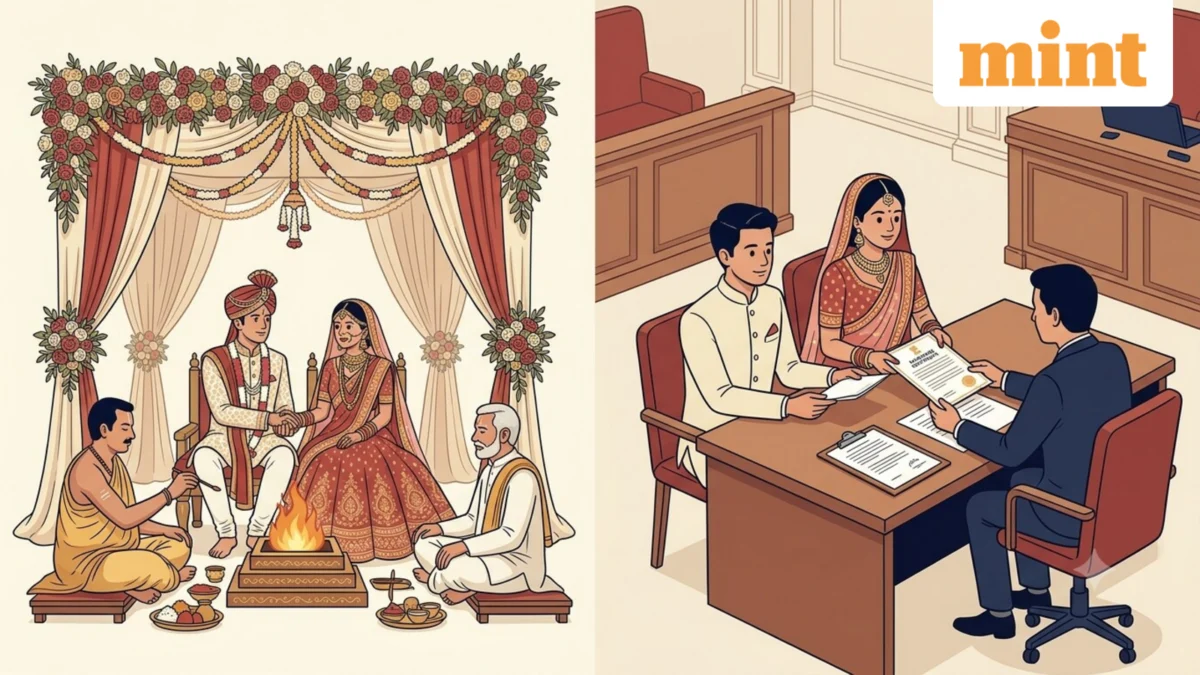
In the diverse tapestry of Indian society, marriage is often viewed as a sacred union—a confluence of traditions, rituals, and familial blessings. For millions, the exchange of vows under a canopy or the lighting of a holy fire marks the beginning of a lifelong commitment. However, in the eyes of the law, the transition from a social union to a legally recognized partnership requires more than just customary performance.
As modern life grows increasingly complex, the question often arises: If you have married according to religious customs but have not registered your marriage, does your union hold legal validity? The answer is nuanced, sitting at the intersection of personal law, judicial directives, and administrative necessity.
The Legal Status of Unregistered Marriages
It is a common misconception that a marriage certificate is the sole determinant of a marriage’s validity in India. To clarify: Marriage registration is not mandatory for a marriage to be considered valid. If a couple has solemnized their marriage through the essential rites and ceremonies required by their personal law (such as the Hindu Marriage Act, 1955), the marriage is legally binding from the moment those rituals are completed.
However, "validity" and "legal convenience" are two distinct concepts. While the absence of a registration certificate does not render a marriage void, it can create significant hurdles in navigating the bureaucratic requirements of modern life.
The Legislative Framework
The legal governance of marriage in India is split between various personal laws. The Hindu Marriage Act, 1955, provides for registration under Section 8, while civil marriages are governed by the Special Marriage Act, 1954. Other communities—including Muslims, Christians, and Parsis—operate under their respective personal law provisions, which often vary in their approach to state registration.
Amitraj Kaushal, an Advocate at the Supreme Court of India, notes that while the law provides a framework for registration, the enforcement and procedural nuances vary significantly across state lines. "State rules differ in terms of procedures, deadlines, and penalties. It is essential for couples to research the specific rules applicable to the state where the marriage was performed, rather than assuming a monolithic national process," he explains.
A Chronology of Judicial Intervention: The Seema v. Ashwani Kumar Mandate
The shift toward encouraging universal registration in India was largely catalyzed by the landmark Supreme Court judgment in Seema v. Ashwani Kumar. In this seminal case, the apex court emphasized the necessity of compulsory registration for all marriages, regardless of the religious community to which the couple belongs.
The court’s rationale was rooted in the protection of women’s rights. By creating an official, public record of a marriage, the state can prevent instances of child marriage, check bigamy, and ensure that women have a definitive legal document to assert their rights to maintenance, inheritance, and succession. Since this judgment, the legal consensus has moved toward treating registration as a vital public policy objective, even if the failure to do so does not retroactively dissolve an otherwise lawful marriage.
Why Registration Is More Than a Mere Formality
While not legally required to validate the union, experts emphasize that registration acts as a robust legal safeguard. Siddharth Maurya, Founder and Managing Director of Vibhavangal Anukulkara, asserts that viewing registration as a "mere formality" is a critical oversight.
"Marriage registration is an important legal safeguard and must not be considered a formality," Maurya warns. "It is the primary instrument that bridges the gap between a private religious ceremony and the public administrative systems that govern our financial and social lives."
The Practical Implications: Where the Certificate Matters
For couples living in the 21st century, the marriage certificate acts as a "key" that unlocks various administrative doors. The most common areas of impact include:
- Immigration and Visas: For couples planning to move abroad, a marriage certificate is usually the first document requested by embassies. Without it, proving a spousal relationship for visa sponsorship becomes an arduous, often impossible, task.
- Financial and Banking Services: Updating bank accounts, joint investments, and insurance policies often requires a marriage certificate to establish legal beneficiary status.
- Succession and Inheritance: In the event of a spouse’s death, the legal struggle to claim assets can be compounded if there is no documentary proof of marriage. A certificate simplifies the transfer of titles, bank deposits, and family property.
- Pension and Employment Benefits: Many corporate and government pension plans require proof of marriage to list a spouse as a nominee. The absence of a certificate can lead to significant delays in accessing these critical funds.
Addressing Older Marriages and Retrospective Registration
A frequently asked question is whether couples married decades ago can still register their unions. The answer is generally yes. According to Advocate Kaushal, registration is not restricted to marriages performed after a specific year. Older couples can seek to register an already solemnized marriage, provided they adhere to the evidentiary requirements of the relevant state authorities.
However, there is a critical caveat: Retrospective registration is not a "cure-all." If a marriage was fundamentally invalid at the time it was performed—for example, if it violated laws regarding age or prohibited degrees of relationship—registering it later does not validate it. The certificate is a record of a fact, not a mechanism to legalize a prohibited union.
Can a Spouse Deny the Marriage?
One of the most distressing scenarios in family law is the denial of a marriage by one of the parties. If a marriage is not registered, does it mean the other spouse has no legal standing?
"Non-registration does not automatically invalidate a marriage, nor does it mean that a party can simply deny the existence of the union," explains Kaushal. If a dispute arises, courts look for a "preponderance of evidence." This includes:
- Photographic and video evidence of ceremonies.
- Testimony from witnesses who attended the rituals.
- Joint bank accounts or shared property ownership.
- Evidence of cohabitation (often termed a "live-in relationship" in legal parlance if the marriage is contested).
However, the legal burden of proof falls on the person asserting the marriage. Without a certificate, the process is expensive, time-consuming, and emotionally draining. As Siddharth Maurya highlights, the absence of an official record turns a simple administrative process into a complex litigation battle, putting the more vulnerable spouse at a distinct disadvantage.
Conclusion: The Path Toward Protection
The Indian legal system, in its wisdom, acknowledges the sanctity of customary marriages. It does not force registration upon citizens to the extent that an unregistered union is declared "illegal" or "void." However, the message from the legal community is clear: registration is the ultimate safety net.
In a world where legal documentation dictates everything from travel to inheritance, the marriage certificate provides a definitive, unassailable, and universally accepted proof of status. For couples who have married through traditional rites, taking the time to register the union is not just an administrative box to tick; it is a proactive step toward securing one’s future and ensuring that, in the face of any legal challenge, the bond remains protected by the full force of the law.
Disclaimer: The information provided in this article is for general informational purposes only and does not constitute legal advice. Marriage laws, registration procedures, and state-specific rules are subject to change. Readers are strongly advised to consult with a qualified legal professional to discuss their specific circumstances and requirements.