Mumbai, India – [Insert Current Date] – A surge of interest is palpable among Non-Resident Indian (NRI) investors regarding a sophisticated financial instrument: leveraged Foreign Currency Non-Resident (FCNR) deposits. Banks, recognizing this burgeoning interest, are actively engaging with NRI clients, and vice versa, to capitalize on a seemingly opportune window that extends until September 30, 2026. This period is significant as it offers a unique confluence of factors, potentially driving demand for these complex products. However, beneath the surface of amplified returns lies a critical, often overlooked, layer of risk that warrants careful consideration and a thorough understanding of the product’s intricacies.
The Allure of Amplified Returns: Understanding Leveraged FCNR Deposits
At its core, a leveraged FCNR deposit allows an NRI investor to utilize their existing foreign currency funds as collateral to obtain a loan in the same currency. This borrowed amount is then used to create a larger FCNR deposit than would be possible with the initial capital alone. The primary attraction lies in the potential for magnified returns. By leveraging their existing capital, investors can aim to earn higher interest on a larger principal amount, thereby boosting their overall yield.
How Leveraged FCNR Deposits Theoretically Work:
The mechanism typically involves the following steps:
- Initial Deposit: An NRI investor deposits a certain amount of foreign currency (e.g., USD 100,000) into a standard FCNR account.
- Loan Against Deposit: The bank, recognizing the FCNR deposit as a secure asset, offers a loan against this collateral. The loan amount is usually a significant percentage of the deposit value, allowing for leverage. For instance, a bank might offer a loan of USD 75,000 against the USD 100,000 deposit.
- New FCNR Deposit: The borrowed amount (USD 75,000) is then used to open a new, larger FCNR deposit, effectively creating a total deposit of USD 175,000 (USD 100,000 initial + USD 75,000 borrowed).
- Interest Earnings: The interest earned on the entire USD 175,000 deposit is then used to service the interest on the loan taken, with any surplus representing the amplified return on the initial capital. The investor aims for the interest earned on the larger deposit to significantly outweigh the interest paid on the borrowed funds.
This structure is particularly appealing in environments where interest rates are favorable, and the investor has a strong conviction about the future appreciation of the currency in which the deposit is held. The ability to control a larger asset with a smaller initial outlay is a cornerstone of leveraged investment strategies.
The Unspoken Risks: A Morbid Scenario and Capital Erosion
While the prospect of amplified returns is undeniably attractive, the inherent leverage in these products cuts both ways. The potential for enhanced gains is mirrored by an equally significant potential for amplified losses, a crucial aspect that seems to be under-discussed within the current discourse surrounding leveraged FCNR deposits. A stark illustration of this downside risk can be painted through a hypothetical, albeit morbid, scenario:
A Hypothetical Downside Scenario:
Imagine an NRI investor who, with great optimism, decides to leverage their USD 100,000 to create a larger FCNR deposit. They obtain a loan of USD 75,000 from their bank, effectively having a total FCNR deposit of USD 175,000. The bank, in order to offer a fixed interest rate on the FCNR deposit, might have simultaneously entered into an Interest Rate Swap (IRS) agreement in the market. This IRS effectively hedges the bank’s exposure to fluctuating interest rates, allowing them to offer a predictable fixed rate to the depositor.
Now, consider a sharp and unexpected downturn in the market. This could manifest in several ways:
- Currency Devaluation: The currency in which the FCNR deposit is held experiences a significant devaluation against the investor’s home currency or the currency of their primary expenses.
- Interest Rate Volatility: Despite the IRS, unforeseen market shifts could lead to substantial costs associated with unwinding the IRS, particularly if the market moves drastically against the bank’s hedging strategy.
- Economic Shock: A global or regional economic crisis could trigger a flight to safety, leading to a rapid decline in the value of the deposited currency and a simultaneous spike in borrowing costs for the bank.
In such a "corner case," the following could unfold:
- Interest Rate Differential Worsens: The interest rate on the FCNR deposit, which was initially attractive, might become significantly lower than the prevailing market rates for new deposits or, more critically, the cost of borrowing for the bank.
- Unwinding Costs: The bank, facing a mismatch between the fixed rate offered to the depositor and its own increased borrowing costs or the cost of exiting its IRS hedge, may decide to close out the entire leveraged position. The cost of unwinding the IRS, which was entered into to secure the fixed rate for the depositor, can be substantial and might be passed on to the investor.
- Capital Loss: The combined effect of currency depreciation and the costs associated with unwinding hedges or higher borrowing rates could lead to a scenario where the investor’s initial capital is not only eroded but also further diminished.
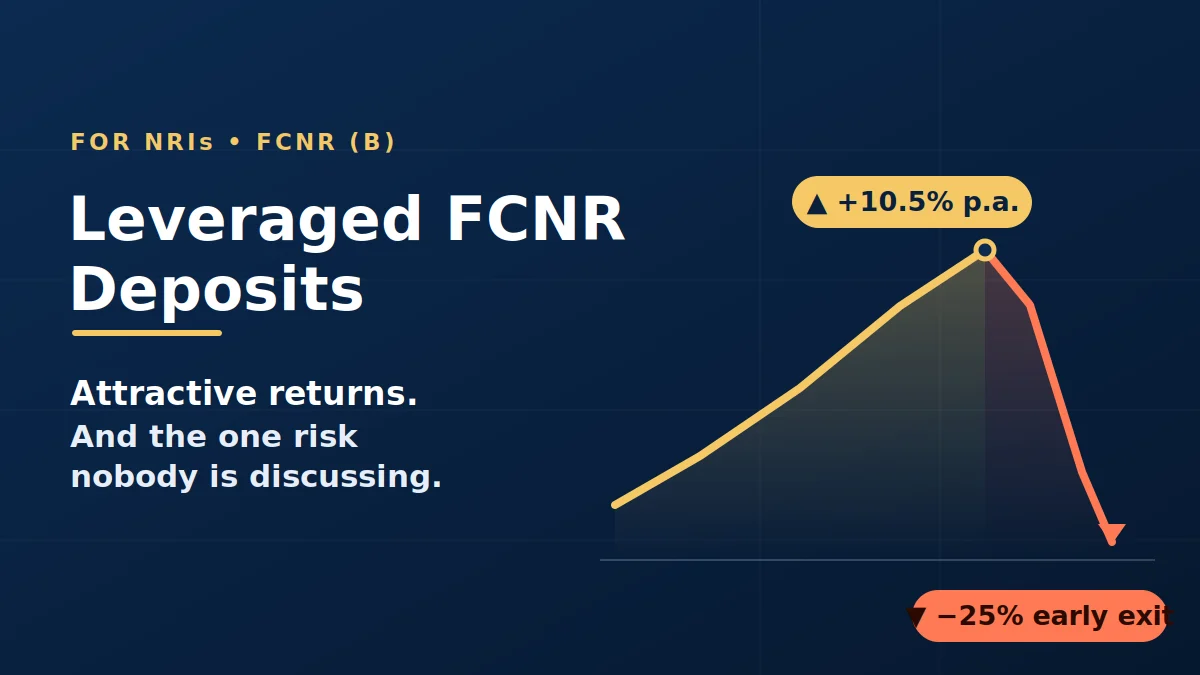
In the illustrative scenario presented, the investor who initially invested USD 100,000 might find themselves receiving only USD 75,000 back. This represents a loss of USD 25,000, or 25% of their initial capital. This is a significant capital erosion, and the situation could be far more dire if the investor had committed a larger sum to such a leveraged strategy. The potential for the bank to pass on the costs of unwinding the interest rate swap further exacerbates this risk.
The Importance of Due Diligence and Transparency
The stark reality of such downside scenarios underscores the critical need for absolute clarity and transparency regarding the potential risks involved in leveraged FCNR deposits. While the allure of amplified returns can be compelling, investors must be acutely aware that leverage magnifies not only gains but also losses.
Key Considerations for Investors:
- Risk Tolerance: Leveraged products are inherently high-risk. Investors must have a robust risk tolerance and a clear understanding of their capacity to absorb potential losses.
- Market Volatility: The performance of these deposits is heavily influenced by currency fluctuations and interest rate movements. Investors need to consider the volatility of the chosen currency and the potential for adverse interest rate shifts.
- Product Structure Complexity: The intricate nature of these products, often involving hedging strategies like Interest Rate Swaps, can make them difficult to fully comprehend. It is imperative for investors to seek detailed explanations from their banks.
- Exit Costs: Understanding the costs associated with unwinding the deposit or the loan in various market conditions is crucial. These exit costs can significantly impact the net returns.
- Bank’s Role and Hedging: Investors should inquire about the bank’s hedging strategies and how potential costs associated with these hedges might be passed on to them.
The author acknowledges that there may be gaps in their understanding of the precise product structures, emphasizing the importance of individual investor due diligence. This serves as a crucial reminder that financial products, especially those involving leverage, are not one-size-fits-all solutions.
Regulatory Landscape and Market Dynamics
The current period, extending until September 30, 2026, suggests a specific market dynamic or a window of opportunity that banks and investors are keen to exploit. This could be driven by favorable interest rate differentials, anticipated currency movements, or specific regulatory frameworks that make these products more attractive.
While specific official responses from regulatory bodies regarding leveraged FCNR deposits are not detailed in the initial content, it is understood that such products fall under the purview of central banks and financial regulators. These entities typically monitor the financial markets to ensure investor protection and market stability. The emphasis on transparency and investor education by financial institutions is a standard expectation from regulators.
The increasing outreach by banks to NRI investors and vice versa indicates a proactive approach to market these instruments. This proactive engagement necessitates a corresponding proactive approach from investors to understand the nuances and potential pitfalls.
Implications for NRI Investors and the Broader Financial Ecosystem
The growing interest in leveraged FCNR deposits highlights several key implications:
- Sophistication of NRI Investment: It signifies a growing appetite among NRIs for more sophisticated financial products that offer the potential for higher returns, moving beyond traditional fixed-income instruments.
- Role of Banks: Banks play a pivotal role in structuring and offering these products. Their due diligence, risk assessment, and clarity in communication with clients are paramount.
- Investor Education Imperative: The complexity of these instruments underscores the urgent need for enhanced investor education. Platforms and institutions must prioritize providing clear, unbiased information about the risks and rewards.
- Market Stability: While individual investors may seek higher returns, the aggregate impact of leveraged products on market stability is a consideration for regulators. Excessive leverage, if unchecked, can amplify market downturns.
- Family Financial Planning: The article rightly points out that decisions made regarding investments have a direct impact on family financial well-being. This emphasizes the need for a holistic approach to financial planning, considering not just potential gains but also the potential for devastating losses.
The author’s concluding remark, urging investors to speak to their banks and understand the behavior of these facilities in edge cases, is a vital call to action. The emphasis on not just worrying about lower returns but about "serious erosion of capital" is a sobering reminder of the stakes involved.
Conclusion: A Call for Prudent Engagement
The excitement surrounding leveraged FCNR deposits is understandable, given the promise of amplified returns. However, as the potential for significant capital erosion in adverse scenarios illustrates, these are not instruments for the faint of heart or for those who have not conducted exhaustive due diligence. NRI investors are strongly advised to approach these products with a healthy dose of skepticism, a commitment to understanding every facet of the deal, and a clear-eyed assessment of their personal risk appetite. The limited window until September 30, 2026, should not be a catalyst for hasty decisions but rather an impetus for thorough research and informed choices, ensuring that the pursuit of higher returns does not jeopardize the financial security of oneself and one’s family.
Disclaimer: Registration granted by SEBI, membership of BASL, and certification from NISM in no way guarantee performance of the intermediary or provide any assurance of returns to investors. Investment in securities market is subject to market risks. Read all the related documents carefully before investing.
This post is for educational purposes alone and is NOT investment advice. This is not a recommendation to invest or NOT invest in any product. The securities, instruments, or indices quoted are for illustration only and are not recommendatory. The author’s views may be biased, and they may choose not to focus on aspects that you consider important. Your financial goals may be different. You may have a different risk profile. You may be in a different life stage than the author. Hence, you must NOT base your investment decisions based on this writing. There is no one-size-fits-all solution in investments. What may be a good investment for certain investors may NOT be good for others. And vice versa. Therefore, read and understand the product terms and conditions and consider your risk profile, requirements, and suitability before investing in any investment product or following an investment approach.