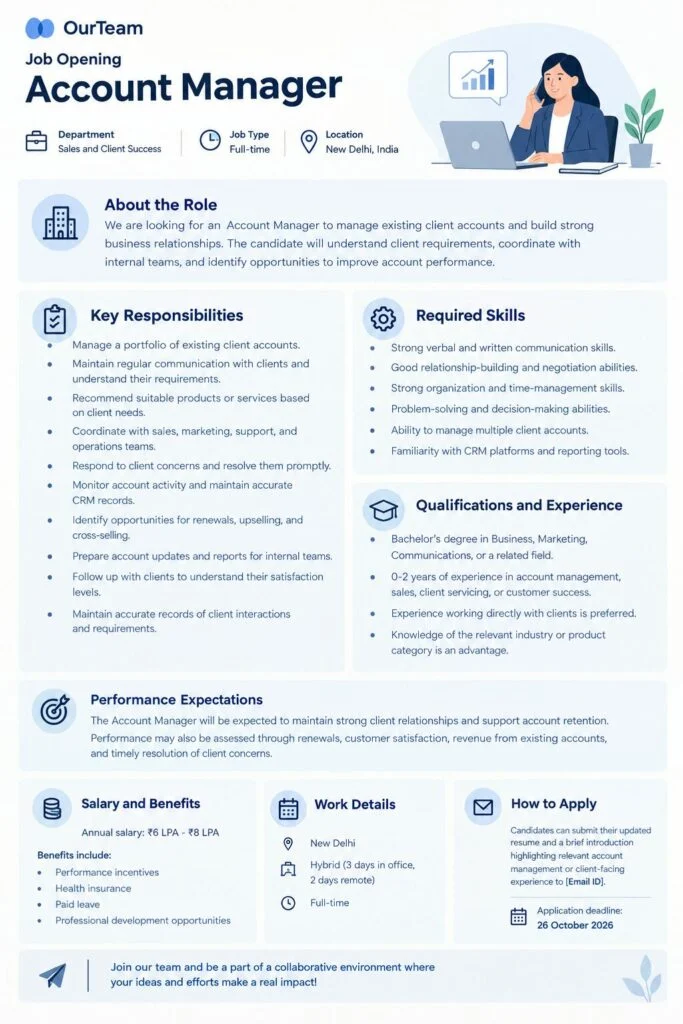
In the modern corporate ecosystem, the Account Manager (AM) serves as the vital bridge between a company’s internal operations and its external client base. They are the architects of long-term loyalty, the guardians of brand reputation, and the primary drivers of sustainable revenue growth. However, finding the right talent for this multifaceted role remains a persistent challenge for hiring managers. A poorly constructed job description often leads to an influx of unqualified applicants, while a precise, well-structured document acts as a filter that attracts high-caliber professionals.
As businesses pivot toward client-centric models, the necessity for a clear, transparent, and comprehensive job description has never been more critical. This guide explores the anatomy of an effective Account Manager job description, providing the tools and insights necessary to streamline your recruitment process.
The Strategic Importance of the Account Manager Role
At its core, an Account Manager is not merely a service provider; they are a strategic partner to the client. The role transcends simple communication—it involves a complex dance of managing expectations, ensuring project alignment, identifying growth opportunities, and resolving conflicts before they escalate.
Core Functionality and Evolution
Historically, account management was viewed as a support function. Today, it is a revenue-generating powerhouse. The role varies significantly depending on the industry. In SaaS (Software as a Service), an AM might focus on technical adoption and renewals; in advertising, they are tasked with creative strategy and campaign performance. Despite these variations, the fundamental requirement remains constant: the ability to foster trust while delivering measurable value to both the client and the employer.
Anatomy of a High-Impact Job Description
A job description serves as the first point of contact between a candidate and your organization. It is a marketing tool that must simultaneously sell the company culture and define the professional rigor expected.

i. The Strategic Job Title
Your title should be specific. Rather than a generic "Account Manager," consider titles that denote the scope, such as "Enterprise Account Manager," "Key Account Manager," or "Technical Account Manager." Specificity reduces the volume of irrelevant applications and ensures that the candidates who do apply have the relevant background.
ii. The Executive Summary
The summary should be a "hook." In two to three sentences, encapsulate the company’s mission, the specific portfolio the candidate will manage, and the primary goal of the position. Avoid corporate jargon; focus on the impact the individual will have on the company’s trajectory.
iii. Key Responsibilities: Defining the Workflow
When listing responsibilities, focus on outcomes rather than tasks.
- Instead of: "Checking in with clients."
- Use: "Cultivating proactive, long-term relationships to drive account retention and identify expansion opportunities."
Key responsibilities should span relationship building, internal cross-functional collaboration, crisis resolution, and data-driven reporting.
iv. Required Skills and Competencies
The ideal Account Manager possesses a blend of "hard" and "soft" skills. Highlight the following:

- Emotional Intelligence (EQ): The ability to read a client’s mood and navigate difficult negotiations.
- Technical Proficiency: Fluency in CRM tools (e.g., Salesforce, HubSpot) is non-negotiable in the modern digital workplace.
- Analytical Thinking: The capacity to translate account data into actionable insights for the internal team.
v. Qualifications: Distinguishing "Must-Haves" from "Nice-to-Haves"
To avoid excluding top talent, clearly delineate between mandatory experience (e.g., "3+ years in B2B sales") and preferred qualifications (e.g., "Industry-specific certifications"). This transparency helps candidates self-select accurately.
Practical Template: The Gold Standard
To standardize your hiring process, use the following framework. It is designed to be modular and scalable for various company sizes.
[Company Name] – Account Manager Job Description
- Job Summary: A concise paragraph detailing the position’s impact on company revenue and client success.
- Responsibilities:
- Serve as the primary point of contact for a portfolio of [Number] accounts.
- Collaborate with Product and Marketing teams to ensure client feedback drives product development.
- Monitor KPIs and deliver quarterly business reviews (QBRs).
- Requirements: Bachelor’s degree, demonstrated experience in account growth, and mastery of CRM software.
- Compensation and Benefits: Transparent salary ranges and a detailed overview of perks, including remote work flexibility and professional development budgets.
Data-Driven Hiring: Salary Benchmarks and Market Trends
Hiring is a financial investment. Understanding the market rate for an Account Manager is essential for maintaining competitiveness. Based on current industry data, compensation structures are generally segmented by experience level:
| Experience Level | Average Salary Range (Annual) |
|---|---|
| Entry Level (0–1 Year) | ₹3.9 LPA – ₹5.4 LPA |
| Intermediate (2–5 Years) | ₹6.2 LPA – ₹7.8 LPA |
| Senior/Experienced (5+ Years) | ₹7.9 LPA – ₹10.2 LPA |
Note: These figures are indicative and vary by region, industry sector, and the complexity of the account portfolio (e.g., Enterprise vs. SMB).

Official Insights: The Role of Performance Targets
Many employers ask if including performance targets in a job description is advisable. The industry consensus is an emphatic "Yes." By outlining KPIs (Key Performance Indicators) such as net retention rates, customer satisfaction scores (CSAT), and upsell targets, you provide the candidate with a roadmap for success.
Expert Perspective: "Candidates who are top-performers actually prefer seeing performance targets. It shows them that the company has a clear structure for success and that they will be rewarded for their results rather than just their time spent in the office," notes a lead hiring consultant in the tech sector.
Implications of a Well-Drafted Job Description
The ripple effects of a precise job description are profound.
- Reduced Time-to-Hire: By accurately describing the role, you filter out unqualified candidates during the application stage, allowing HR teams to focus on high-potential leads.
- Higher Retention Rates: When a candidate knows exactly what the role entails—including the challenges—they are less likely to experience "role shock," which leads to higher long-term employee satisfaction.
- Employer Branding: A polished, professional job description signals to the market that your company is organized, transparent, and values its employees. It sets the tone for the entire candidate experience.
Conclusion: Crafting the Future of Your Team
The Account Manager is the lifeblood of a sustainable business. By investing time in crafting a job description that is both transparent and aspirational, you do more than just fill a vacancy; you set the foundation for a successful client-company relationship.
Use the provided templates and data as a baseline, but remember to infuse them with your company’s unique culture and values. A great job description is a living document—one that evolves as your business grows and as the needs of your clients change. For those seeking to further refine their process, focusing on inclusive language and clear, measurable expectations will consistently yield the highest quality candidates in an increasingly competitive talent market.

Frequently Asked Questions
Q: Should I include travel requirements in the JD?
A: Absolutely. If the role requires on-site client visits, this must be stated clearly, as it is a significant factor in the work-life balance for prospective employees.
Q: How do I handle remote/hybrid work policies?
A: Be specific. If you are a hybrid company, state the number of mandatory office days. Transparency here prevents attrition later in the hiring cycle.
Q: Can an Account Manager be purely administrative?
A: While some administrative tasks are involved, a high-performing Account Manager role is inherently proactive. If the role is purely administrative, consider titles like "Account Coordinator" to better reflect the scope of the position.