
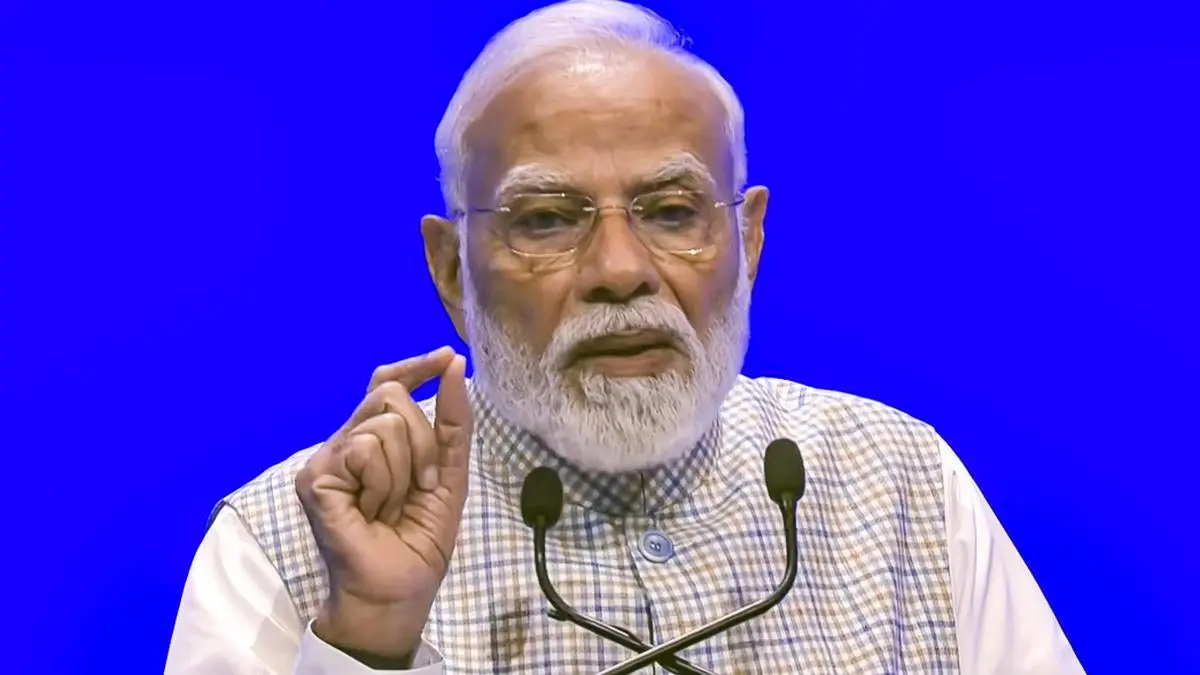
NEW DELHI – In a clarion call for global digital governance, Prime Minister Narendra Modi inaugurated the 10th edition of the India Mobile Congress (IMC) 2026 on Thursday, setting a decisive tone for the future of connectivity. Under the theme "Scale Without Boundaries," the event served as a platform for India to assert its leadership in the global telecommunications ecosystem, while simultaneously sounding the alarm on the escalating risks of transnational cybercrime.
As the nation charts an ambitious course toward 6G dominance, the Prime Minister emphasized that the true measure of technological success lies not merely in the velocity of data, but in the integrity of the digital architecture and the security of the citizens it serves.
The Call for a Global Cyber-Security Framework
The centerpiece of Prime Minister Modi’s address was a pragmatic appeal to the global community to address the "borderless" nature of modern digital fraud. Speaking to a gathering of international delegates, policy-makers, and industry titans, the Prime Minister highlighted the alarming ease with which bad actors operate across jurisdictions.
"A person sitting in one country, with the help of an accomplice in another, can perpetrate a sophisticated crime against a citizen in a third," Modi noted, underscoring the inadequacy of localized laws in a hyper-connected age. The Prime Minister specifically identified the proliferation of deepfakes and AI-driven impersonation as a critical threat to social stability and economic trust.
A Plea to Global Stakeholders
Addressing the GSMA and international telecom conglomerates, Modi urged for the creation of a unified global mechanism. The proposal seeks to establish proactive defensive layers that intercept fraudulent communications and digital attacks before they reach end-users.
"Technology can achieve scale only when it gains people’s trust," the Prime Minister stated. "India has learned significant lessons through its own journey in digitizing public services, and we are ready to share these experiences—and our technological frameworks—with the rest of the world to build a safer digital commons."
Chronology: A Decade of Telecom Transformation
The 10th edition of the IMC stands as a testament to India’s meteoric rise in the global telecommunications sector. To understand the current momentum, it is essential to view the last decade of policy shifts and infrastructure development:
- 2016–2018 (The Foundation): The launch of aggressive, low-cost data policies transformed India into the world’s largest data-consuming nation, laying the groundwork for widespread digital adoption.
- 2019–2021 (The Pandemic Pivot): Digital infrastructure proved to be the backbone of the economy during global lockdowns. The government fast-tracked fiber-to-the-home (FTTH) initiatives and began planning the indigenous 5G roadmap.
- 2022 (The 5G Leap): The official rollout of 5G services placed India on the global map for rapid deployment, with major telcos reaching urban centers in record time.
- 2023–2025 (Indigenous Innovation): Focus shifted toward "Make in India" hardware, increasing the domestic manufacturing of telecom equipment and reducing reliance on foreign supply chains.
- 2026 (The Visionary Milestone): At the 10th IMC, the discourse moved from mere adoption to global standard-setting, with a specific focus on 6G research and international cyber-governance.
Supporting Data: The 5G and 6G Trajectory
Telecom Minister Jyotiraditya Scindia complemented the Prime Minister’s vision with a roadmap for the next four years. The Ministry’s data reveals a clear trajectory toward total digital saturation.
5G: The Road to One Billion
As of October 2026, India boasts 550 million 5G users. The Ministry of Communications has set a bold target to nearly double this figure, aiming for one billion 5G subscribers by 2030. This expansion is expected to be driven by the proliferation of affordable 5G-enabled devices and the expansion of coverage into Tier-2 and Tier-3 cities.
The 6G Ambition: Patenting the Future
Perhaps the most significant revelation from Minister Scindia was the status of India’s 6G readiness. The Bharat 6G Alliance, a consortium comprising 90 institutions, has already established a footprint in global intellectual property.
- Total Patents Filed: 7,700
- International Patents: 4,400
- Strategic Stance: Unlike the 4G era, where India remained a follower, and the 5G era, where India moved in lockstep with global leaders, the current strategy is to become a primary contributor to 6G standards.
"We were behind the world in 4G. We marched with the world on 5G. But it is our resolve that we will lead the world on 6G," Scindia asserted. This shift indicates a transition from a consumer-led market to an innovation-led power.

Official Responses and Industry Perspectives
Industry leaders at the IMC 2026 welcomed the Prime Minister’s call for a global security framework. Many CEOs acknowledged that while digital fraud is a universal problem, the lack of standardized cross-border cooperation is the greatest obstacle to resolution.
Global industry bodies, including representatives from the GSMA, expressed interest in India’s model of "Digital Public Infrastructure" (DPI). The Indian government’s success in implementing platforms like UPI (Unified Payments Interface) has provided a blueprint for secure, high-scale, and interoperable digital systems that minimize the risk of fraud.
Cybersecurity analysts noted that while the goal of a "global mechanism" is ambitious, it aligns with current trends in international diplomacy, where digital sovereignty is increasingly being discussed at G20 and Quad-level forums.
Implications: A New Era of Digital Sovereignty
The implications of the announcements made at IMC 2026 are profound, both domestically and internationally.
For the Domestic Economy
By targeting one billion 5G users, India is effectively creating a massive, high-speed digital economy that can support advanced applications like autonomous logistics, real-time remote healthcare, and immersive education. The scale of this user base provides a unique advantage for domestic startups to test and refine AI-driven products.
For Global Geopolitics
India’s insistence on a global cyber-security pact signals a departure from a passive role in international tech governance. By positioning itself as a leader in 6G patents and a provider of secure digital frameworks, India is signaling that it intends to influence the rules of the road for the next generation of the internet.
The Challenge Ahead
The primary challenge remains the implementation of these goals. Coordinating a global mechanism for cyber-crime prevention requires diplomatic heavy lifting and the willingness of nations to share sensitive intelligence and adhere to common standards. Furthermore, the rapid transition to 6G requires sustained investment in R&D and a steady supply of high-end semiconductor chips and rare-earth materials, which remain a point of global supply chain vulnerability.
Conclusion
As the curtains rise on the next chapter of the digital age, the 10th India Mobile Congress has served as a decisive waypoint. Under the theme "Scale Without Boundaries," India is no longer asking to be included in the global technology conversation—it is actively steering it.
With a clear roadmap toward a billion-strong 5G network and a concerted effort to patent the future of 6G, the country is signaling to the world that it is ready to shoulder the responsibilities of a global leader. However, as Prime Minister Modi wisely noted, this technological progress is hollow without the foundation of trust. By calling for a global framework to combat digital fraud, India is asserting that the future of connectivity must be as secure as it is swift, and as ethical as it is expansive.
The path to 2030 is clear: India intends to lead not just by the size of its market, but by the strength of its innovation and the integrity of its digital borders.