In the modern corporate ecosystem, data is the new currency. With approximately 62% of Indian finance leaders identifying strategic planning and high-level decision support as their primary organizational mandates, the demand for precise, actionable financial intelligence has never been higher. Yet, for many aspiring finance professionals and business students, the lines between "Cost Accounting" and "Management Accounting" often blur. While both disciplines are vital to a firm’s health, they function as different gears in the same machine. Understanding these nuances is not just an academic exercise—it is a prerequisite for navigating a career in modern finance.
The Strategic Imperative: Why Accounting Matters
Businesses operate under constant pressure to optimize margins and streamline operations. To achieve this, leadership relies on financial accounting—which serves external stakeholders—and two specialized internal disciplines: cost and management accounting.
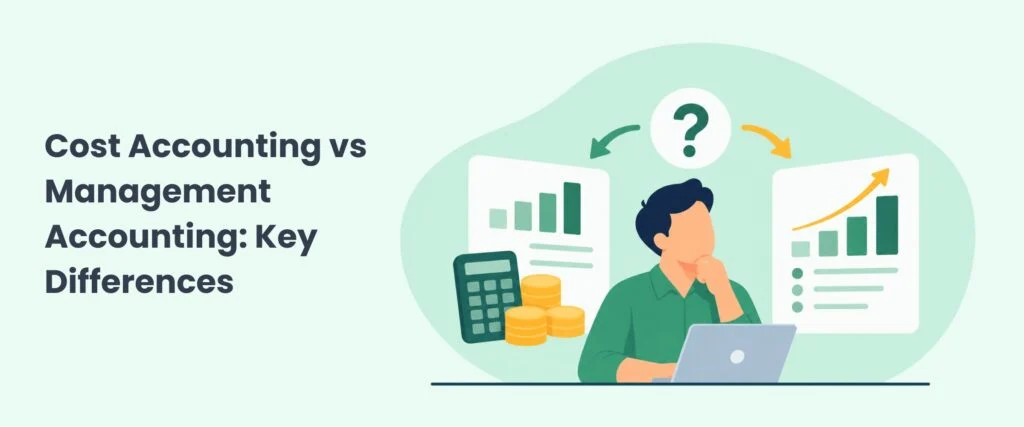
Cost accounting acts as the microscope, zooming in on the granular details of production and resource consumption. Management accounting acts as the telescope, looking at the wider horizon to forecast trends, allocate capital, and drive long-term strategy. Mastery of these fields allows professionals to transform raw numbers into a roadmap for growth.
1. Defining the Disciplines
What is Cost Accounting?
At its core, cost accounting is the systematic process of identifying, measuring, and analyzing the costs associated with producing a product or delivering a service. It is a highly specialized field focused on "unit economics." By determining the exact cost of raw materials, direct labor, and manufacturing overheads, cost accountants provide the data necessary for pricing products competitively while maintaining healthy profit margins.
What is Management Accounting?
Management accounting is the practice of identifying, measuring, analyzing, interpreting, and communicating financial information to internal stakeholders. Unlike cost accounting, which is tethered to the production floor, management accounting is deeply integrated with the boardroom. It synthesizes operational and financial data to assist in budgeting, variance analysis, forecasting, and the evaluation of business performance. It is the language of executive decision-making.

2. Chronology of Evolution: From Record-Keeping to Strategy
The history of these fields runs parallel to the Industrial Revolution.
- The 19th Century: As factories expanded, the need to track individual component costs became apparent, giving birth to Cost Accounting. It was the era of "scientific management," where efficiency was measured by the second.
- The 20th Century: As global competition increased, businesses required more than just cost tracking; they needed forward-looking strategies. This led to the formalization of Management Accounting, incorporating behavioral science and statistical forecasting to help managers anticipate market shifts.
- The Modern Era: Today, both fields are heavily digitized. The rise of ERP (Enterprise Resource Planning) systems and AI-driven predictive analytics has pushed these roles from being purely clerical to becoming strategic business partners.
3. Key Differences: A Comparative Analysis
While both disciplines fall under the umbrella of internal reporting, their objectives, scope, and target audiences differ significantly.
Scope and Functionality
Cost accounting is inward-facing toward the manufacturing process. It seeks to answer: "What did this cost to make?" and "Can we make it cheaper?" Management accounting is outward- and future-facing, asking: "What will the market look like next quarter?" and "Which investment yields the highest ROI?"
The Data Matrix
| Feature | Cost Accounting | Management Accounting |
|---|---|---|
| Primary Focus | Cost efficiency and control | Decision support and strategy |
| Time Horizon | Historical and current | Current and future (proactive) |
| Information Type | Quantitative (Production costs) | Quantitative & Qualitative (Market trends) |
| Users | Production managers, Cost auditors | CEOs, CFOs, Department heads |
| Mandate | Mandatory for inventory valuation | Optional (at management discretion) |
4. Supporting Data: The Scale of the Profession
The importance of these roles is reflected in the massive professional infrastructure built around them. According to data from the Institute of Cost Accountants of India (ICMAI), there are over 98,500 active Cost and Management Accountant (CMA) members and more than 750,000 students currently enrolled. This massive influx of talent underscores the vital role these professionals play in India’s growing economy, particularly in the manufacturing and service sectors that rely on rigorous fiscal discipline.
5. Strategic Implications for Business
The implications of effectively utilizing both systems are profound. A company that ignores cost accounting risks "margin leakage"—where hidden inefficiencies erode profit despite strong sales. Conversely, a company that ignores management accounting risks "strategic drift"—where the business remains efficient at producing products that the market no longer desires.

For example, a manufacturing firm might use cost accounting to discover that their plastic injection molding process is 5% more expensive than the industry average. Once this is identified, management accounting can then be used to determine whether the company should continue producing the part in-house, outsource it, or pivot the entire product line to a more profitable segment.
6. Career Scope: Mapping Your Path
For those entering the job market, the career trajectories are distinct but equally lucrative.
The Cost Accounting Path
- Roles: Cost Accountant, Cost Controller, Inventory Auditor.
- Industries: Manufacturing, Logistics, Construction, FMCG.
- Skillset: Variance analysis, bill of materials, activity-based costing.
- Progression: From Analyst to Controller to Head of Manufacturing Finance.
The Management Accounting Path
- Roles: FP&A (Financial Planning and Analysis) Analyst, Finance Manager, Business Analyst.
- Industries: Banking, Tech, Consulting, Healthcare.
- Skillset: Financial modeling, KPI tracking, data visualization, communication.
- Progression: From Analyst to Finance Manager to CFO.
7. Expert Insights: Bridging the Gap
Finance experts often note that the most successful professionals are those who are "bilingual." A CFO who understands the technical, granular nature of cost accounting can better challenge the assumptions made by production managers. Similarly, a cost accountant who understands the broader management accounting framework can better communicate their findings to the executive team, effectively "selling" their cost-saving initiatives.
Pro Tip: For those looking to build a foundation, mastering tools like Tally is essential. As businesses shift toward digital transformation, the ability to generate reports that are both accurate and timely is the hallmark of a high-value finance professional.
8. Conclusion: Choosing Your Focus
The decision between specializing in cost accounting or management accounting rests on your professional temperament. If you thrive on precision, enjoy digging into complex data sets, and derive satisfaction from optimizing physical processes, cost accounting is your natural habitat. If you are driven by the big picture, enjoy analyzing market trends, and want to be at the table where strategic decisions are made, management accounting is the superior path.

In either case, the foundation remains the same: a relentless commitment to accuracy, integrity, and the intelligent use of financial data. As businesses navigate an increasingly complex global economy, the role of these professionals will only grow in importance, transforming them from mere number-crunchers into the true architects of corporate success.
FAQs (Frequently Asked Questions)
Q1. Does cost accounting fall under the umbrella of management accounting?
Answer: They are distinct but overlapping. While cost accounting is a specific tool used to calculate unit costs, management accounting is the broader management function that utilizes cost data—along with market research and sales data—to make enterprise-wide decisions.
Q2. Which career path offers higher compensation?
Answer: Both offer significant earning potential. Management accounting, due to its proximity to strategic decision-making and executive leadership, often leads to roles like CFO or Finance Director, which typically command higher compensation packages. However, specialized cost consultants in the manufacturing or energy sectors also earn premium salaries.
Q3. Is a certification necessary for these roles?
Answer: While not always legally mandated for every position, professional certifications such as the CMA (Certified Management Accountant) or CA (Chartered Accountant) are highly valued. They provide the standardized knowledge base required to navigate complex financial regulations and strategic frameworks.
Q4. Can AI replace these roles?
Answer: AI is rapidly automating the data entry and basic reporting aspects of these roles. However, the interpretation of that data—the ability to tell the "story" behind the numbers and make ethical, strategic decisions—remains a uniquely human capability that is becoming more, not less, valuable.