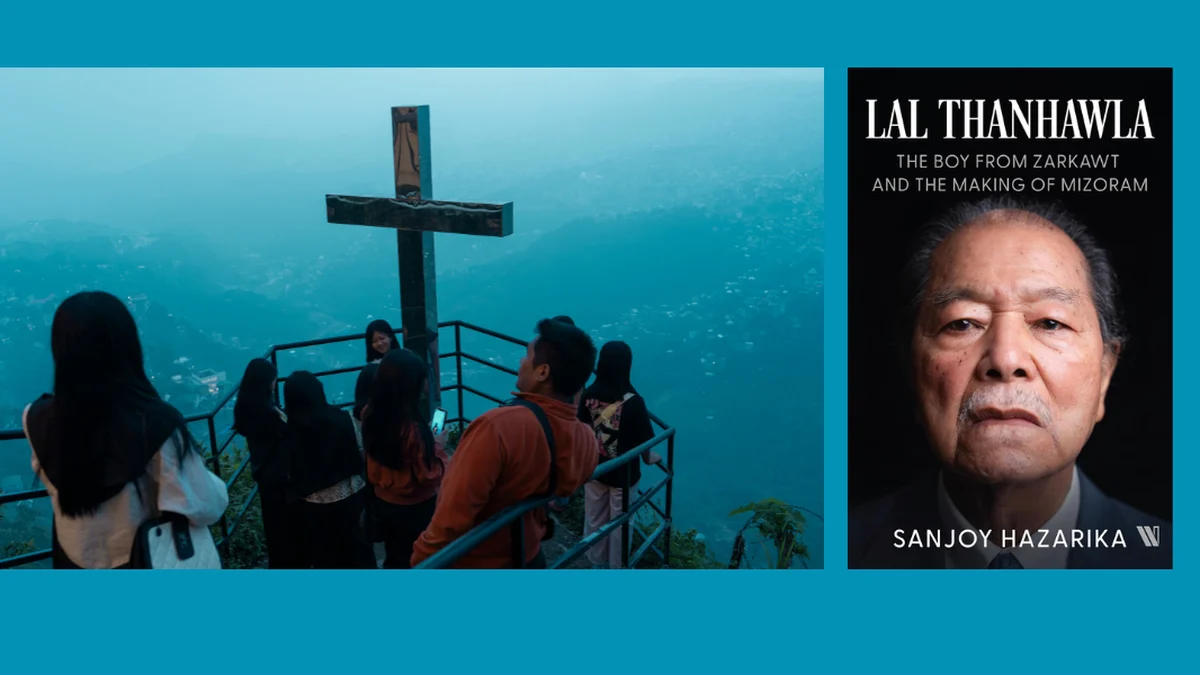
In the fifty-four years since Mizoram transitioned from a Union Territory to a full-fledged state within the Indian Union, the political landscape of this mountainous northeastern frontier has been remarkably concentrated. In over half a century, the state has seen only six Chief Ministers. Among them, one figure stands as an immovable pillar: Lal Thanhawla. Serving for 22 years as Chief Minister, his political trajectory is not merely a career; it is the definitive biography of the state itself.
In his latest work, Lal Thanhawla: The Boy from Zarkawt, and the Making of Mizoram (Westland, ₹799), seasoned journalist and researcher Sanjoy Hazarika weaves a complex tapestry of the man who navigated the treacherous path from rebellion to governance, offering a seminal account of how a volatile frontier was integrated into the Indian mainstream.
The Chronology of Conflict and Consolidation
To understand Mizoram, one must confront the seismic events of 1966. The Mizo National Front (MNF), led by the enigmatic Laldenga, launched a daring uprising that resulted in the Indian Air Force bombing Aizawl—the only instance in independent India’s history where the state strafed its own territory. Hazarika’s archival research sheds new light on the protracted, often messy negotiations that followed, suggesting that Laldenga’s violent struggle was as much an individual quest for power as it was a nationalist movement.
Key Milestones in the Mizoram Narrative:
- 1950s: The Mautam (bamboo flowering) crisis, a cyclical natural disaster that caused mass starvation, served as the primary catalyst for the Mizo insurgency.
- 1966: The MNF uprising and the subsequent IAF aerial bombardment of Aizawl.
- 1967: Lal Thanhawla joins the Indian National Congress, pivoting away from his early flirtations with the MNF.
- 1986: The historic Mizo Peace Accord is signed. In a move of immense political foresight, Thanhawla steps down as Chief Minister to allow Laldenga to assume the mantle, effectively ending the insurgency.
- 1987: Mizoram achieves full statehood.
- 2026: Reflection on 54 years of statehood, with the political legacy of figures like Thanhawla, Sailo, and current Chief Minister Lalduhoma being re-evaluated through the lens of modern geopolitics.
The Policy of Accommodation vs. The Politics of Intransigence
The contrast between Laldenga and Lal Thanhawla defines the dichotomy of Mizo politics. While Laldenga spent years courting foreign powers—including Pakistan—and demanding secession, Thanhawla represented the path of "accommodative nationalism."
Hazarika illustrates that the Indian state rewards limited, tactical intransigence. Laldenga’s eventual surrender and rehabilitation by New Delhi set a precedent that some observers argue the Naga leadership, specifically figures like Thuingaleng Muivah, failed to replicate with the same efficacy. Thanhawla, by contrast, navigated the system with a "Congress-first" loyalty, yet remained a fierce proponent of Mizo sub-nationalism.

His journey from a young man who acted as an MNF emissary to Burma in 1965, to a four-time Chief Minister, encapsulates the transformation of the Mizo identity—from a rebel frontier to a democratic participant in the Indian project.
Societal Shifts: The Christian Transition
One of the most profound, yet under-examined, aspects of the Mizo experience is the rapid sociological shift from traditional animism to Christianity. Hazarika’s book touches upon this, referencing the extensive work of JNU professor Joy L.K. Pachuau.
The statistics remain staggering: in 1901, the Christian population in the Lushai Hills was less than 1%. Within a mere 50 years, this figure surged to over 80%. Today, the Church is the single most influential institution in Mizo society, acting as both a moral arbiter and a political pressure group. While the book provides a compelling look at this transformation, it leaves open questions regarding how this totalizing religious identity interacts with the secular, nationalist aspirations of a state increasingly integrated into global digital and economic networks.
Supporting Data: The ‘Rambuai’ and Governance
The period of Rambuai—the "time of trouble"—remains a traumatic scar in the Mizo collective memory. The village regrouping scheme, championed by Field Marshal Sam Maneckshaw, aimed to drain the "sea" (the populace) in which the "fish" (the insurgents) swam. Hazarika provides the most comprehensive account to date of this period, detailing how the forced displacement of thousands of villagers fundamentally restructured Mizo society.
Beyond the trauma, the book assesses Thanhawla’s administrative record. It does not shy away from criticizing his policy failures, nor does it ignore the complexities of leading one of India’s smallest, most isolated states. Thanhawla emerges as a man who was deeply flawed—a patriarch who once pined for rice in an Assam jail and struggled with the contradictions of his own personal life—yet he remained the ultimate steward of the Mizo state.

Implications for the Future: The Zomiland Question
Perhaps the most resonant theme in Hazarika’s work is the concept of "Zomiland" and the idea of a dispersed nation. Despite the physical borders separating Mizos across India, Myanmar, and Bangladesh, the feeling of oneness persists.
Leaders across the spectrum—from Brigadier T. Sailo and Laldenga to Zoramthanga and current CM Lalduhoma—have all, at various points, upheld this pan-Mizo identity. The implication for New Delhi is clear: as long as the Indian state respects the cultural and sub-national aspirations of the Mizos, the region remains a stable, if unique, component of the Union. However, the book suggests that the "Mizo identity" is not static. It is constantly being renegotiated by a new generation that is as much interested in global integration as it is in local traditions.
Conclusion: An Intimate Political Portrait
Lal Thanhawla: The Boy from Zarkawt is, at its heart, a study of the "Indian nationalist and Mizo sub-nationalist." Hazarika succeeds in humanizing a political titan, moving beyond the dry accounts of election results and policy papers to capture the man who survived the transition from the colonial era to the digital age.
For those seeking to understand the Northeast, the book serves as a vital primer. It reminds us that Mizoram’s stability today was not a given; it was the result of a deliberate, often painful, process of political accommodation. As Mizoram looks toward its future, the life of its longest-serving Chief Minister provides both a roadmap of how far the state has come and a cautionary tale of the compromises required to hold a frontier together.
In the final analysis, Hazarika’s work confirms that the history of Mizoram is not just a collection of dates and borders—it is the story of a people who, having endured the fires of rebellion, chose the path of the ballot, all while holding tight to the dream of a unified Mizo soul.