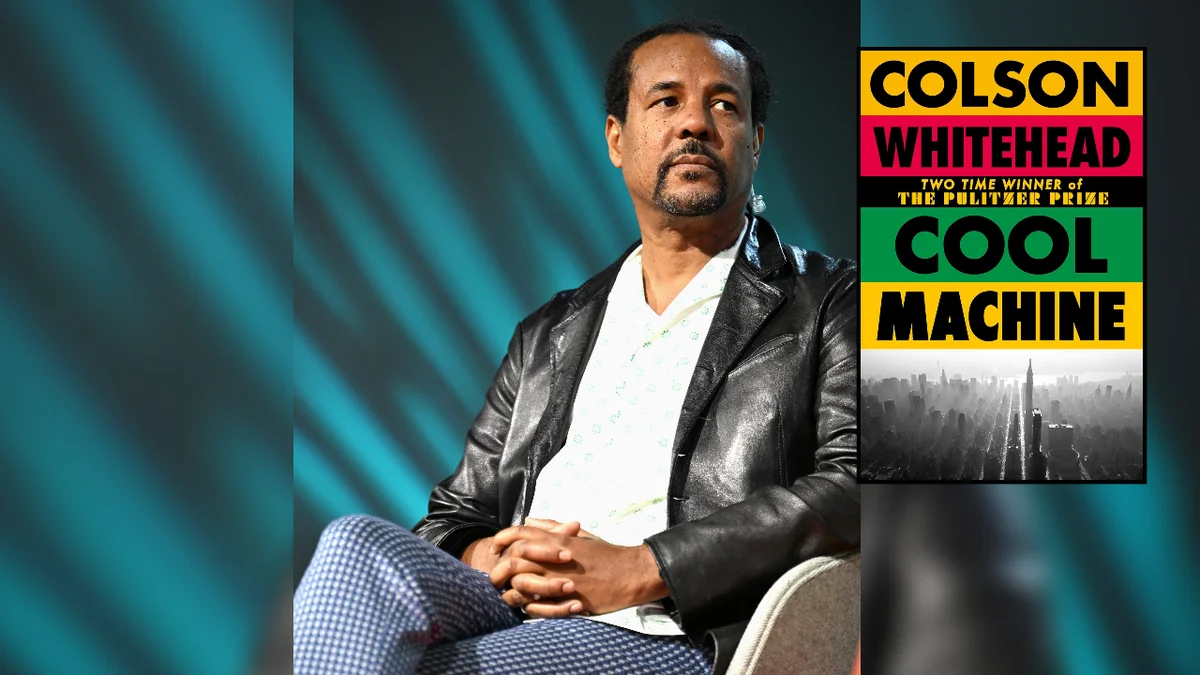
In the landscape of contemporary American literature, few authors command the structural ingenuity and stylistic command of Colson Whitehead. A two-time Pulitzer Prize winner, Whitehead has spent the better part of the last decade meticulously reconstructing the grit, glamour, and systemic rot of 20th-century New York City. With the release of his latest work, Cool Machine, Whitehead brings his celebrated Harlem Trilogy to a definitive, swaggering close.
While readers might initially mistake the volume for a singular, sweeping novel, Cool Machine reveals itself as a triptych—a collection of three interconnected novellas that capture the feverish energy of 1980s New York. It is a work of picaresque noir that manages to be both a love letter to a bygone era and a masterclass in the craft of storytelling.
The Architecture of the Harlem Trilogy
The Harlem Trilogy has always functioned as a bridge between the historical and the cinematic. Following the acclaim of Harlem Shuffle (2021) and Crook Manifesto (2023), Cool Machine completes the saga of Ray Carney, a man caught between the respectable aspirations of a furniture dealer and the illicit allure of the criminal underworld.

The structure of this final installment is deceptive. Upon opening the book, the reader is met with three distinct narrative threads, each revolving around a specific "MacGuffin"—an object or goal that drives the plot forward with relentless momentum.
- The First Novella: Explores the high-stakes obsession surrounding Jesse Owens’ "Hitler Olympics" gold medal, placing Carney in the crosshairs of history and greed.
- The Second Novella: Shifts focus to a sacred mask crafted by the Fang people of Gabon, weaving themes of cultural appropriation and underworld trafficking.
- The Third Novella: Finds Carney entangled in a desperate situation involving his nephew, who has become inadvertently involved in a mob-sanctioned homicide.
These stories do not merely occupy the same world; they breathe the same smog-filled, neon-lit air of an 80s New York that feels both dangerous and oddly domestic.
Character Dynamics: Ray Carney and the "Crooked Timber"
At the heart of the trilogy remains Ray Carney. Carney is an anomaly in the crime genre: he is a man of principle, a devoted husband, and a shrewd businessman who happens to operate as a fence for stolen goods. He is the embodiment of the philosophical notion that "human timber is fundamentally crooked."

Whitehead uses Carney to explore the tension between normalcy and deviance. Carney is observant and financially comfortable, yet he is magnetically drawn to the shadows. When the moral weight of his choices becomes too heavy, he employs Pepper—a stoic, battle-hardened associate whose presence provides the muscle for Carney’s intellectual schemes.
In Cool Machine, the spotlight shifts significantly toward Pepper. By elevating Pepper to the protagonist of the second novella, Whitehead grants the reader an intimate look at the mechanics of violence. While both characters are African-American, and their racial identity is woven into the fabric of their experiences, Whitehead deliberately avoids making the story a mere social treatise. Instead, he treats their struggle as a universal human endeavor—the resilience of a marginalized group fighting for their piece of a city that was never built for them.
The Aesthetic of 80s Noir: A Lived-in World
Whitehead’s prose in Cool Machine possesses a "habitability" that is rare in modern fiction. He constructs his settings with the meticulous detail of a 19th-century novelist, yet populates them with the archetypes of 1970s Blaxploitation cinema. The characters, ranging from "The Melancholy Hitman" to "The Rabbit," are rendered with a protective, almost parental, affection.

The setting itself—the 1980s—is treated as a "cool machine," a vast, uncaring mechanism that grinds down the hopes of its residents. Whitehead describes the environment with evocative precision, such as his description of "the Marlin," a dive bar on 110th and Broadway with a décor "inspired by an old leather shoe that lived in a drainage pipe." This is the hallmark of Whitehead’s genius: the ability to ground his narratives in physical, tangible reality.
The Critique of Modern Literature
One of the most compelling aspects of the critical reception of Cool Machine is the commentary it invites regarding the current state of the literary novel. Many critics have noted that Whitehead’s "carnivalesque" use of language stands in stark contrast to the modern trend of "vapid interiority" often encouraged by MFA programs.
In an age where contemporary literature often prioritizes psychological introspection over narrative drive, Whitehead reminds us that literature can—and should—be fun. By eschewing the "pedestrian English" that has become the standard for "great art," Whitehead returns to a tradition of storytelling that values pacing, dialogue, and atmospheric world-building. Cool Machine is a rejection of the idea that a book must be "difficult" to be profound. It proves that the genre of picaresque noir, when handled by a master, can offer as much insight into the human condition as any self-consciously literary novel.

Implications for the Genre
The completion of the Harlem Trilogy marks a significant milestone in Whitehead’s career. Having moved from the speculative historical fiction of The Underground Railroad and The Nickel Boys to the crime-thriller landscape of Harlem, Whitehead has demonstrated a remarkable versatility.
The implications for the crime genre are profound. By elevating the "fence" story to the level of high art, Whitehead has challenged the boundaries between "genre fiction" and "literary fiction." His work suggests that the tropes of the street—the escape sequences, the heist, the mob murder—are not merely vehicles for suspense, but effective mirrors for systemic societal issues.
Supporting Data and Technical Specifications
For those tracking the trajectory of this release, the details are as follows:

- Cool Machine
- Author: Colson Whitehead
- Publisher: Fleet
- Price: ₹799
- Publication Date: October 23, 2026
- Genre: Picaresque Noir / Crime Fiction
The critical consensus suggests that Cool Machine will serve as the benchmark for historical crime fiction for the foreseeable future. It is a book that demands to be read, not just for its plot, but for the sheer pleasure of witnessing a writer at the height of his powers.
Conclusion: A Farewell to Harlem
As the Harlem Trilogy concludes, the legacy of Ray Carney and his associates remains. Whitehead has successfully painted a portrait of a city "sagging on the ropes like an ageing boxer," yet still standing. Through the music subcultures, the art scenes of Harlem, and the underground denizens who define the city’s hidden pulse, Whitehead has left an indelible mark on American letters.
Cool Machine is, ultimately, a call to action for the reader: to stop "purging our lips" and rediscover the joy of a well-told story. In doing so, Whitehead ensures that his readers leave the Harlem Trilogy not just entertained, but enriched. The book is a testament to the idea that, regardless of the era or the setting, the most enduring literature is that which manages to balance the weight of history with the relentless, kinetic energy of the present.