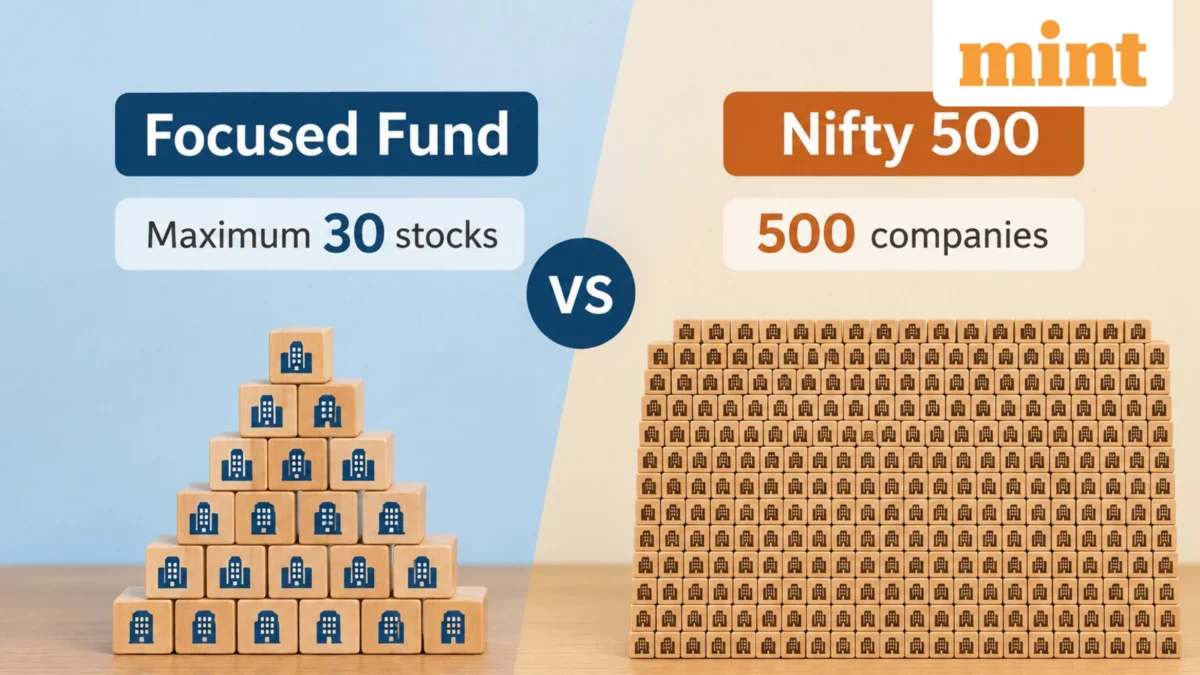
Mumbai, India – October 26, 2026 – In the dynamic landscape of Indian mutual funds, Focused Funds occupy a unique and often debated niche. These equity schemes, designed for high-conviction investing, operate with a mandate to hold a concentrated portfolio of a maximum of 30 stocks. To maintain their equity-oriented status and tax efficiency, they must invest at least 65% of their assets in equities. Crucially, their flexibility allows them to traverse the entire market capitalisation spectrum, from established large-cap giants to nimble mid-cap players and high-growth small-cap opportunities. This blend of concentration and flexibility positions them as potentially high-alpha generators, but also subjects them to intense scrutiny, particularly concerning how their performance is measured.
At the heart of this scrutiny lies the persistent question of benchmarking. Every actively managed mutual fund scheme is evaluated against a pre-defined benchmark index, providing investors with a critical yardstick for performance comparison. For Focused Funds, the standard Tier 1 benchmarks are typically the Nifty 500 TRI or the BSE 500 TRI. TRI, or Total Return Index, is a comprehensive measure that accounts not only for price changes in the underlying stocks but also for the reinvestment of dividends, offering a more accurate reflection of an investor’s total return.
However, herein lies the central paradox: investors are tasked with comparing the returns of a highly concentrated portfolio, comprising perhaps 20 to 30 carefully selected stocks, against an index that represents the performance of 500 diverse companies. This inherent disparity has sparked a significant industry debate, questioning the fairness and utility of such broad-market benchmarks for a category built on selectivity. Recent performance figures from October 22, 2026, further underscore this complexity. The largest scheme in the category by assets under management (AUM), SBI Focused Fund, delivered a 1-year return of 4.02%, notably outperforming its benchmark, the BSE 500 TRI, which fell by 7.95%. Similarly, the HDFC Focused Fund, another prominent player, experienced a decline of 6.56%, yet still managed to perform marginally better than its benchmark, the Nifty 500 TRI, which saw a 7.64% fall. These figures, while seemingly positive in a challenging market, reignite the discussion: why do focused funds use such broad-market benchmarks, and is it time for the industry to adopt a more refined approach?
Main Facts: The Anatomy of Focused Funds and Their Benchmarking Challenge
Focused funds are predicated on the belief that a skilled fund manager, through rigorous research and high-conviction calls, can identify a limited number of exceptional companies that will outperform the broader market. This concentrated approach is distinct from diversified equity funds, which typically hold a much larger number of stocks (often 50-100 or more) to mitigate individual stock risk. The regulatory framework, specifically SEBI’s guidelines, caps the maximum number of stocks at 30 for this category, ensuring that managers genuinely focus their investments.
Understanding the Mandate: Concentration and Flexibility
The core characteristic of a focused fund is its concentrated portfolio. This strategy is rooted in the principle that true alpha generation often comes from a deep understanding and significant allocation to a select few businesses. Unlike a broad-based diversified fund that aims to capture market returns with moderate outperformance, a focused fund manager takes higher conviction bets, believing their chosen stocks will deliver superior returns. This approach inherently entails higher idiosyncratic risk – the risk associated with individual companies – but also offers the potential for significantly higher returns if those high-conviction bets pay off.
The flexibility to invest across market capitalisations is another defining feature. This means a fund manager is not restricted to just large-cap, mid-cap, or small-cap stocks but can dynamically allocate capital based on where they perceive the best opportunities. During periods when large-caps are leading the market, the fund can tilt towards them; conversely, if mid-caps or small-caps offer compelling valuations and growth prospects, the fund can increase its exposure there. This multi-cap approach, within the constraint of 30 stocks, allows fund managers to be agile and adapt to evolving market conditions, theoretically enhancing their ability to generate alpha. The minimum 65% allocation to equities ensures that these funds remain true to their equity mandate, aligning with taxation norms for equity-oriented schemes.
The Standard Benchmark: Nifty 500 TRI and BSE 500 TRI
A benchmark serves as the standard against which the performance of an investment fund is measured. It provides a comparative basis for investors to assess whether the fund manager has successfully added value (generated alpha) or merely tracked the market. For focused funds, the Nifty 500 TRI and BSE 500 TRI are the mandated Tier 1 benchmarks.
The "TRI" (Total Return Index) component is crucial here. Unlike price indices, which only reflect changes in stock prices, a total return index assumes that all dividends paid out by the constituent companies are reinvested back into the index. This provides a more accurate and holistic representation of the actual returns an investor would have earned by holding the entire index, making it the preferred method for evaluating active fund performance.
However, the challenge arises from the sheer breadth of these benchmarks. The Nifty 500 TRI comprises the 500 largest companies listed on the National Stock Exchange (NSE) by market capitalisation, covering a vast spectrum of sectors and sizes, representing approximately 90% of the total market capitalisation of the NSE. Similarly, the BSE 500 TRI tracks the performance of 500 top companies listed on the Bombay Stock Exchange (BSE). When a focused fund, by design, holds only a fraction of these companies – a maximum of 30 – the comparison becomes inherently skewed. Investors are essentially asking a marathon runner to compete against a field of 500, but only judging them against the collective average of that entire field, rather than a more comparable subset. This fundamental incongruity is the crux of the benchmarking debate for focused funds.
Supporting Data: Performance in a Challenging Market
The latest performance data, current as of October 22, 2026, offers a contemporary lens through which to examine the efficacy of these broad benchmarks, particularly in a period that appears to have presented significant market headwinds.
Recent Performance Snapshot (October 22, 2026)
In a year marked by global economic uncertainties, geopolitical tensions, and potentially rising interest rates that have impacted equity valuations, the Indian market, as reflected by its broad indices, has experienced a downturn. Against this backdrop, the performance of focused funds becomes particularly insightful.
- SBI Focused Fund, the largest scheme in its category by AUM, demonstrated a 1-year return of 4.02%. Crucially, this was achieved while its benchmark, the BSE 500 TRI, fell by 7.95%. This represents a substantial outperformance of nearly 12 percentage points, a significant achievement in a declining market. This suggests that the fund manager’s concentrated stock selection and active management calls paid off, protecting investor capital more effectively than the broader market.
- HDFC Focused Fund, another major player, also navigated the challenging environment, recording a 1-year decline of 6.56%. While a negative return, it still managed to marginally outperform its benchmark, the Nifty 500 TRI, which declined by 7.64%. This narrower outperformance, approximately 1 percentage point, still indicates the fund manager’s ability to mitigate losses compared to the wider market, albeit to a lesser degree than the SBI counterpart.
These figures illustrate the potential for active management in focused funds to generate alpha, even in adverse market conditions. When the broader market is falling, a fund that loses less than its benchmark is, in fact, adding value. The concentrated nature allows managers to avoid underperforming sectors or stocks that are heavily weighted in the broad index, and instead, focus on resilient businesses or those with specific growth drivers.
The Concept of Active Share
To truly understand the benchmarking conundrum, it’s essential to grasp the concept of "active share." Active share is a measure of the percentage of a portfolio’s holdings that differ from its benchmark index. A fund with an active share of 0% would be an index fund, perfectly replicating its benchmark. Conversely, a fund with an active share of 100% would have no holdings in common with its benchmark.
Focused funds, by their very design, inherently possess a high active share. With a maximum of 30 stocks, their holdings and their respective weights are bound to differ substantially from an index of 500 companies. Many focused funds exhibit an active share well above 70%, often reaching 80% or 90%. This high active share signifies a strong conviction by the fund manager and a genuine attempt to deviate from the index in pursuit of superior returns.
However, this very characteristic makes the Nifty 500 or BSE 500 TRI a challenging benchmark. When a portfolio is so distinct from its benchmark, comparing their performances can feel like comparing apples and oranges. While the benchmark indicates whether the fund’s net return justified its fees, it offers limited insight into the specific drivers of that performance or the manager’s skill within their chosen investment universe. It measures the "what" (the end result) but not adequately the "how" (the investment process and specific stock selection decisions). This limitation often leaves investors wanting more nuanced information to truly evaluate a concentrated fund’s strategy.
Official Responses: The Rationale Behind Broad Benchmarks
The practice of benchmarking focused funds against broad-market indices like the Nifty 500 TRI is not arbitrary. It stems from a combination of regulatory requirements, practical considerations, and an underlying philosophy regarding market representation. Industry experts weigh in on the rationale.
Regulatory Imperatives and Standardisation
Jyoti Bhandari Chandra, Founder of Lovak Capital, highlights the regulatory framework as a primary driver. "Focused funds use the Nifty 500 TRI or BSE 500 TRI because of the category’s investment mandate. Under SEBI’s uniform benchmark framework, AMFI assigns a Tier 1 benchmark to each category."
SEBI (Securities and Exchange Board of India) introduced the uniform benchmark framework to bring standardisation and clarity to mutual fund performance reporting. Prior to this, fund houses often had the flexibility to choose benchmarks, which could sometimes lead to "benchmark shopping" – selecting an index that made their fund look better. The uniform framework, implemented in phases, aimed to ensure that all funds within a particular category are measured against the same, consistent yardstick. AMFI (Association of Mutual Funds in India), as the industry body, plays a crucial role in operationalising these guidelines by assigning specific Tier 1 benchmarks.
For focused funds, the multi-cap and multi-style investment mandate makes a broad index like the Nifty 500 a logical choice within this framework. Since these funds can invest across large-cap, mid-cap, and small-cap segments, and adopt various investment styles (growth, value, blend), a narrower index (like a pure large-cap or mid-cap index) would not accurately reflect their diverse potential investment universe. The Nifty 500 is seen as a common denominator that encompasses the vast majority of the Indian equity market, providing a consistent reference point for all funds in this flexible category.
Representing the Investment Universe
Bruce Keith, Co-founder & CEO, InvestorAi, provides another perspective: "The Nifty 500 is appropriate because it represents the universe from which these funds can select stocks."
This view posits that while a focused fund may only hold 30 stocks, its fund manager has the opportunity to select from the 500 largest companies (or even more, depending on the fund’s specific investment policy, though the Nifty 500 forms a significant portion of the investable universe). Therefore, the benchmark should reflect the broader opportunity set available to the manager. By comparing against the Nifty 500, investors can assess whether the manager is effectively identifying superior investment opportunities from the vast pool available, and whether their concentrated bets are delivering better results than a passive investment across that entire universe. It allows investors to analyze whether these concentrated funds are indeed outperforming the index, thus justifying the active management fees.
Avoiding Distortions and Maintaining Consistency
Harsha Vardhana VM, Founder-Group CEO, Atom Financial Services, argues against narrower benchmarks, stating, "narrower benchmarks could create their own distortions. Comparing a fund holding mid-cap stocks with the Nifty 50 could make those holdings appear to be bets against the index. A broad benchmark provides a consistent yardstick across the category."
Consider a focused fund that, at a particular point, has a tactical overweighting in mid-cap stocks because the manager finds compelling valuations and growth stories in that segment. If this fund were benchmarked against, say, the Nifty 50 TRI (a large-cap index), its mid-cap holdings would immediately appear as "bets against the index." This could mislead investors into perceiving the fund as riskier or off-mandate, even if the manager is simply executing their multi-cap strategy effectively. A broad benchmark like the Nifty 500, which encompasses all market cap segments, avoids this kind of distortion, providing a more neutral and consistent yardstick. It ensures that regardless of a focused fund’s internal market-cap tilt at any given time, it is always being compared against the overall market performance from which it draws its constituents.
The "How" vs. "What" Dilemma
Despite these rationales, there remains a fundamental limitation. As Vardhana VM points out, a portfolio of 26 holdings (or any small number) will have an "active share well above 70%, meaning its holdings and weights differ substantially from the index." While the broad benchmark "shows whether the fee was worth paying," it "says nothing about how the manager got the result."
This highlights the core challenge: the Nifty 500 TRI is effective at measuring the outcome (did the fund beat the market?), but less so at explaining the process (why did these specific 30 stocks outperform/underperform the other 470?). For sophisticated investors and financial advisors, understanding the ‘how’ is crucial for assessing the sustainability and replicability of a fund manager’s alpha, not just their historical track record. This gap in insight is what drives the call for a more granular approach to benchmarking.
Implications and the Quest for More Appropriate Benchmarks
The ongoing debate surrounding the benchmarking of focused funds carries significant implications for various stakeholders: fund managers, regulators, and most importantly, investors. It underscores the tension between the need for industry-wide standardization and the desire for more precise and context-specific performance evaluation.
The Case for a Refined Approach
Manish P. Hingar, Chartered Accountant, Founder and Chief Executive Officer of Fintoo, succinctly captures the complexity: "There’s no perfect answer. The Nifty 50 is too narrow for many of these funds, since a lot of them own mid and small caps, so comparing them with 50 large companies isn’t fair either. A fully customised benchmark has its own problem: make it too specific, and you can’t compare the fund with anything." This "Goldilocks problem" – finding a benchmark that is "just right" – is at the core of the discussion. While the current system offers simplicity, its lack of precision can obscure the true skill of a concentrated portfolio manager.
Hybrid Benchmarks: Learning from Other Categories
One proposed solution involves adopting a multi-benchmark approach, similar to what is already seen in other mutual fund categories. Jyoti Bhandari Chandra suggests "a sounder approach is an industry-standard second benchmark that mirrors each fund’s actual market cap mix, kept alongside the Tier 1 index."
This concept draws inspiration from hybrid funds, which inherently invest across different asset classes (equity and debt). These funds often use "composite benchmarks" that reflect their asset allocation. For example, a balanced advantage fund might be benchmarked against a composite of 65% Nifty 500 TRI and 35% Nifty Composite Debt Index. Applying this logic to focused funds would mean having the Nifty 500 TRI as the primary, broad-market benchmark, and a secondary, composite benchmark tailored to the fund’s average market-cap exposure over a period. This secondary benchmark could be a blend of, say, the Nifty 100 TRI (for large-cap exposure), Nifty Midcap 150 TRI, and Nifty Smallcap 250 TRI, in proportions that reflect the fund’s typical asset allocation. This would provide investors with a more relevant context for evaluating the fund’s performance against its actual investment style without sacrificing the overarching comparability provided by the Nifty 500.
Customised Benchmarks Based on Historical Exposure
Harsha Vardhana VM proposes an even more granular approach: "The more accurate approach is a composite benchmark built from the fund’s own history. If a scheme has held about 70% large caps and 30% mid caps over time, a blend of 70% Nifty 100 TRI and 30% Nifty Midcap 150 TRI would test the manager against the exposure actually taken."
This method would involve analyzing a fund’s historical portfolio allocations (e.g., average exposure to large-cap, mid-cap, and small-cap stocks over the last three to five years) and then constructing a bespoke composite benchmark. The advantage here is unparalleled accuracy in measuring the manager’s performance against the actual risk and style exposure they undertook. It directly addresses the "how" of performance by benchmarking against the fund’s demonstrated investment choices. However, this approach also presents challenges. Creating a unique benchmark for every fund could complicate cross-fund comparison for investors and might also introduce potential for "benchmark gaming" if the construction methodology isn’t strictly regulated and transparent. The industry would need robust guidelines to ensure consistency and prevent fund houses from manipulating these historical averages to present a more favorable comparison.
Potential Regulatory Evolution
The ongoing dialogue among experts suggests that AMFI and SEBI might eventually need to revisit the benchmarking guidelines for focused funds. While the current Tier 1 benchmark serves its purpose for broad classification and initial comparison, the increasing sophistication of investors and the nuanced nature of concentrated portfolios may necessitate further refinement. This could involve:
- Mandating a secondary, style-specific benchmark: Similar to the hybrid fund model, requiring fund houses to report performance against both the Nifty 500 TRI and a predefined composite benchmark that reflects typical market-cap allocation for focused funds.
- Allowing fund houses to declare a "peer group" benchmark: Where focused funds could identify a group of similarly managed funds (e.g., those with a strong large-cap bias within the focused category) and present their performance against the average of that group, alongside the primary benchmark.
- Enhancing disclosure requirements: Mandating more detailed reporting on active share, market-cap allocation changes over time, and specific performance attribution (which stocks/sectors contributed most to alpha/beta) to help investors understand the drivers of returns.
Such regulatory evolution would aim to strike a better balance between standardisation and the provision of meaningful, actionable insights for investors.
Navigating Focused Funds: A Guide for Investors
Given the unique characteristics and benchmarking challenges of focused funds, investors need a sophisticated approach to analysis. Relying solely on the primary Nifty 500 TRI comparison can be misleading.
Beyond the Primary Benchmark
Harsha Vardhana VM advises investors to look at two crucial numbers: "how the fund performed against the broader market (Nifty 500) and how it performed against its own style (large-, mid-, or small-cap indices). The difference between these two numbers is itself useful information."
For instance, if a focused fund primarily invests in large-cap companies (even within its 30-stock limit), comparing its performance against the Nifty 100 TRI (an index of 100 large-cap companies) would offer a more relevant peer-group comparison than the Nifty 500. Investors can often perform this check