The relentless pursuit of financial freedom often overshadows a more fundamental truth: wealth, in isolation, offers little solace if it cannot be enjoyed. A seasoned financial planner argues that true prosperity lies not just in accumulating assets, but in cultivating a holistic ecosystem of well-being encompassing health, time, relationships, and purpose.
In the modern lexicon of aspiration, "financial freedom" has ascended to the zenith of personal goals. It conjures images of unburdened existence, where monetary constraints no longer dictate life choices. Yet, as many individuals diligently chart their course towards this coveted state, a critical question often goes unasked, lost amidst the intricate spreadsheets and ambitious savings targets: what is the true value of money if one is not present, healthy, or at liberty to savor its fruits?
This pervasive oversight is a recurring theme for seasoned professionals in the financial planning sphere. For over fifteen years, this author, a fee-only financial planner, has observed a common pattern: clients meticulously outline objectives – robust retirement corpora, funding children’s education, acquiring larger homes – yet frequently neglect the foundational inquiry into the ultimate purpose of this accumulation. The stark reality, often learned too late, is that wealth devoid of the capacity to enjoy it is, in essence, inert.
The Inertia of Wealth: Money’s True Value Unveiled
The fundamental axiom underpinning true financial well-being is that wealth, in and of itself, possesses no intrinsic value. Its utility is inextricably linked to the individual’s capacity to experience and benefit from it. This capacity is predicated on a triad of essential pillars: life itself, robust health, and the freedom to engage with the world.
Anecdotal evidence abounds within the financial planning community, painting a poignant picture of this disconnect. Planners recount instances of clients who amassed substantial portfolios, only to find their dreams of travel curtailed by debilitating health conditions. Others, possessing vast fortunes in fixed deposits, find themselves in the twilight of their lives with no one to share a simple meal, their accumulated wealth serving as a silent monument to missed opportunities for connection. Money, whether parked in a bank account or a mutual fund, remains a dormant entity until it is actively leveraged by a living, healthy, and engaged individual.
Therefore, a financial plan that solely prioritizes monetary accumulation, while neglecting the safeguarding and enhancement of life’s other vital dimensions, addresses only a fraction of a much larger, more complex equation. This singular focus risks creating a scenario where individuals achieve their financial targets only to discover they lack the fundamental resources – health, time, and genuine contentment – to truly appreciate their achievements.
The Ten Pillars of Enjoyable Wealth: A Holistic Framework
To truly unlock the potential for wealth to foster happiness and fulfillment, a broader perspective is essential. Beyond mere financial accumulation, ten interconnected pillars form the bedrock upon which a life of genuine enjoyment, enriched by financial security, can be built:
1. Robust Health (Physical and Mental): This encompasses not only the absence of disease but also the ability to engage actively in life – to move, eat, travel, and sleep soundly. Equally crucial is mental well-being, characterized by peace of mind and freedom from chronic stress. As the adage goes, "health is wealth," and no financial portfolio can substitute for the ability to digest a meal or achieve a restorative night’s sleep.
2. Precious Time: While money can expand choices, it cannot create more time. Many individuals dedicate their most vibrant years to earning, only to later spend their accumulated wealth attempting to reclaim lost health. This represents a fundamentally flawed transaction. The realization that time is a finite and non-renewable resource often dawns in the later stages of life, when the capacity to enjoy it may have diminished.
3. Financial Security: This pillar transcends the sheer size of one’s portfolio. It is about possessing sufficient resources to meet one’s needs without perpetual anxiety. A portfolio of Rs. 2 crore that alleviates financial stress is demonstrably more valuable than a Rs. 10 crore portfolio that fosters sleepless nights and constant worry. True enjoyment stems from security, not just accumulation.
4. Meaningful Relationships: The bonds of family, friendship, and companionship are indispensable to a fulfilling life. Celebrating successes in isolation rarely yields lasting happiness. Reflecting on life’s journey, the regrets most commonly expressed by individuals facing their mortality are not related to insufficient time spent at the office, but rather to neglected personal connections.
5. Genuine Freedom: Wealth should serve as an enabler of choices, not a gilded cage. If one’s financial resources are perpetually tied up in servicing debt for unnecessary possessions, acquired to impress others, this is not freedom but a sophisticated form of self-imposed servitude. True freedom lies in having the autonomy to live according to one’s values and priorities.
6. A Sense of Purpose: A compelling reason to greet each day is invaluable. Retirement, in this context, should not signify an cessation of activity but a transition to work that is intrinsically meaningful and personally fulfilling. Financial planning should therefore focus on cultivating purpose, not merely on securing a pension.
7. Fulfillment of Basic Physical Needs: Access to nutritious food, safe shelter, clean water, comfortable clothing, and restful sleep are fundamental. While often overlooked in the technicalities of financial planning, these elements form the essential foundation for any form of well-being.
8. Personal Safety and Protection: This encompasses physical security, access to quality healthcare, and financial resilience through adequate insurance coverage and a robust emergency fund. These are not optional add-ons but critical components that provide a safety net, safeguarding against unforeseen adversities.
9. Enrichening Experiences: Travel, lifelong learning, pursuing hobbies, and contributing to society through philanthropy offer a depth of satisfaction that often surpasses material possessions. While a car depreciates the moment it is purchased, a memorable trip with loved ones appreciates in value over time, becoming a cherished source of reflection and joy.
10. Inner Contentment: Perhaps the most elusive yet vital factor, contentment signifies an inner peace and an understanding of when "enough is enough." Wealth without contentment can perpetuate an insatiable cycle of "just a little more," leading to perpetual dissatisfaction. Individuals with modest but sufficient resources, coupled with contentment, often exhibit a higher degree of peace than those with vast fortunes but an unquenched desire for more.
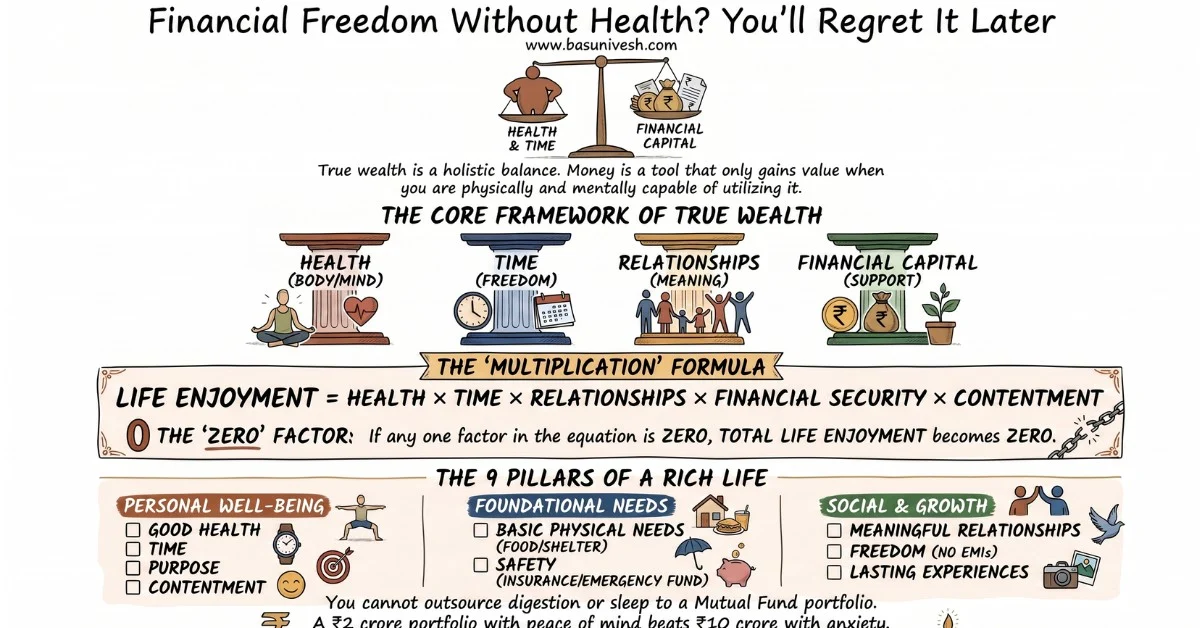
The Four Capitals: A Holistic Approach to Wealth Management
To encapsulate this multifaceted understanding of well-being, financial planners often distill these concepts into four interconnected forms of "capital" that are essential for truly enjoying wealth:
- Health Capital: This refers to the individual’s physical and mental well-being, the fundamental capacity to experience life.
- Time Capital: This represents the years one has remaining and the freedom to allocate them meaningfully.
- Relationship Capital: This encompasses the network of individuals who enrich life and provide support and joy.
- Financial Capital: This is the traditional measure of wealth – money and assets that support life goals.
The absence or severe depletion of any single form of capital significantly diminishes one’s ability to derive genuine enjoyment from their financial capital. A cautionary tale often cited involves individuals possessing substantial financial capital but suffering from profound health deficits, where even immense wealth cannot reclaim what has been irrevocably lost.
The Undiscussed Formula for Life Enjoyment
This holistic perspective can be elegantly summarized by a simple, yet profound, equation that is rarely discussed in conventional financial planning discourse:
Life Enjoyment = Health Capital × Time Capital × Relationship Capital × Financial Security × Contentment
The critical element of this formula is the multiplicative nature of its components. If any single factor approaches zero, the overall product – life enjoyment – plummets drastically, irrespective of the magnitude of the other factors. One cannot compensate for a complete lack of health with a larger financial portfolio, nor can lost time be recovered through a higher compound annual growth rate (CAGR). This mathematical reality underscores the imperative of a balanced approach to wealth creation and life enrichment.
Rethinking Financial Planning: Living Well, Not Just Dying Rich
Consequently, the true objective of financial planning should transcend the simplistic goal of "dying rich." Instead, it should be reoriented towards the far more profound aim of "living well." Financial freedom, therefore, is not the ultimate destination but rather a potent tool that empowers individuals to protect and nurture the other vital pillars of their existence – health, time, relationships, and contentment. This strategic utilization of financial resources allows for a life that is not only financially secure but also genuinely rich in experiences and fulfillment.
As individuals engage in the process of reviewing their financial plans, the focus must extend beyond portfolio performance and goal attainment. A critical self-assessment is required: does the current plan actively safeguard one’s health, preserve valuable time, and foster meaningful relationships? If the answer is anything less than a resounding affirmation, then the pursuit of financial freedom, however diligently undertaken, will ultimately fall short of delivering true liberation. The ultimate measure of success lies not in the size of one’s bank balance at the end of life, but in the richness and joy experienced throughout its unfolding.