
New Delhi, India – [Date of Publication] – In a significant move to safeguard investors from the escalating menace of stock market fraud, the Securities and Exchange Board of India (SEBI) has rolled out two innovative, investor-centric tools. These initiatives aim to empower individuals with the ability to unequivocally verify the legitimacy of intermediaries and payment channels, thereby preempting a growing wave of sophisticated financial scams. The introduction of "SEBI Valid UPI Handles" and the "SEBI Check" feature marks a crucial step in SEBI’s ongoing commitment to fostering a secure and transparent investment ecosystem.
The surge in stock market scams has become a pressing concern, with fraudsters increasingly leveraging social media platforms to impersonate SEBI-registered investment advisors and research analysts. These unscrupulous individuals often resort to fabricating profit screenshots and forged SEBI registration certificates to lure unsuspecting investors into transferring funds, either as fees or purported investments. By the time victims realize they have been duped, their money is often irretrievably lost. A primary challenge identified by SEBI has been the general lack of awareness among investors regarding the simple yet effective methods to ascertain the genuineness of an intermediary.
This new suite of tools, detailed in a SEBI circular dated June 11, 2025, addresses this critical knowledge gap, providing investors with straightforward mechanisms to verify payments and, most importantly, to avoid falling prey to scams.
The Escalating Threat of Financial Impersonation
The digital age, while offering unprecedented access to investment opportunities, has also paved the way for more sophisticated fraudulent schemes. Social media, in particular, has become a fertile ground for these activities. Imposters, often posing as credible financial professionals, actively solicit investors, promising lucrative returns and offering seemingly expert advice. Their tactics are varied and cunning:
- False Credentials: They fabricate SEBI registration certificates, mimicking official documents to gain trust.
- Deceptive Profit Claims: Fabricated screenshots of impressive profits are commonly used to create an illusion of success and expertise.
- Urgency and Pressure Tactics: Investors are often pressured to make quick decisions, leaving them little time for due diligence.
- Direct Fund Transfers: The most alarming tactic involves requesting direct money transfers to personal bank accounts or via instant payment platforms, bypassing regulated channels.
The anonymity afforded by some digital platforms, coupled with the instant nature of digital transactions, has made it exceptionally difficult for the average investor to discern between legitimate entities and malicious actors. This is precisely where SEBI’s proactive intervention becomes vital.
SEBI’s Strategic Response: Valid UPI Handles and SEBI Check
SEBI’s introduction of "SEBI Valid UPI Handles" and the "SEBI Check" feature is a direct response to the evolving modus operandi of fraudsters. These tools are designed to be intuitive and easily accessible, empowering investors with the confidence to transact safely.
1. SEBI Valid UPI Handles: A Shield Against Impostor Payments
The proliferation of the Unified Payments Interface (UPI) has revolutionized digital payments in India. Its speed, convenience, and widespread adoption, however, have also made it an attractive channel for fraudsters. They often exploit the instant nature of UPI, asking victims to transfer money directly to their mobile numbers via popular apps like PhonePe, Google Pay, or Paytm. Unlike traditional bank transfers where a brief pause might allow for reflection, UPI transactions are often completed without a second thought, leaving victims with no time to reconsider.
To counter this, SEBI has mandated a standardized and exclusive format for UPI IDs used by its registered intermediaries. This move ensures that every payment directed towards a legitimate financial advisor or research analyst will carry a distinct and verifiable digital signature.
Understanding the "SEBI Valid UPI Handle" Format:
Every SEBI-registered intermediary is now required to adopt a specific UPI ID format that is validated by SEBI, along with the stock exchanges (BSE/NSE) and their designated bank. This structured format makes it immediately clear who the recipient of the payment is.
The standard format is: <username>.<intermediary category>@valid<Bank Name>
The key identifiers within this format are:

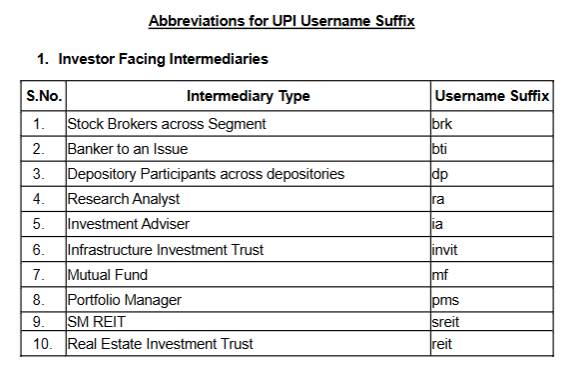
<username>: This is the unique identifier chosen by the intermediary..<intermediary category>: This crucial segment denotes the type of registration the intermediary holds with SEBI. For instance:iafor Investment Adviser.rafor Research Analyst.- Other categories may have their specific suffixes.
@valid: This is the most significant and defining feature. The inclusion of the word "valid" immediately signals that the UPI handle is associated with a SEBI-registered entity.<Bank Name>: This indicates the bank with which the intermediary has registered for payment collection.
Illustrative Examples:
-
For a Registered Investment Adviser (IA) named "ABC" using ICICI Bank:
A valid UPI handle would likely appear as:abc.ia@validicici
Here,.iaclearly indicates the "Investment Adviser" category, and@validconfirms its legitimacy. -
For a Research Analyst (RA) named "XYZ" using HDFC Bank:
A valid UPI handle would likely appear as:xyz.ra@validhdfc
Similarly,.rasignifies "Research Analyst," and@validassures the investor of its authenticity.
The Critical Indicator: The Presence of "@valid"
The presence of the word "valid" immediately after the "@" symbol is the non-negotiable hallmark of a SEBI-sanctioned UPI handle. If this keyword is absent from the UPI ID provided by an individual or entity, it is a red flag. Investors must understand that this is not an optional feature but a mandatory requirement for all SEBI-registered intermediaries. Any UPI handle lacking this specific marker signifies that the payment is likely being requested by an unregistered entity, and investors should refrain from engaging further.
Important Note: The word "valid" must appear after the "@" symbol, not before. This distinction is crucial in preventing deceptive variations.
QR Codes and UPI Handles: A Unified Verification Process
Often, investors are presented with QR codes for payment. It is essential to understand that a UPI QR code is merely a visual representation of a UPI address, and it ultimately translates into a UPI handle. Therefore, the same verification principles apply.
Before scanning a QR code or initiating a payment:
- Scan the QR Code: Use your preferred UPI app to scan the provided QR code.
- Review the Recipient Details: The app will display the recipient’s name and UPI ID.
- Verify the UPI Handle: Crucially, examine the displayed UPI handle for the presence of the "valid" keyword in the correct format (
@valid).
While some QR codes might display a thumbs-up icon as an additional indicator of legitimacy, investors should not solely rely on this. SEBI has acknowledged that such icons might not be foolproof. The most reliable method remains the strict adherence to the valid UPI handle format. Even if a QR code appears legitimate, always ensure that the underlying UPI address conforms to the mandated standard.
2. SEBI Check Feature: Verifying Bank Account Details
Fraudsters are adaptable and may attempt to circumvent UPI altogether by requesting funds via traditional bank transfers, such as NEFT, IMPS, or RTGS, providing only bank account details. To address this, SEBI has introduced the "SEBI Check" feature, a comprehensive online portal designed to verify the authenticity of bank account numbers and IFSC codes.
How the SEBI Check Feature Operates:
The SEBI Check feature allows investors to authenticate the genuineness of:
- Bank Account Numbers: By entering an account number, investors can ascertain if it belongs to a SEBI-registered intermediary.
- IFSC Codes: Similarly, verifying the IFSC code linked to an account provides an additional layer of assurance.
- PAN Numbers: While not explicitly stated for payment verification, the ability to check PAN numbers can be part of broader due diligence for intermediaries.
The Verification Process:
- Access the SEBI Check Portal: Investors can visit the dedicated SEBI Check portal at https://siportal.sebi.gov.in/intermediary/sebi-check.
- Input Required Details: Enter the bank account number and/or IFSC code provided by the individual or entity.
- Submit for Verification: The system will then cross-reference the provided details against SEBI’s database of registered intermediaries.
- Review the Results: The portal will indicate whether the account details are associated with a legitimate SEBI-registered entity.
Crucial Takeaway: If the QR code, UPI address, or bank details shared with you fail the "SEBI Check," it is a definitive sign that you are dealing with an imposter. In such scenarios, investors must cease all communication and refrain from transferring any funds.
Recognizing the Red Flags of Fraud
To further empower investors, SEBI has outlined clear indicators that suggest an individual or entity is likely a fraudster:
- Absence of "valid" in UPI Handle: As previously emphasized, the lack of
@validin a UPI ID is a primary red flag. - QR Codes Lacking UPI Handle Verification: Relying solely on a QR code without verifying the underlying UPI address for the "valid" marker is risky.
- Request for Direct Bank Transfers (NEFT/IMPS/RTGS) to Personal Accounts: While legitimate intermediaries may use these methods, they should be verifiable through SEBI Check. Be wary if the account details seem unusual or do not match the intermediary’s official communication.
- Unsolicited Contact and Pressure: Individuals who contact you out of the blue, aggressively push for quick investments, and promise unrealistic returns are often fraudsters.
- Lack of Official SEBI Registration: Always cross-verify the registration status of any intermediary. Legitimate entities will have their registration details readily available and verifiable on SEBI’s official website or through the SEBI Check portal.
- Demands for Upfront Fees or Investment Without Clear Service Description: Be suspicious of demands for significant upfront fees without a clear explanation of the services to be rendered or investment strategy.
Chronology of SEBI’s Investor Protection Measures
SEBI’s journey in fortifying investor protection is a continuous process. The introduction of these new tools follows a strategic roadmap aimed at adapting to evolving market dynamics and fraud tactics.
- Early Interventions: SEBI has historically implemented measures such as registration requirements for market intermediaries, disclosure norms, and investor grievance redressal mechanisms.
- Digital Evolution: With the rise of digital platforms and instant payment systems, SEBI recognized the need for more targeted and technologically advanced solutions.
- June 11, 2025 Circular: This landmark circular officially mandated the adoption of standardized, validated, and exclusive UPI IDs for payment collection by SEBI-registered intermediaries. It also paved the way for the integration of these UPI IDs with the SEBI Check feature.
- Ongoing Awareness Campaigns: SEBI, in collaboration with stock exchanges and industry bodies, consistently conducts investor awareness programs to educate the public about investment risks and preventive measures.
Supporting Data and Official Response
The impetus behind SEBI’s proactive measures is underscored by the growing volume of investor complaints related to fraudulent activities. While specific real-time data on the success rate of these new tools will emerge over time, the regulatory intent is clear: to create a robust deterrence against financial impersonation.
In a statement accompanying the circular, a SEBI spokesperson emphasized, "Our primary objective is to create an investment environment where every investor feels secure and empowered. The introduction of Valid UPI Handles and the SEBI Check feature are significant strides towards achieving this goal. We urge all investors to utilize these tools diligently and report any suspicious activities to SEBI."
The circular itself, officially titled "Adoption of Standardised, Validated and Exclusive UPI IDs for Payment Collection by SEBI Registered Intermediaries from Investors," outlines the technical specifications and compliance requirements for all registered entities. This document serves as the foundational legal framework for the implementation of these new investor protection measures.
Implications for Investors and the Market
The ramifications of SEBI’s latest initiatives are far-reaching:
- Enhanced Investor Confidence: By providing clear verification mechanisms, SEBI is likely to boost investor confidence, encouraging more individuals to participate in the capital markets without fear of falling victim to fraud.
- Deterrence of Fraudsters: The standardized UPI format and the SEBI Check feature make it significantly harder for imposters to operate undetected. This increased risk of exposure and identification is expected to deter a considerable number of fraudulent actors.
- Streamlined Due Diligence: Investors will no longer have to rely on guesswork or anecdotal evidence. The tools offer a direct and reliable way to perform essential due diligence before making any financial commitments.
- Greater Accountability for Intermediaries: Registered intermediaries are now bound by stricter payment verification protocols, fostering greater accountability and reinforcing ethical practices within the financial services sector.
- Reduced Burden on Grievance Redressal: By proactively preventing scams, SEBI can potentially reduce the volume of investor complaints related to fraud, allowing for more efficient resolution of other genuine grievances.
Conclusion: A Safer Investment Horizon
The escalating threat of stock market scams necessitated a robust and innovative response from the market regulator. SEBI’s introduction of "SEBI Valid UPI Handles" and the "SEBI Check" feature represents a significant leap forward in safeguarding investors. These tools empower individuals with the knowledge and means to verify the legitimacy of financial intermediaries and payment channels, effectively creating a digital shield against impersonation and fraud.
As the financial landscape continues to evolve, SEBI’s commitment to investor protection remains paramount. By embracing these new technologies and staying vigilant, investors can navigate the capital markets with greater confidence, secure in the knowledge that their hard-earned money is protected by a vigilant regulator and advanced verification systems. Staying alert, staying informed, and utilizing these invaluable tools are the keys to ensuring a safer and more prosperous investment future for all.