New Delhi, India – In an era where the pursuit of financial freedom often dominates personal aspirations, a growing chorus of financial experts is urging individuals to look beyond mere monetary accumulation. While a robust portfolio and secure retirement are undeniably crucial, true prosperity, they argue, is inextricably linked to a holistic integration of health, time, relationships, and personal contentment. This paradigm shift challenges the conventional definition of financial success, proposing that wealth is merely a tool, not the ultimate prize, in the construction of a fulfilling life.
The stark reality, as highlighted by seasoned financial planners, is that many individuals meticulously plan for their financial future, meticulously tracking retirement corpus, children’s education funds, and property acquisitions. However, a fundamental question often remains unaddressed: what is the intrinsic value of accumulated wealth if one lacks the vitality, time, or meaningful connections to truly savor it? This oversight, experts contend, can lead to a profound disconnect between financial attainment and genuine life satisfaction.
The Illusion of Wealth: Money’s Limited Currency
For over fifteen years, observing client after client navigate their financial journeys, a consistent truth has emerged: money, in isolation, possesses no inherent value. Wealth, detached from the individual’s capacity to experience it, remains inert. Anecdotal evidence abounds of individuals who, despite amassing significant financial assets, find themselves unable to enjoy the fruits of their labor due to debilitating health conditions or a lack of companionship. A substantial bank balance or a burgeoning mutual fund folio, while indicative of financial prudence, offers little solace if one is too unwell to travel, too isolated to share a meal with loved ones, or too time-poor to engage in cherished activities.
This perspective underscores a critical flaw in purely wealth-centric financial planning. When the sole focus is on accumulation, other vital pillars of a well-lived life are often neglected, leaving individuals with only a partial solution to the complex problem of achieving holistic well-being. The pursuit of financial freedom, therefore, must extend beyond the spreadsheet to encompass the fundamental elements that contribute to a rich and meaningful existence.
The Ten Pillars of True Prosperity: Beyond Financial Capital
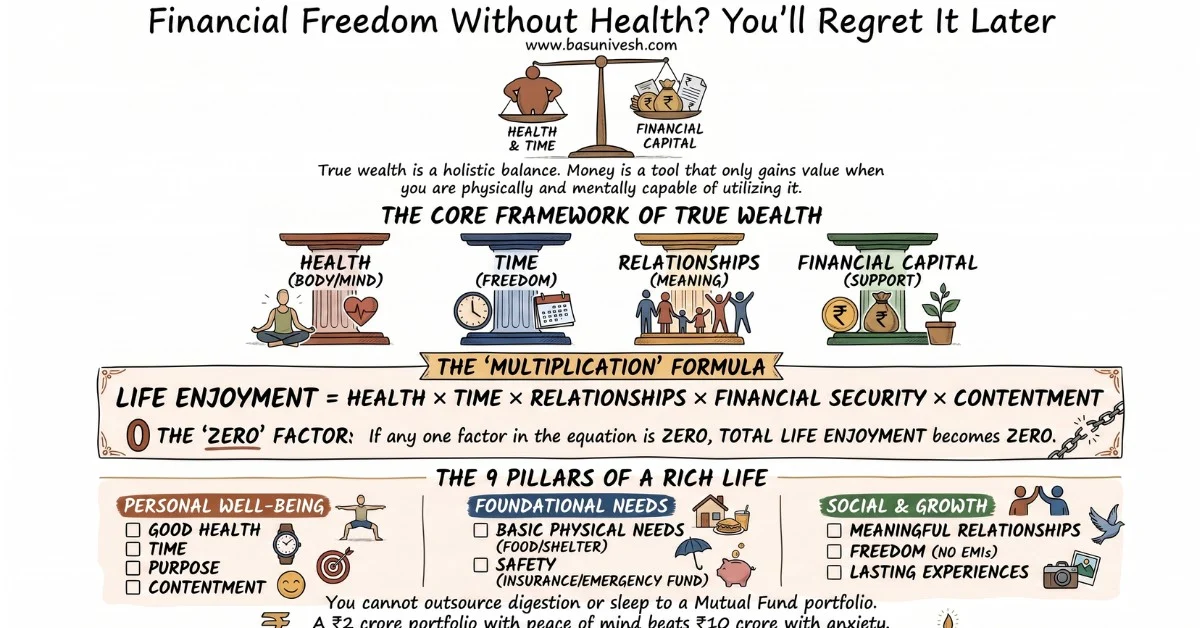
To truly unlock the enjoyment that wealth can afford, individuals must cultivate and protect ten essential pillars that form the bedrock of a fulfilling life. These are not mere abstract concepts but tangible aspects that directly influence our ability to experience happiness and satisfaction:
1. Robust Health: The Foundation of Enjoyment
Physical and mental well-being form the indispensable foundation upon which all other forms of enjoyment are built. This encompasses the ability to move freely, eat well, travel without hindrance, and achieve restful sleep, alongside a mind unburdened by chronic stress and possessing a sense of inner peace. No amount of financial capital can compensate for the loss of health; one cannot outsource the fundamental processes of digestion or the restorative power of a good night’s sleep to an investment portfolio. Proactive health management, therefore, is not an optional expenditure but a critical investment in one’s capacity to enjoy life.
2. The Precious Commodity of Time
While money can facilitate choices and expand opportunities, it possesses no power to generate more time. This is a realization that often dawns on individuals in their late 40s, a period when the healthiest years of earning may have been spent at the expense of personal time, only to be later traded for efforts to reclaim health. This represents a fundamentally poor exchange, emphasizing the importance of prioritizing time management and work-life balance alongside financial goals.
3. Unshakeable Financial Security
The psychological impact of financial security far outweighs the sheer magnitude of one’s portfolio. A portfolio that alleviates anxiety and provides peace of mind is inherently more valuable than a larger sum that perpetuates worry and sleepless nights. True financial security is about having sufficient resources to meet one’s needs without constant apprehension, fostering a sense of calm that allows for genuine enjoyment of one’s circumstances.
4. The Nourishing Embrace of Meaningful Relationships
Family, friends, and a strong sense of community are non-negotiable components of a happy life. The solitary celebration of success, devoid of loved ones, rarely yields lasting joy. Reflecting on life’s journey, it is seldom the time spent in the office that individuals wish they had more of on their deathbeds, but rather the moments shared with those they hold dear. Nurturing these connections is as vital as any financial investment.
5. The Essence of True Freedom
Wealth should ideally expand one’s options and grant greater autonomy, rather than becoming a gilded cage. If one’s financial resources are perpetually tied to servicing debt for assets that are not truly needed, or to maintaining a lifestyle solely to impress others, then this is not freedom, but a sophisticated form of entrapment. Genuine financial freedom liberates, rather than binds.
6. The Guiding Light of Purpose
A compelling reason to greet each day with enthusiasm is invaluable. Retirement, in this context, should not signify an end to meaningful engagement but rather the liberation to pursue work that resonates with one’s passions and values. For individuals managing their own investments, planning for purpose, not just a pension, is a more potent and fulfilling objective.
7. The Essential Foundation of Basic Physical Needs
The fundamental requirements of life – nutritious food, safe and comfortable shelter, access to clean water, appropriate clothing, and restful sleep – form the bedrock of human well-being. While often overlooked in complex financial plans laden with investment jargon, these basic necessities are the true determinants of our immediate quality of life.
8. The Shield of Safety and Protection
Ensuring personal safety, access to adequate healthcare, and financial resilience through robust insurance coverage and an emergency fund are paramount. These are not discretionary line items in a financial plan but rather the essential structural elements that provide security and peace of mind. Term life insurance, health insurance, and a well-funded emergency corpus are the cornerstones of a truly secure financial future.
9. The Lasting Value of Experiences
The pursuit of experiences, such as travel, lifelong learning, engaging in hobbies, and contributing to society, generally yields more profound and enduring satisfaction than the accumulation of material possessions. While a car depreciates the moment it is purchased, a cherished trip with loved ones can appreciate in memory and emotional value year after year.
10. The Pinnacle of Contentment
Perhaps the most elusive yet critical factor is contentment – the ability to recognize and appreciate when "enough is enough." Wealth devoid of contentment often fuels an insatiable desire for "just a little more," perpetuating a cycle of dissatisfaction. Individuals with modest financial resources but a profound sense of contentment can often experience greater peace than those with significantly larger portfolios but an unending craving for accumulation.
The Four Capitals: A Holistic Framework
To encapsulate this comprehensive view, financial planners often present a simplified model of four essential capitals that are necessary to truly enjoy wealth. This framework moves beyond the singular focus on financial capital:
- Health Capital: This refers to the vitality and well-being of one’s body and mind.
- Time Capital: This encompasses the years one has to live and the freedom to allocate them meaningfully.
- Relationship Capital: This represents the network of people who enrich life and provide emotional support.
- Financial Capital: This is the monetary resource that serves to support and enable the other capitals and life goals.
The absence or depletion of even one of these capitals can significantly diminish an individual’s capacity to enjoy their accumulated wealth. The stark reality is witnessing individuals with substantial financial capital but severely compromised health capital, where no amount of money can reclaim what has been lost.
The Undiscussed Equation of Life Enjoyment
This interconnectedness can be distilled into a simple, yet profound, equation that rarely finds its way into mainstream financial planning discourse:
Life Enjoyment = Health × Time × Relationships × Financial Security × Contentment
Crucially, this is a multiplication, not an addition. This multiplicative relationship highlights that if any single factor in the equation approaches zero, the overall potential for life enjoyment plummets dramatically, irrespective of the size of one’s financial capital. One cannot offset a complete lack of health with an increased savings rate, nor can lost time be redeemed through a higher compound annual growth rate (CAGR) on investments.
The True Purpose of Financial Planning: Living Well, Not Dying Rich
Therefore, the fundamental objective of financial planning should not be to accumulate wealth for the sake of dying rich, but rather to cultivate a life that is lived well. Financial freedom is not the ultimate destination but a powerful tool that empowers individuals to protect and nurture the other vital pillars – health, time, relationships, and contentment. It is the enabler that allows for genuine enjoyment of the life being meticulously built.
As individuals review their financial plans, the focus must broaden. Beyond portfolio performance and goal attainment, the critical question to ask is: "Is this plan actively safeguarding my health, my time, and my relationships?" If the answer is no, then even the most substantial financial freedom will ultimately feel like a profound lack of freedom. The true measure of financial success lies not in the zeros in one’s bank account, but in the richness and fulfillment of one’s lived experience.
The conversation around financial planning needs a fundamental recalibration, urging individuals to build not just wealth, but a life that is truly worth living and enjoying.