As the digital landscape pivots from traditional keyword-based search to generative AI-powered discovery, marketing teams are facing a new imperative: Artificial Intelligence Optimization (AEO). The shift is monumental. Consumers no longer just "search"; they engage with AI agents that synthesize, summarize, and recommend. Consequently, visibility—once the domain of blue links—is now measured by citations, brand mentions, and the nuanced presence of a company within a conversational AI response.
For organizations navigating this transition, selecting the right measurement infrastructure is critical. Profound and Bluefish AI have emerged as two of the most prominent players in this nascent space. While both aim to provide visibility into the "black box" of AI answers, they do so through fundamentally different philosophies, architectures, and service models.
The Evolution of AI Discovery: Why Measurement Matters
AEO is significantly more complex than tracking whether a brand appears in a search engine results page (SERP). An AI answer is dynamic; it is subject to model drift, regional variations, and the shifting underlying training data of engines like ChatGPT, Gemini, and Perplexity. A brand may appear in a response at 9:00 AM, only to be omitted by 2:00 PM due to a change in the model’s weightings or a new source citation.
A visibility score, in isolation, is a vanity metric. True AEO requires a "chain of evidence": the prompt, the AI’s verbatim response, the citations provided, and the specific brand mention. Without this context, teams cannot diagnose why visibility has fluctuated or determine whether a dip warrants a strategic pivot. As AI discovery continues to displace traditional organic traffic, the ability to trace these digital interactions has become the cornerstone of modern search strategy.

Comparing the Architectures: Profound vs. Bluefish AI
While both platforms offer daily visibility tracking, their approaches to data collection and model coverage reveal a divergence in market focus.
Engine Coverage and Model Cadence
Profound distinguishes itself through granular configurability. It provides users with deep control over regional settings and platform-specific parameters, allowing global teams to monitor how a brand appears in localized versions of AI engines. Its strength lies in its transparency; Profound’s documentation clearly delineates how data is captured, which is essential for brands that require a high degree of auditability.
Conversely, Bluefish AI takes a broader, more diversified approach, claiming coverage across 10+ models, including niche commerce-focused AI assistants. This makes Bluefish particularly attractive to e-commerce giants and retailers who need to monitor how their products are recommended during the "buying" phase of an AI interaction. Bluefish also emphasizes "model-drift" controls, a critical feature for maintaining consistent baselines in an environment where the underlying LLMs are updated with alarming frequency.
Citation Tracking and Actionable Feedback Loops
Citation analysis is where both platforms aim to provide the most ROI. Both tools identify the URLs cited by AI, but they differ in how they process this information.

Profound’s "FactCheck" feature is its primary differentiator. It allows teams to upload a proprietary Knowledge Base—essentially a "source of truth"—and automatically cross-references it against AI claims. If an AI engine hallucinates or misrepresents a brand, Profound flags the discrepancy and provides a pathway to update owned content or conduct PR outreach.
Bluefish utilizes a sophisticated "Impact Score" and "Influence Rank." These metrics attempt to quantify the strength of a source’s influence on the AI’s final output. While highly useful for SEO-heavy organizations, these metrics are model-based, meaning they are interpretations of data rather than direct, raw observations. For teams evaluating Bluefish, it is essential to understand the underlying modeling to avoid basing strategic decisions on potentially skewed algorithmic assumptions.
Data Capture Methods: The "How" Behind the Results
The methodology used to harvest data is the most common source of discrepancy between AEO platforms. Some providers use APIs, while others scrape the consumer-facing interfaces.
Profound maintains a strict policy of capturing responses directly from consumer-facing AI interfaces. The logic is sound: if you want to know what a customer sees, you must measure what the customer experiences. Bluefish’s methodology is more opaque, often referencing a mix of signals, including proprietary panel data and "controlled environments." While this often leads to more stable data, procurement teams should prioritize a demo that explicitly asks: "Where does this specific response come from?"

The Integration Ecosystem: Connecting AEO to Business Outcomes
Data is only as valuable as the decisions it informs. Both Profound and Bluefish recognize that AEO cannot exist in a vacuum.
Profound has invested heavily in enterprise-grade integrations. By funneling AI-driven insights into Business Intelligence (BI) tools and Google Analytics, Profound allows for a direct comparison between "AI visibility" and "business outcomes." For example, a team can see if a spike in AI citations for a specific product correlates with an increase in tracked conversions on their website.
Bluefish AI focuses on the "closed-loop" attribution model. Its suite allows teams to group URLs into collections and associate specific marketing tactics with those groups. This "test-and-learn" cycle is ideal for organizations with dedicated AEO teams that are aggressively iterating on their content strategy. However, prospective buyers should look for concrete evidence of how these tools integrate with their specific CRM and analytics stack to avoid data siloing.
Governance, Security, and Enterprise Fit
For the modern enterprise, the security of the AEO platform is non-negotiable. Both Profound and Bluefish have achieved SOC 2 Type II compliance, which is the baseline requirement for any enterprise-grade software.

Profound, however, leans into the "audit-ready" nature of its platform, providing extensive documentation on role-based permissions, data retention policies, and encryption. It is built with the assumption that legal and IT security teams will be scrutinizing the tool.
Bluefish, while secure, operates with a more service-oriented model. It is often described as "HIPAA Ready" and provides bespoke support for organizations with complex compliance needs. The decision here often comes down to internal culture: does the team want a highly configurable, self-serve platform (Profound), or a managed, service-led partnership (Bluefish)?
Onboarding and the "Time to Signal"
The "Time to Value" is a frequent pain point in the AEO space. Because these tools require the setup of complex prompt libraries, onboarding can be labor-intensive.
Profound encourages a "strategic-first" approach, advising users to start with 5–10 core topics. This prevents the "analysis paralysis" that often plagues teams when they try to track thousands of irrelevant prompts. Bluefish, by contrast, functions more like an extension of a marketing agency. Their onboarding often includes custom strategy sessions, making it a strong choice for brands that lack an internal AEO specialist.

Final Implications: Which Path Should You Choose?
The choice between Profound and Bluefish AI ultimately rests on the "ownership" of the AEO function within the organization.
- Choose Profound if: Your organization values transparency, auditability, and deep, self-serve configurability. If you have an internal team that wants to own the "FactCheck" process and integrate AI data directly into your existing BI stack, Profound provides the infrastructure to do so effectively.
- Choose Bluefish AI if: You require a service-led partnership, operate in a highly regulated industry with complex compliance requirements, or need to track a massive volume of products across disparate AI models. It is an excellent choice for organizations that need a "done-for-you" strategy to supplement their internal operations.
The Role of HubSpot AEO
It is important to note the entry of platforms like HubSpot AEO, which bridges the gap between dedicated AEO tools and broader marketing workflows. For teams already embedded in the HubSpot ecosystem, the ability to trigger content updates or marketing workflows directly from an AEO insight is a significant operational advantage. HubSpot AEO provides the essential "signals"—visibility, citations, and competitor presence—across major engines, effectively serving as a "first-tier" solution for brands looking to establish a baseline before investing in a highly specialized, enterprise-only platform.
Conclusion: The Path Forward
The era of "passive" SEO is ending. Whether a brand chooses Profound, Bluefish AI, or an integrated solution like HubSpot AEO, the primary objective remains the same: the transition from measuring clicks to measuring influence.
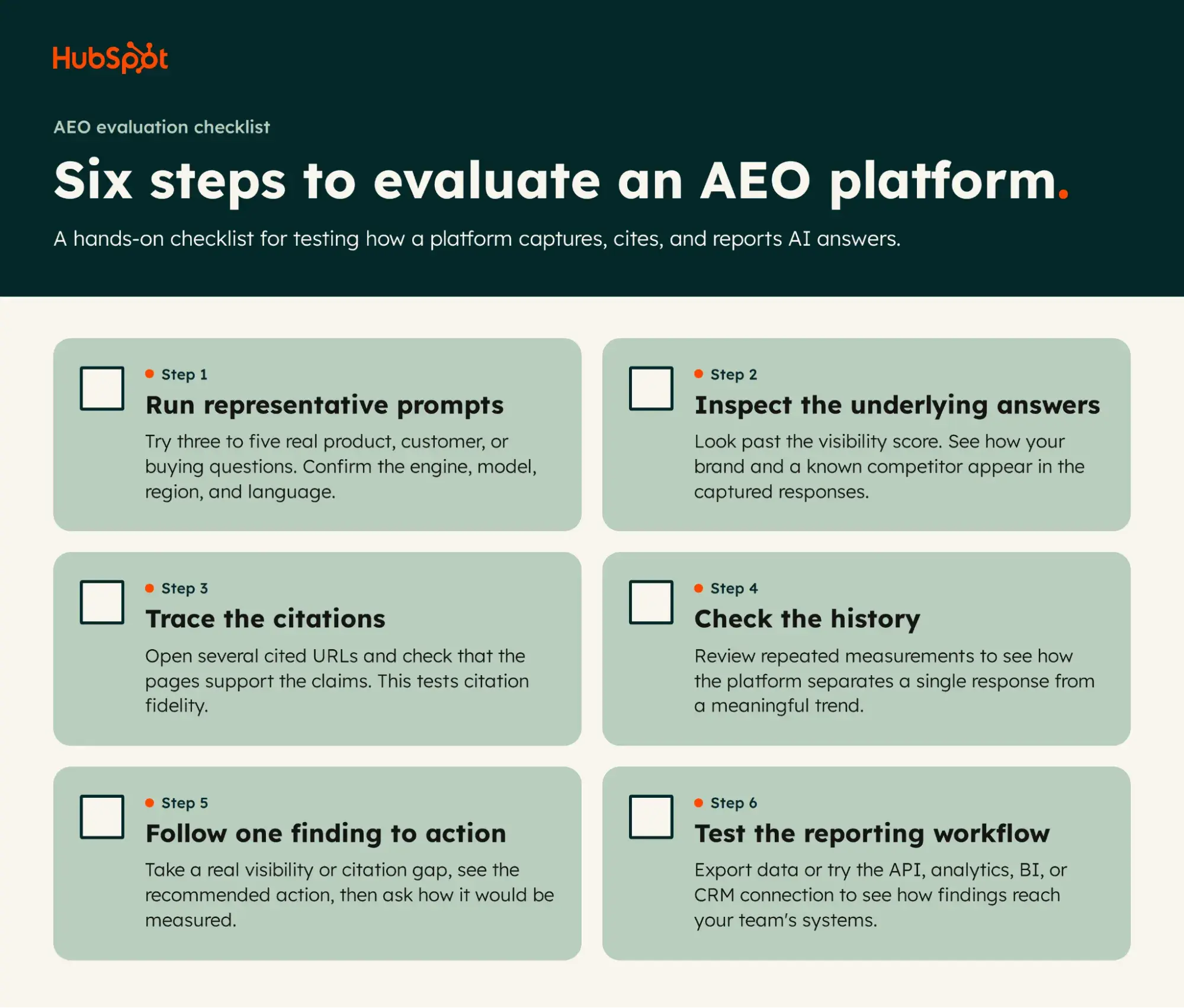
The most successful brands will be those that adopt a structured approach to AEO, treating it as an iterative cycle of diagnosis, action, and re-measurement. As AI models continue to evolve, the tools that provide the most granular, transparent, and actionable data will define the winners in this new, competitive landscape of machine-generated discovery. Before signing any contract, teams should mandate a "real-world" demo—using their own, most difficult, and most critical search prompts—to see which platform actually provides the clarity needed to lead in the age of AI.