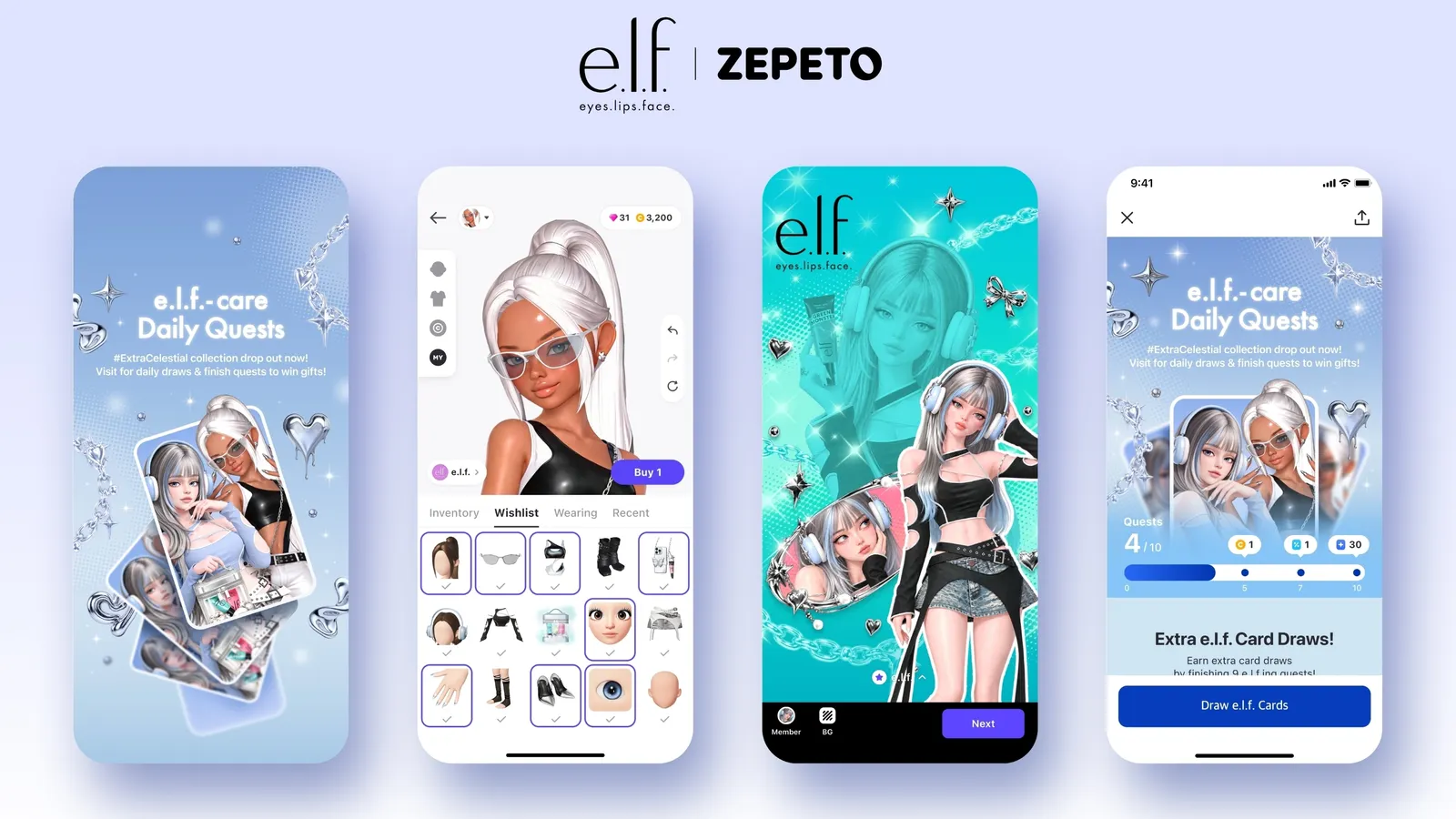
In an era where the lines between physical vanity and digital identity are increasingly blurred, E.l.f. Cosmetics is once again positioning itself at the vanguard of consumer engagement. The company, which has consistently outperformed its peers by courting Gen Z through innovative gaming and social media strategies, has officially launched its latest immersive activation on the metaverse-adjacent platform, Zepeto.
Titled “Express your e.l.f.,” the initiative invites Zepeto’s 15–20 million monthly active users to deck out their avatars in digital makeup and accessories inspired by the brand’s popular “Power Grip” product line. This move represents more than just a marketing stunt; it is a calculated effort to weave the E.l.f. brand into the daily habits of a demographic that views virtual self-expression as an extension of their real-world identity.
The Intersection of Beauty and Virtual Identity
For E.l.f. Cosmetics, the decision to migrate to Zepeto—a Korean-born “avatar-based social universe”—is grounded in demographic data. With approximately 70% of Zepeto’s user base falling within the Gen Z cohort, the platform serves as a high-affinity environment for the beauty brand.
Unlike static social media feeds, Zepeto requires constant maintenance of one’s digital persona. Users update their avatars an average of 14 times per week, a frequency that provides E.l.f. with a continuous stream of opportunities to remain top-of-mind. By allowing users to apply virtual versions of the Power Grip line, E.l.f. is effectively gamifying product discovery. The strategy is simple yet potent: when a user experiments with a virtual look, they are subconsciously priming themselves for a future physical purchase.
A Chronology of Digital Dominance
To understand the weight of the Zepeto activation, one must look at E.l.f.’s track record of digital innovation over the past several years. The brand has evolved from a budget-friendly drugstore staple to a digital-first powerhouse.
- Early Gaming Forays (2023-2024): E.l.f. began its serious expansion into gaming by identifying platforms where its core audience spends the most time. This included pioneering livestream shopping ads on Twitch, where the brand claimed the title of the number one beauty presence.
- The Roblox Breakthrough: The launch of “Glow Up!” on Roblox marked a turning point. By creating a branded environment that prioritized user experience over aggressive advertising, the game became the top makeup-focused experience on the platform, proving that Gen Z players would willingly engage with brand IP if it added value to their gameplay.
- Metaverse Experimentation (2025): As competitors scrambled to understand the virtual landscape, E.l.f. maintained a steady, disciplined approach, focusing on utility and aesthetic expression rather than speculative real estate.
- The Zepeto Launch (October 2026): Following a year of high-growth earnings, the brand entered Zepeto, moving beyond traditional gaming and into the realm of social avatar interaction, further cementing its position as a lifestyle brand rather than a mere cosmetics manufacturer.
Supporting Data: By the Numbers
The success of E.l.f. is not merely anecdotal; it is backed by robust financial and engagement metrics. In its fiscal first quarter ended June 30, 2026, E.l.f. Beauty reported net sales of $479.4 million—a staggering 36% year-over-year increase. This growth is directly correlated to the brand’s ability to convert digital engagement into tangible market share.
Furthermore, the longevity of these platforms offers a compelling case for investment. While the broader "Metaverse" narrative—once hyped to reach a $900 billion valuation by 2030—has faced significant skepticism and cooling interest, platforms like Zepeto, Roblox, and Fortnite have proven resilient. They have succeeded where corporate-led virtual worlds failed because they are fundamentally centered on community and self-actualization rather than top-down corporate mandates.
Zepeto’s architecture is specifically designed for high-frequency engagement. By allowing users to trade, customize, and display virtual items, the platform creates a digital economy that mirrors real-world fashion cycles. For E.l.f., the ability to drop "digital collections" that coincide with physical product launches creates a cohesive marketing ecosystem that traditional billboard or television advertising cannot replicate.
Official Perspectives: Breaking Down Boundaries
The philosophy driving these moves comes directly from the top. Patrick O’Keefe, Chief Integrated Marketing Officer at E.l.f. Brands, has been vocal about the brand’s refusal to accept traditional industry boundaries.
“As a different kind of company, e.l.f. does not see boundaries between where beauty lives and where culture happens,” O’Keefe stated in recent press materials. “We meet our community where they like to play and give them a platform to fuel discovery, empowerment, and self-expression.”

This statement underscores a shift in the role of the Chief Marketing Officer. It is no longer enough to manage a brand image; one must manage a cultural presence. By framing beauty as a form of cultural play, E.l.f. removes the friction of "selling" and replaces it with the joy of "participating." This is a crucial distinction that keeps the brand from feeling intrusive in the virtual environments it occupies.
The Implications for the Beauty Industry
The E.l.f. and Zepeto partnership has profound implications for the future of retail. As Walmart demonstrated in 2025 by launching its first e-commerce experience on Zepeto, the platform is rapidly evolving from a social hub into a legitimate sales channel.
1. The Death of the Traditional Funnel
The traditional marketing funnel—awareness, interest, desire, action—is being compressed. In a virtual world, the "desire" and "action" phases can occur simultaneously. If a user can see how a product looks on their avatar and immediately purchase the physical item (or a digital accessory) within the same interface, the conversion path is shortened, and the likelihood of purchase increases.
2. The Rise of "Phygital" Strategy
E.l.f. is setting a standard for "phygital" (physical + digital) retail. By linking the Power Grip line to virtual assets, they are creating a dual-value proposition. The virtual asset provides immediate gratification and social signaling, while the physical product provides the functional beauty benefit. This duality is likely to become the gold standard for consumer goods companies in the next decade.
3. The Resilience of Gaming-Adjacent Platforms
The narrative surrounding the "death of the metaverse" is, at best, premature. While the grand, centralized vision of a singular, interconnected virtual world may have faltered, the "splinternet" of gaming platforms is thriving. Brands that recognize this nuance—like E.l.f.—are finding success by embedding themselves into existing, healthy ecosystems rather than trying to build their own.

4. Cultivating Future Loyalty
By targeting Gen Z through these platforms, E.l.f. is playing a long game. The brand is establishing itself as a native element of the digital generation’s lives. Today’s Zepeto user is tomorrow’s primary consumer; by the time they reach full financial independence, their brand loyalty to E.l.f. will be deeply entrenched, reinforced by years of virtual interaction and positive brand experiences.
Conclusion: A Blueprint for the Future
As E.l.f. Cosmetics continues to scale, its strategy serves as a blueprint for any brand looking to remain relevant in a digital-first economy. The company’s success in Zepeto is not just about the makeup; it is about recognizing that in the modern world, "culture" is a digital space.
By prioritizing the user’s need for creative autonomy, E.l.f. has managed to bypass the skepticism that often accompanies corporate entries into virtual spaces. Instead of being an outsider attempting to monetize a community, E.l.f. has become a facilitator of that community’s creativity. Whether this trend continues to yield high returns remains to be seen, but for now, E.l.f. has clearly identified the winning formula: meet the consumer where they are, give them tools to express themselves, and treat digital interaction with the same level of seriousness as physical retail.
As the digital landscape evolves, one thing is certain: E.l.f. will likely be there, waiting with the next generation of virtual tools to ensure that its community continues to "Express their e.l.f." in every world they inhabit.