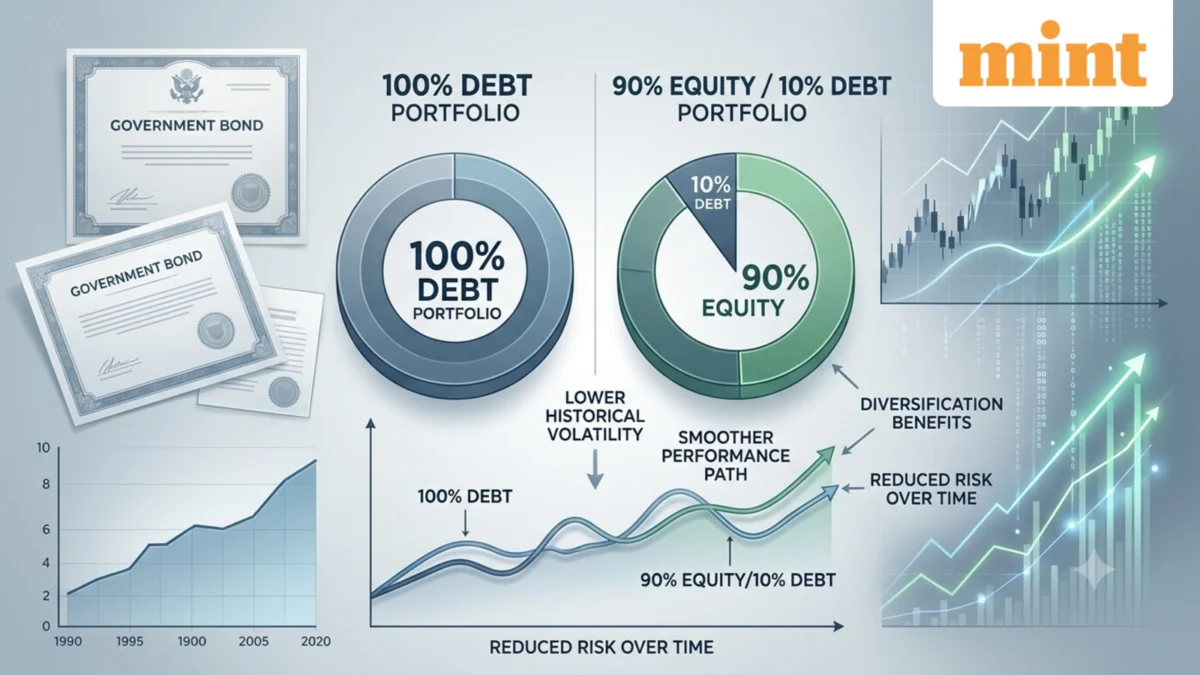
For generations, the bedrock of conservative financial planning has been the "safety" of debt instruments. Whether it is government bonds, fixed deposits, or debt mutual funds, the prevailing wisdom suggests that avoiding the stock market is the surest way to preserve capital. However, a comprehensive 25-year study by WhiteOak Capital Mutual Fund, titled "Chemistry of Investing," challenges this long-held dogma, suggesting that a pure debt portfolio may actually be riskier—and less rewarding—than a strategy that incorporates a modest equity component.
The Myth of the "Safe" All-Debt Portfolio
In the world of personal finance, risk is frequently conflated with volatility. Investors often equate the absence of stock market fluctuations with safety. Consequently, many risk-averse individuals park their entire corpus in debt instruments, believing they are immunizing their wealth against market shocks.
The WhiteOak Capital study, which analyzed market data from September 2001 to September 2026, exposes a critical flaw in this approach. By examining the interplay between the CRISIL 10-Year Gilt Index (representing debt) and the BSE Sensex Total Return Index (TRI) (representing equity), researchers found that the path to true portfolio efficiency is rarely found at the extremes.
The study reveals that a portfolio consisting of 90% debt and 10% equity actually experienced lower volatility than a portfolio consisting of 100% debt. This counterintuitive finding suggests that the slight inclusion of equity acts as a stabilizer, or a "diversification hedge," rather than a source of added danger.
Chronology of Market Performance (2001–2026)
To understand these findings, one must look at the historical context of the study period. Spanning a quarter-century, the data covers multiple market cycles, including the 2008 Global Financial Crisis, the post-2013 taper tantrum, the 2020 pandemic-induced crash, and the subsequent recovery phases.
- 2001–2008: The Growth Phase: This period saw the Indian equity market transition from a nascent stage to a global investment destination. Pure debt portfolios provided steady, predictable yields, but they failed to capture the massive upside of the mid-2000s equity bull run.
- 2008–2009: The Crisis Period: During the Global Financial Crisis, equities plummeted, but the diversification benefits of holding even a small amount of debt became apparent. Conversely, the study shows that in the long run, the "drag" of holding only debt resulted in significant opportunity costs.
- 2010–2026: The Era of Complexity: As inflation patterns fluctuated and interest rate cycles became more erratic, the returns on pure debt instruments faced pressure. The data from the last decade suggests that relying solely on fixed income in an inflationary environment often leads to a decline in real (inflation-adjusted) purchasing power.
Data-Driven Insights: The "Chemistry" of Asset Allocation
The core value of the WhiteOak Capital study lies in its quantitative breakdown of risk versus reward. By utilizing rolling returns—a method that looks at performance over fixed periods across multiple start dates—the study removes the bias of choosing a single "lucky" or "unlucky" investment date.
Comparative Performance Matrix
| Portfolio Composition (Debt:Equity) | Avg. Annual Return | Avg. Annual Volatility (Std. Deviation) |
|---|---|---|
| 100% Debt | 6.74% | 6.36% |
| 90% Debt / 10% Equity | 7.93% | 5.77% |
| 80% Debt / 20% Equity | 9.11% | 6.40% |
| 75% Debt / 25% Equity | 9.70% | 7.10% |
| 50% Debt / 50% Equity | 12.66% | 12.41% |
| 0% Debt / 100% Equity | 18.58% | 25.34% |
Source: WhiteOak Capital Mutual Fund (Data: Sep 2001 – Sep 2026)
The data paints a compelling picture. The "sweet spot" for many conservative investors appears to be the 90:10 allocation. By introducing just 10% equity, the investor not only boosts their average annual return by over 1.1% but simultaneously lowers their risk profile (as measured by standard deviation) from 6.36% to 5.77%.
As the allocation shifts further toward equity, the returns climb, but the volatility increases proportionally. The 100% equity portfolio, while yielding the highest returns at 18.58%, demands a level of emotional and financial fortitude that many investors lack, given its staggering 25.34% volatility.

Implications for Modern Mutual Fund Investors
The findings of this study have profound implications for how financial advisors and retail investors should structure their portfolios.
1. The Redefinition of "Risk"
Risk should not be defined merely as "downside movement." It must include "shortfall risk"—the risk that your portfolio fails to grow enough to outpace inflation and meet your long-term life goals. If a 100% debt portfolio yields 6.74% while inflation hovers at 5-6%, the real return is negligible. The study suggests that adding equity is a legitimate strategy to combat this silent destroyer of wealth.
2. The Power of Rebalancing
While the study highlights the benefits of specific allocations, it implicitly advocates for the discipline of rebalancing. When the equity portion of a 90:10 portfolio grows, the investor must periodically sell some equity and buy debt to return to the original allocation. This mechanical process forces the investor to "sell high and buy low," a cornerstone of successful long-term investing that is absent in a static 100% debt portfolio.
3. Tailoring to Personal Horizons
The study does not advocate for a one-size-fits-all approach. Younger investors with longer time horizons may find the 60:40 or 70:30 splits more appropriate, as they have the capacity to ride out the higher volatility associated with these structures. Conversely, those nearing retirement may find that a 90:10 or 80:20 split provides the necessary growth to protect against longevity risk without exposing their nest egg to excessive market swings.
Expert Perspective: What the Industry Says
Industry analysts point out that while the numbers are mathematically sound, investors must account for psychological barriers. "It is one thing to see a spreadsheet showing 5.77% volatility, and quite another to watch your portfolio drop during a market crash," notes a senior market strategist. "The ‘chemistry’ of investing is as much about the investor’s temperament as it is about asset classes."
Furthermore, experts emphasize that these findings assume a long-term holding period. For short-term goals (under 3 years), the volatility of even a small equity component could be detrimental. The primary lesson here is not that debt is "bad," but that the exclusion of equity is an active choice that comes with its own set of risks—specifically, the risk of sub-par performance.
Conclusion: A Shift in Strategy
The "Chemistry of Investing" study serves as a necessary wake-up call for the "safety-first" crowd. By clinging to a 100% debt allocation, many investors have been inadvertently accepting higher risk in the form of lower returns.
The path forward is one of nuanced balance. By embracing a modest equity tilt, investors can optimize their portfolios to achieve a better "Sharpe ratio"—a measure of risk-adjusted return. As you review your financial plan, consider whether your current debt-heavy allocation is truly protecting you, or if it is merely shielding you from the growth necessary to secure your financial future.
Disclaimer: This article is for informational purposes only and does not constitute professional financial advice. Market investments are subject to risk. Please consult with a SEBI-registered investment advisor or a qualified financial planner before making any changes to your portfolio.