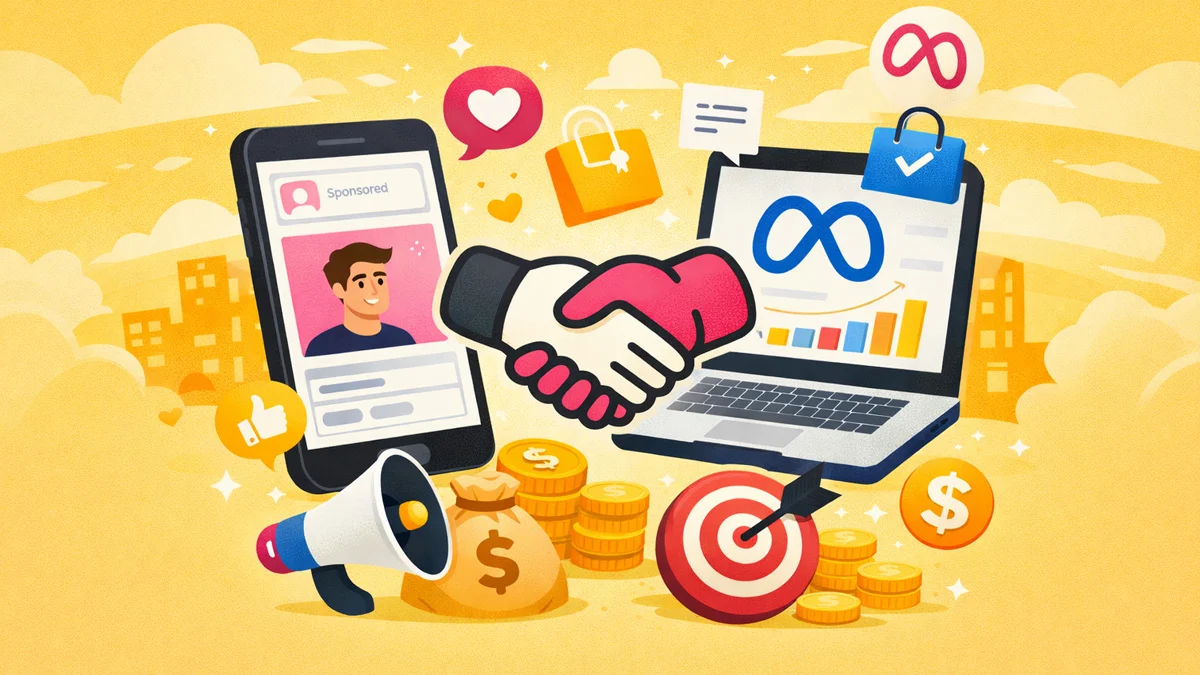
In a strategic shift that redefines the relationship between digital creators and global brands, Meta is aggressively moving to cement its position as the primary architect of the creator economy. During its third-quarter earnings call on October 21, 2026, the tech giant revealed that its "Partnership Ads" business has experienced explosive growth, surging more than 97% year-on-year. With the segment now boasting an annual revenue run-rate exceeding $15 billion, Meta is clearly signaling that creators are no longer mere peripheral influencers, but the central engine driving its multi-billion-dollar advertising machinery.
Main Facts: The Evolution of Partnership Ads
Meta’s latest financial disclosures underscore a fundamental change in how advertising is executed across its ecosystem, which includes Instagram, Facebook, and WhatsApp. Partnership Ads—a format that allows brands to collaborate directly with creators to run co-branded advertisements—have evolved from a niche offering into a pillar of the company’s advertising suite.
The core of this growth is the global rollout of the Creator Marketing Hub. Now accessible to all advertisers, this platform functions as a centralized command center for creator-led marketing. It consolidates three traditionally siloed processes—discovery, organization, and activation—into a single, frictionless workflow. By granting brands access to a searchable database of over 10 million creators, Meta has removed the "search and vet" friction that has long plagued influencer marketing, turning a manual, fragmented industry into a streamlined, automated advertising operation.
Chronology: Building the Infrastructure
The path to this quarter’s record-breaking figures has been marked by a series of deliberate, incremental updates aimed at "industrializing" creator partnerships.
- Early 2026: Meta begins beta testing the Creator Marketing Hub in select regions, testing AI-driven discovery tools that allow brands to filter creators based on audience demographics and content performance.
- Mid-2026: The integration of Meta AI Business Assistant into the advertising workflow begins, providing brands with a conversational interface to identify high-potential creator content.
- October 21, 2026 (Q3 Earnings): Meta announces the global rollout of the Creator Marketing Hub. The company reports the 97% year-on-year growth in Partnership Ads and highlights the $15 billion annual revenue run-rate.
- Late 2026 (Ongoing): Meta continues the rollout of "Meta One," a unified subscription service that integrates business-specific AI tools for creators and enterprises, further tightening the grip of the Meta ecosystem on professional content creators.
Supporting Data: By the Numbers
The scale of Meta’s current advertising expansion is immense. To understand the significance of the $15 billion Partnership Ads milestone, it is necessary to view it against the broader backdrop of Meta’s financial performance:
- Total Ad Revenue: Meta’s "Family of Apps" advertising revenue hit $63.1 billion in Q3 2026, a 26% increase year-on-year.
- Ad Pricing and Volume: The company saw a 10% increase in total ad impressions, complemented by a 14% rise in the average price per ad, suggesting that the inventory being sold—particularly through creator-led formats—is commanding a premium.
- AI Adoption: Nearly 10 million advertisers utilized at least one generative AI advertising creative tool during the third quarter. Furthermore, adoption of Meta’s video-generation features grew by 25% quarter-on-quarter.
- Subscription Momentum: The "Meta One" service, which offers advanced AI capabilities and business management tools, surpassed 15 million subscriptions and trials during the quarter.
While the $15 billion run-rate is an impressive indicator of momentum, Meta has been careful to manage expectations. The company has not provided a precise breakdown of revenue by market, specific creator category, or the direct contribution of AI tools to individual campaign performance metrics.
Official Responses and Strategic Vision
During the earnings call, Meta’s leadership emphasized that the integration of AI is not merely a feature, but the foundational architecture for the future of its business. By embedding the Meta AI Business Assistant directly into the Creator Marketing Hub, Meta is attempting to democratize professional-grade influencer marketing.
"The goal is to reduce the friction involved in finding suitable creators and putting their content to work," a spokesperson noted during the analyst briefing. The company maintains that the "Meta One" subscription—while a revenue stream in its own right—is designed to provide businesses and creators with the specialized capabilities needed to remain competitive in an AI-saturated market.
Notably, Meta continues to reinforce its commitment to a "freemium" model. The core experience across Facebook, Instagram, and WhatsApp remains free, ensuring that the pool of 10 million creators—the primary fuel for the Partnership Ads machine—remains as large and diverse as possible. Subscriptions are positioned as an "upgrade" for power users and businesses, offering advanced analytics and automated campaign optimization.
Implications for the Industry
The shift toward automated, AI-assisted creator marketing has profound implications for both brands and the creator economy.
1. The Death of Manual Influencer Marketing
For years, influencer marketing was characterized by slow, manual negotiations and inconsistent campaign measurement. By folding discovery and activation into the existing advertising infrastructure, Meta is forcing creator marketing to mirror the performance-based metrics of traditional digital ads. Brands now expect the same "click-to-conversion" tracking for a creator’s video that they would for a standard display banner.
2. The Rise of the "Algorithmic Creator"
With Meta AI assisting in the selection and optimization of content, the role of the creator is changing. Success on the platform is increasingly tied to how well a creator’s content aligns with the data-driven preferences of the algorithm. This may lead to a homogenization of content as creators optimize for "discoverability" within Meta’s search systems, but it also provides a clear path to monetization for creators who understand how to leverage these new tools.
3. A New Revenue Moat
By bundling creator partnerships, generative AI, and subscription services like Meta One, the company is building a formidable "moat." Advertisers who adopt these tools become deeply embedded in the Meta ecosystem. Switching to a competitor becomes increasingly difficult when a brand’s entire workflow—from AI-driven creator discovery to video production and ad-spend management—is housed within a single, integrated platform.
4. The Challenge of Quality and Relevance
Despite the impressive growth, a significant challenge remains: can Meta maintain the authenticity that makes creator content effective in the first place? As AI-generated and AI-curated content floods the feeds, the risk of "creative fatigue" grows. The next phase for Meta will be to prove that its tools do not just generate more ads, but better, more relevant ads that yield sustained returns on investment (ROI) for advertisers.
Conclusion: The Next Frontier
Meta’s transition from a social media company to an integrated advertising and creator-management ecosystem is well underway. The $15 billion run-rate for Partnership Ads is more than just a financial milestone; it is a declaration that the company has successfully integrated human creativity into its automated ad-targeting engine.
As Meta enters the final stages of 2026, the focus will shift from simple adoption to performance verification. Advertisers are no longer satisfied with the mere existence of these tools; they will soon demand transparent data on how AI-driven discovery and Partnership Ads contribute to bottom-line conversions. If Meta can prove that its AI-powered creator ecosystem produces superior returns compared to traditional advertising, the company will have successfully secured its dominance in the digital economy for the foreseeable future.
For the creators themselves, the landscape is now one of unparalleled scale—offering the potential to reach global audiences at the click of a button—provided they are willing to play by the rules of the platform’s new, AI-driven reality.