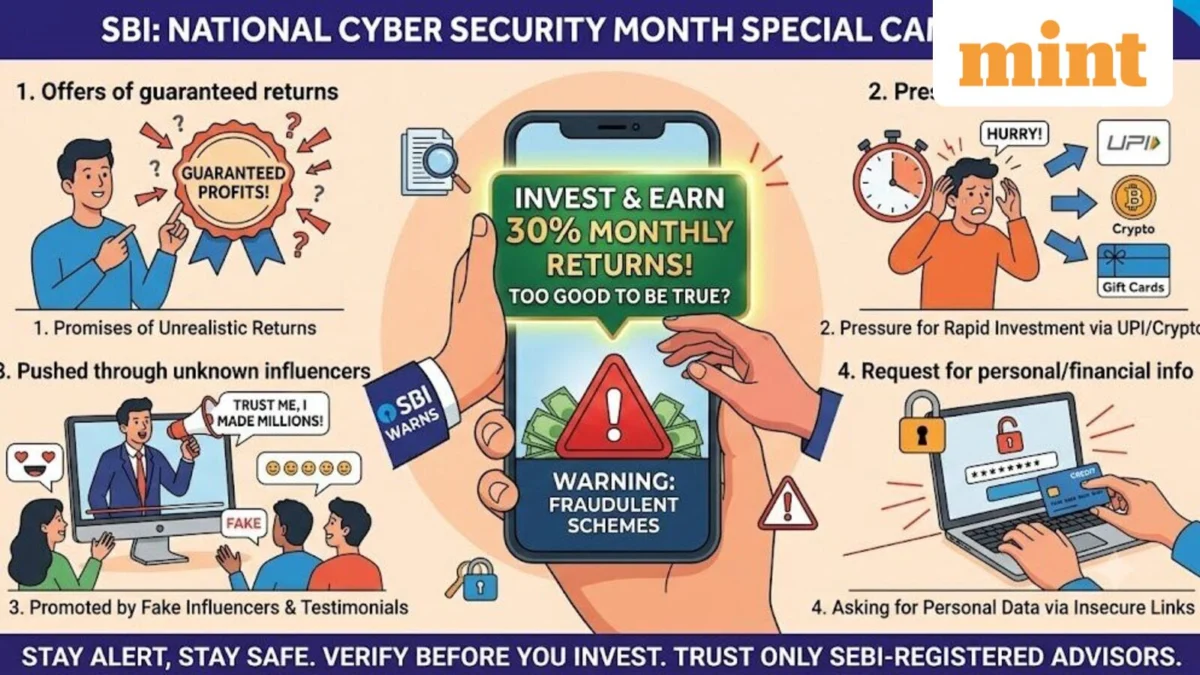
In an era where digital connectivity has revolutionized personal finance, it has simultaneously opened a Pandora’s box of sophisticated financial fraud. As retail participation in stock markets and digital investments reaches an all-time high, the State Bank of India (SBI), the nation’s largest lender, has issued a stern advisory warning citizens against fraudulent investment schemes that promise exorbitant returns—specifically those claiming to generate 30% monthly profits.
This warning, issued as part of the "National Cyber Security Month Special Campaign 6.0," serves as a critical wake-up call for investors who are increasingly targeted by sophisticated cybercriminals masquerading as legitimate investment advisors.
The Anatomy of the Scam: How Fraudsters Lure Victims
The mechanics behind these fraudulent schemes are as simple as they are lethal. Typically, scammers utilize social media platforms—such as WhatsApp, Telegram, and Instagram—to create an illusion of exclusivity and high-reward opportunities.
The strategy often involves:
- The Hook: Fraudsters post advertisements promising "guaranteed" monthly returns of 20% to 30%, far outpacing any legitimate asset class, including equity markets or real estate.
- Social Proof: To build credibility, scammers often use fake testimonials, doctored screenshots of high-profit trading accounts, and manipulated bank statements to show that other investors are already "getting rich."
- Urgency and FOMO: Potential victims are pressured to act quickly. They are told that the investment window is closing or that the "expert" is only accepting a limited number of participants.
- The Technical Facade: Victims are directed to fake websites or mobile applications that mimic the interfaces of reputable brokerage houses. These platforms show the user’s "investment" growing daily, creating a sense of false security that encourages further, larger deposits.
Official Stance: SBI’s Call for Vigilance
On October 12, 2026, the State Bank of India utilized its official social media channels to cut through the noise of these fraudulent promises. In a clear, unequivocal message, the bank stated: "If it sounds too good to be true, it definitely is! Fraudsters lure victims with fake investment schemes and steal hard-earned money. Don’t fall for quick-rich traps. Verify before investing."
The bank emphasized that the current surge in online financial fraud requires a proactive approach from the public. By tagging the Department of Financial Services (DFS) and official cyber security channels, the SBI is signaling a coordinated effort to combat what has become a systemic threat to household savings.
Understanding the "Too Good to Be True" Metric
Financial literacy is the strongest defense against such scams. To put the 30% monthly return claim into perspective: even the most successful hedge fund managers and legendary investors, such as Warren Buffett, have historically aimed for annual returns in the range of 20% to 25%.
When an unknown entity promises 30% per month, they are essentially claiming to outperform the world’s best investors by a factor of 12 or more on an annual basis. Mathematically, such compounding would turn a modest ₹10,000 investment into over ₹2.3 lakh in just one year. Any scheme offering such yields without the high-risk disclosure associated with speculative trading is, by definition, a Ponzi scheme or a simple theft mechanism.
Four Critical Red Flags to Watch
Investors are urged to be hyper-vigilant when encountering these four common warning signs of financial fraud:
1. Unsolicited Communication
Legitimate investment firms do not send random messages on WhatsApp or Telegram offering "guaranteed" profits. If you receive an unsolicited link from a number you do not recognize, it is almost certainly a phishing attempt.
2. High-Pressure Sales Tactics
Legitimate financial planning is a consultative process. If an individual or an online group is pressuring you to transfer funds immediately—often into personal bank accounts rather than a registered corporate entity—this is a massive red flag.

3. Lack of Regulatory Transparency
Every legitimate financial intermediary in India must be registered with the Securities and Exchange Board of India (SEBI) or the Reserve Bank of India (RBI). Scammers often lack these registrations or provide fake license numbers.
4. Obscure Payment Methods
Be wary if you are asked to deposit money into personal bank accounts (mule accounts) or via cryptocurrencies. Reputable platforms only accept payments through secure, transparent channels linked to their official corporate registration.
Protecting Your Savings: A Step-by-Step Guide
The responsibility of financial safety lies with the investor. Here is how you can shield yourself from these digital predators:
Verify Before You Trust
Always check the SEBI website for a list of registered brokers and investment advisors. If the firm is not on the list, do not engage. A simple search for the entity’s name in the SEBI database can prevent the loss of your life savings.
Avoid Clicking Suspicious Links
Malware and phishing links can capture your personal information, including bank credentials, the moment they are clicked. Always navigate directly to the official websites of known financial institutions by typing the URL manually into your browser.
Keep Personal Information Private
Never share your PAN card, Aadhaar details, or bank OTPs with anyone claiming to be an "investment expert" on social media. Financial institutions have strict KYC (Know Your Customer) protocols that do not involve sharing sensitive credentials via chat apps.
Report Fraudulent Activities
If you encounter a scam, do not just delete the message. Report it to the National Cyber Crime Reporting Portal at www.cybercrime.gov.in or call the helpline at 1930. By reporting these numbers and websites, you contribute to a larger effort to dismantle these fraud networks.
The Broader Implications for the Financial Ecosystem
The proliferation of these scams has broader implications for the Indian financial system. As millions of new investors enter the market, the ease of access to digital tools has outpaced the development of digital financial literacy. When individuals lose their savings to scams, it leads to a loss of trust in legitimate investment avenues, potentially slowing down the process of financialization of savings.
Regulators like SEBI and the RBI have been working overtime to implement stricter norms for digital platforms. However, as one site is blocked, scammers simply spin up ten more. The solution lies in a three-pronged approach: stricter enforcement by authorities, better technology by banks to detect mule accounts, and, most importantly, a cautious, informed investor base.
Conclusion: Discipline Over Greed
The desire for quick wealth is the fuel that powers every Ponzi scheme in history. In the world of finance, there is no shortcut to wealth creation. Legitimate investing requires patience, a diversified portfolio, and an understanding of market risks.
As the SBI’s recent campaign highlights, the best way to grow your wealth is to stay informed, choose trusted financial channels, and remain skeptical of any offer that promises extraordinary returns with zero risk. In the digital age, being a "smart investor" means protecting what you have as much as it means trying to grow it. Keep your guard up, verify every opportunity, and remember: if it sounds too good to be true, it almost certainly is.