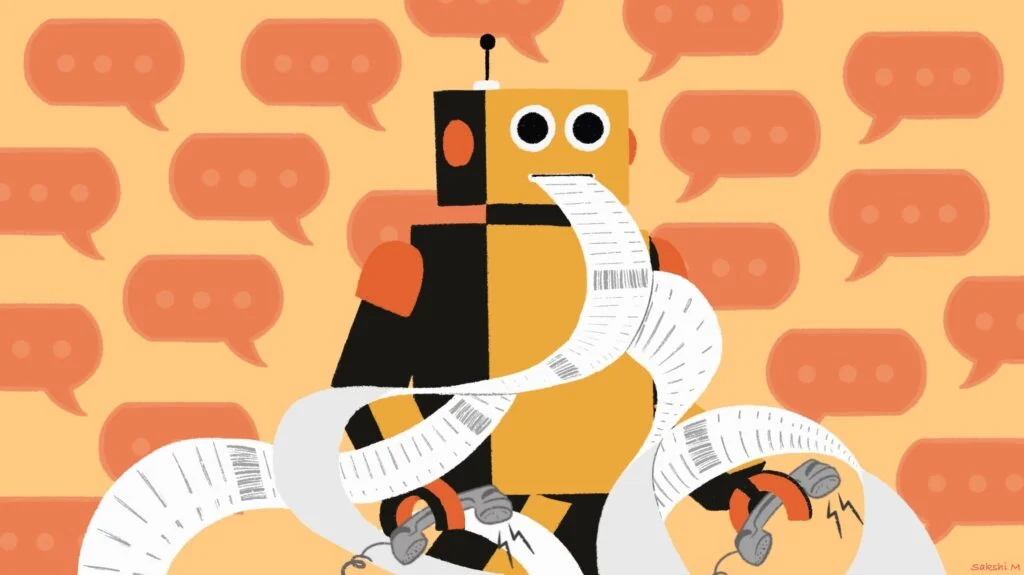
For 26-year-old Saloni, a call centre employee in Delhi, the daily rhythm of her professional life has undergone a radical transformation. For years, her role was defined by the human element: onboarding new drivers for ride-hailing giants, verifying complex documentation, and—most crucially—acting as a bridge between the company and its most frustrated users.
Until recently, Saloni spent a significant portion of her day de-escalating conflicts with disgruntled customers of Uber, Rapido, and Ola. Today, however, the front lines of customer service have been ceded to automated voice-AI bots. Saloni’s role has shifted from a primary point of contact to an infrequent, high-stakes safety net, stepping in only when the artificial intelligence reaches an impasse.
"By the time the voice bot transfers a call to me regarding a refund or a lost item, the customer is already so incensed that they often start screaming the moment I pick up," Saloni says. Her experience is not an anomaly; it is the new standard of the Indian service economy.
The Rise of the Machine Agent
The rapid proliferation of voice-AI companies—including firms like Gnani.ai, Corover, Skit, Bolna, Haptik, Navana, and Ringg AI—has fundamentally altered the economics of customer support. These companies are enabling businesses to automate thousands of simultaneous conversations at a fraction of the cost of a human-staffed call centre.
For corporations, the incentive is clear: cost-efficiency and 24/7 scalability. For the consumer, however, the shift is marked by the commodification of human interaction. Access to a "live person" is increasingly being recast as a premium, paid perk. Major platforms such as Flipkart (via its Black program), Swiggy (One BLCK), and Zomato (VIP Mode) now offer priority support and direct access to human agents as a benefit gated behind subscription paywalls or additional fees.
Capital Influx and Market Consolidation
The trend has not gone unnoticed by the investment community. According to data from Tracxn, Indian voice-AI startups have collectively raised nearly $450 million. This surge is heavily buoyed by Sarvam AI, often hailed as India’s sovereign AI champion, which has secured over $350 million in funding.

The global interest is equally palpable. London-based ElevenLabs, a leader in voice-synthesis technology, has announced plans to invest "hundreds of millions of dollars" into the Indian market, signaling a belief that India will serve as the primary laboratory for scaling voice-AI for the global South.
Chronology of a Disrupted Sector
The transition from human-centric to AI-automated customer service has unfolded in three distinct phases over the last decade:
- The Human Era (2014–2018): Customer service was primarily human-driven, with call centres serving as the backbone of the "App Economy."
- The Chatbot Transition (2018–2022): Companies began deploying text-based chatbots to filter simple queries, reducing the volume of incoming calls but failing to resolve complex emotional or high-stakes issues.
- The Voice-AI Revolution (2023–Present): With the advent of large language models (LLMs) and advanced speech-to-text capabilities, bots gained the ability to mimic human intonation and handle nuanced, multi-turn conversations. This phase triggered the mass layoffs currently impacting the BPO sector.
Supporting Data: The Economic Reality
The economic pressure on traditional BPO models is intense. Maintaining a human workforce involves significant overhead: salaries, benefits, office space, and the inherent friction of human fatigue. In contrast, a voice-AI system requires high initial R&D investment but offers near-zero marginal costs per call once operational.
Data from recent industry reports suggests that companies adopting comprehensive voice-AI solutions can reduce their customer support operating expenses by as much as 60–70% within the first year. For a company like Uber, which recently cut roughly 10% of its customer service headcount, this is not merely a technological upgrade—it is a strategic pivot toward a leaner, automated operational model.
The Regulatory Horizon: Trai’s Intervention
Just as the industry reaches a fever pitch of adoption, a new obstacle has emerged. The Telecom Regulatory Authority of India (Trai) recently introduced stringent rules on Application-to-Person (A2P) communication. These regulations, aimed at curbing spam and enhancing user security, are expected to significantly disrupt the "fragile unit economics" of voice-AI companies.
By imposing stricter authentication and compliance standards on automated calls, the regulator is essentially forcing these companies to account for the "quality" of their automated interactions. If the compliance costs of these A2P regulations increase the cost per call significantly, the value proposition of replacing humans with AI—which relies on extreme cost-efficiency—may become untenable for smaller players.

Implications for the Workforce
The implications for workers like Saloni are profound. The "Human-in-the-loop" model, where humans are kept on standby to handle edge cases, is not a sustainable career path for the millions currently employed in India’s BPO sector. As AI models grow more sophisticated, the number of "edge cases" will continue to dwindle, further marginalizing human agents.
Furthermore, the quality of service for the average user is at risk. When human interaction becomes a luxury good, the baseline experience for non-paying customers risks becoming an exercise in frustration. If an AI bot cannot resolve a complex issue, the customer is left in a "loop of incompetence," unable to find an exit path to a human who possesses the empathy and authority to solve the problem.
The Future of "Human" Service
The industry stands at a crossroads. While voice-AI is undeniably efficient, the "premiumization" of human support suggests that corporations acknowledge a fundamental truth: human interaction is a value-add.
The question remains whether the market will eventually reach an equilibrium where AI handles the routine and humans handle the critical, or if the race to the bottom in operating costs will hollow out the customer experience entirely. For now, the silence of the automated line is growing louder, and the human voice is becoming a commodity that companies are increasingly hesitant to spend on.
As India positions itself as the global hub for AI development, the domestic impact of these technologies will serve as the litmus test for the rest of the world. Whether this transition fosters a more efficient economy or simply alienates the consumer remains to be seen. For employees like Saloni, the future is no longer about answering the phone—it is about waiting for the moment when the machine finally admits it doesn’t know the answer.