In March 2025, a quiet stretch of country road became the backdrop for a transformation that would eventually influence the creative output of one of the world’s most prominent modern thinkers. Ryan Holiday, bestselling author and strategist, encountered two ten-week-old puppies abandoned in the elements. This chance encounter, which began as an act of compassion for two emaciated, flea-bitten creatures cowering from a thunderstorm, evolved into a profound exploration of the physiological and psychological necessity of walking—a practice rooted in antiquity and validated by modern neuroscience.
Chronology of a Rescue: From Abandonment to Adoption
The discovery occurred during a volatile period of weather in the rural outskirts of Austin, Texas. The two puppies, one white with spots and the other a predominantly black dog with white accents on her chest and paws, were suffering from severe neglect.
Holiday, cognizant of the sociological phenomenon known as “Black Dog Bias”—the documented tendency for shelter dogs with darker coats to be perceived as more aggressive or intimidating, leading to lower adoption rates—decided to intervene. While the spotted puppy was quickly rehomed, the family chose to keep the black puppy, whom they named “Oreo.”
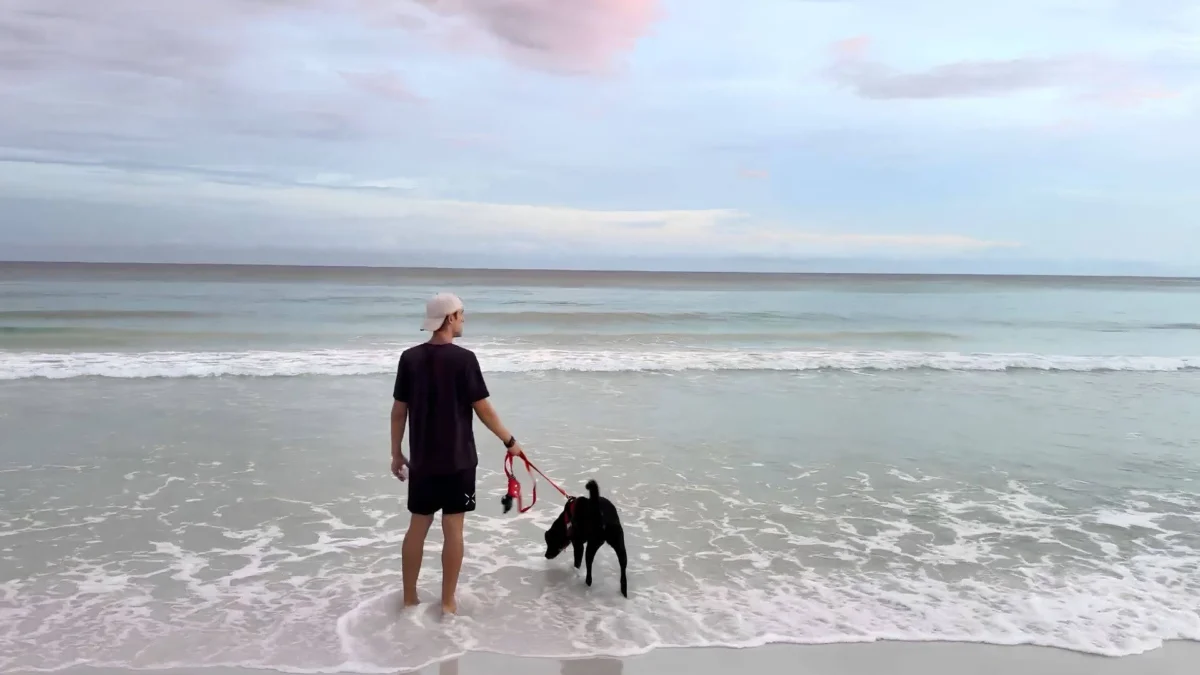
What followed was a familiar domestic script: the children promised to handle the responsibilities of pet ownership, including the daily walking regimen. Predictably, that enthusiasm waned, leaving the daily commitment of exercise to Holiday himself. However, what began as a chore soon morphed into a daily ritual of discovery. This transition from "forced" activity to a deliberate, contemplative practice echoes the habits of history’s most influential minds.
The Science and Philosophy of the Stride
While the health benefits of walking—calorie expenditure, vitamin D synthesis, and cardiovascular longevity—are well-documented, the primary impetus for Holiday’s daily ritual transcends physical fitness. He argues that the true value of the walk lies in its capacity to act as a catalyst for cognitive clarity and intellectual production.
The Peripatetic Tradition
The term "Peripatetic" is derived from the Greek peripatein, meaning "to walk about." This was the hallmark of Aristotle’s teaching method. It is a historical constant that the world’s greatest thinkers have utilized rhythmic movement to bypass mental plateaus.
- Friedrich Nietzsche: Famously asserted that "It is only ideas gained from walking that have any worth." His magnum opus, Thus Spoke Zarathustra, was conceptualized during long, solitary walks.
- Charles Darwin: Known for his strict adherence to a daily walking schedule, Darwin utilized the "Sandwalk" on his property to deliberate over his scientific theories.
- William Wordsworth: The Romantic poet’s output was arguably fueled by his staggering lifetime mileage, estimated at 180,000 miles, or roughly six and a half miles per day since childhood.
- Ernest Hemingway: When the creative process stalled in Paris, Hemingway would take to the quais of the Seine, finding that physical motion often broke the paralysis of the blank page.
Spiritual and Psychological Resonance
Walking is not merely a tool for productivity; it is a mechanism for spiritual alignment. The accounts of Dorothy Day, who walked the beaches of Staten Island to find a sense of divine presence, and the meditative practice of kinhin in Buddhism, highlight walking as a form of active mindfulness. Søren Kierkegaard, perhaps the most eloquent proponent of the walk, once wrote to his sister-in-law: “Every day I walk myself into a state of well-being and walk away from every illness; I have walked myself into my best thoughts.”
Data on Movement and Cognitive Performance
While the philosophical testimonials are compelling, modern neuroscience supports the link between gait and cognition. When an individual is seated at a computer, they are subjected to a constant barrage of digital stimuli—emails, notifications, and information overload. This creates a state of "cognitive tunneling," where the brain becomes trapped in reactive cycles.
Walking facilitates a "diffuse mode" of thinking. When the body is engaged in a rhythmic, low-stakes physical activity, the mind is liberated from the constraints of immediate task-processing. This allows for:

- Lateral Thinking: The ability to connect seemingly unrelated ideas, often leading to creative breakthroughs.
- Emotional Regulation: The rhythmic nature of walking lowers cortisol levels, effectively "walking off" the stress of the day.
- Default Mode Network Activation: Allowing the brain to process long-term goals and abstract concepts that are often ignored during high-intensity desk work.
Implications for the Modern Professional
In the context of the "Attention Economy," the habit of walking represents a radical act of resistance. Holiday notes that he has frequently solved complex business challenges and conceptualized major literary projects—such as The Stoic Virtue Series—while walking with his children or his dog.
The implication for the modern worker is clear: productivity is not merely a function of time spent at a desk. In many cases, it is inversely proportional to the amount of time spent in a sedentary state. By stepping away from the screen, one creates the necessary mental vacuum for innovation to occur.
Holiday’s personal routine—returning from a walk and immediately transcribing thoughts onto notecards—has become a codified part of his creative process. His wife’s recognition of his post-walk "flow state" serves as a testament to the tangible results of this practice. It is not that the walk solves every problem, but it shifts the mood, which, as Holiday notes, "is usually most of the problem anyway."
A Call to Action: The Persistence of the Walk
The narrative of Oreo the dog is a microcosm of a larger societal shift. We are living in an era of unprecedented distraction, yet the solution to our "illness"—the stress, the frustration, and the lack of clarity—remains as simple as it was in the time of the Greeks.
Kierkegaard’s anecdote about returning from a walk, only to be confronted by a neighbor’s chatter and subsequently choosing to leave the house again to continue walking, serves as an essential parable for our times. When the world imposes its chaos, the solution is not to retreat further into the digital void, but to go outside.
As Ryan Holiday prepares for another walk with Oreo, the message is one of necessary repetition. We must walk, and then we must walk some more. It is a humble, rhythmic, and profoundly human endeavor. In an age of high-speed connectivity, the most sophisticated tool for advancement remains the simplest: putting one foot in front of the other.
Whether one is searching for a business solution, a creative breakthrough, or a moment of psychological respite, the path forward is found on foot. The outdoors provides the silence that the office cannot, and in that silence, we find the best versions of our thoughts.
About the Author
Ryan Holiday is the author of numerous internationally bestselling books on philosophy, marketing, and the human condition, including "The Obstacle Is The Way" and "Ego Is The Enemy." His firm, Brass Check, provides strategic counsel to top-tier organizations and individuals. He currently resides in Austin, Texas, where he continues to advocate for the virtues of the daily walk.