The digital landscape is undergoing its most significant shift since the birth of the search engine. For decades, the goal of search engine optimization (SEO) was to secure a top-ten blue link. Today, when a user asks a question to ChatGPT, Perplexity, or Google’s AI-powered search, they are no longer presented with a list of links. Instead, they receive a single, synthesized answer grounded in a handful of chosen citations.
For brands, this creates a stark binary: if your content is one of those citations, you capture attention, traffic, and trust. If it isn’t, you are effectively invisible—even if you rank first on the traditional search results page. This is the era of AI Search Optimization (AEO), and for revenue teams, it is no longer an optional discipline.
The Shift: From Referral Links to Synthesized Answers
The audience has not disappeared; it has simply moved into the answer. According to recent industry data, referral traffic from AI tools like ChatGPT and Gemini has tripled over the past year. More importantly, nearly half of all marketers—44%—report having made a business purchase based on a brand they first discovered through an AI-generated answer. For one-third of these buyers, this has become a recurring habit.
This transition marks a departure from keyword-driven dominance toward a model rooted in context, authority, and structural clarity. As the search experience becomes more conversational, the "winner-take-all" nature of AI citations becomes the primary driver of brand awareness.
Under the Hood: How AI Engines Retrieve and Ground Content
To master AEO, one must first understand the mechanism between a user’s prompt and the AI’s response. As Pat Reinhart, Vice President of Professional Services at Conductor, explains, "An LLM does not operate the same way a traditional search engine does. They aren’t just reaching into an index to link a query to a page; they are working off their own internal model. If they don’t know the answer, they reach out to the live web to find it in real time."

This process relies on two critical technologies: Retrieval-Augmented Generation (RAG) and Query Fan-out.
Retrieval-Augmented Generation (RAG)
RAG is the "connective tissue" of modern AI search. Because LLMs are prone to hallucinations or rely on outdated training data, they use RAG to fetch current, relevant web pages to "ground" their responses. By retrieving live data, the AI can provide a verifiable answer with clickable citations. For a brand, this means content must be crawlable, indexable, and snippet-eligible; if the system cannot extract your content, it simply does not exist for the AI.
Query Fan-out
Where RAG focuses on the "where," query fan-out addresses the "why." When a user enters a complex prompt, the AI engine breaks that query into dozens of sub-queries, covering related phrasings, follow-ups, and logical implications. Because these prompts are often 20+ words long—compared to the traditional three-to-four-word search query—the AI has a much larger "conversational" context. Pages that address a cluster of related questions are far more likely to be retrieved because they provide multiple surfaces for the AI to extract information from.
The Evolution of Strategy: AEO vs. Classic SEO
A common misconception is that AI search optimization replaces traditional SEO. In reality, AEO is a new layer of structural discipline added on top of existing fundamentals.
| Feature | Classic SEO | AI Search Optimization |
|---|---|---|
| Primary Goal | Ranking and Clicks | Citations and Mentions |
| Focus | Keywords and Backlinks | Entities, Context, and Q&A |
| Measurement | Organic Traffic/SERP Position | Citation Frequency/Share of Answer |
| Structure | Page-Level Optimization | Extractable Block Optimization |
"It’s not about ranking for a particular keyword," says Reinhart. "It’s about how often I am being mentioned and cited for the topics my customers are discussing."

Building for Extraction: The "Claim-Then-Evidence" Model
Since AI answer engines "lift" passages rather than whole pages, the unit of optimization has shifted from the page to the extractable block. To win, content must be written in a way that allows a machine to identify a claim and its supporting evidence instantly.
The Three Pillars of Extraction
- Claim Statements with Immediate Citations: Avoid burying the answer. Lead with a direct, self-contained claim, then support it immediately with data or a named example. This mirrors the structure of an AI-grounded response.
- Question-Based Subheads: Organize content around the specific questions users ask. If your H2s and H3s act as a map of the intent cluster, you provide the AI with more matchable surfaces for query fan-out.
- Optimized Q&A Blocks: Use short, direct answers (two to three sentences) to address user questions. Romana Kuts, founder of SaaStorm, emphasizes that "most traffic coming from GPT is coming from a short and sweet FAQ."
The Role of Entities and Authority
In the world of AI, domain authority is secondary to entity authority. Systems need to trust that a brand, a person, or an organization is the definitive source on a topic.
Standardizing Entities
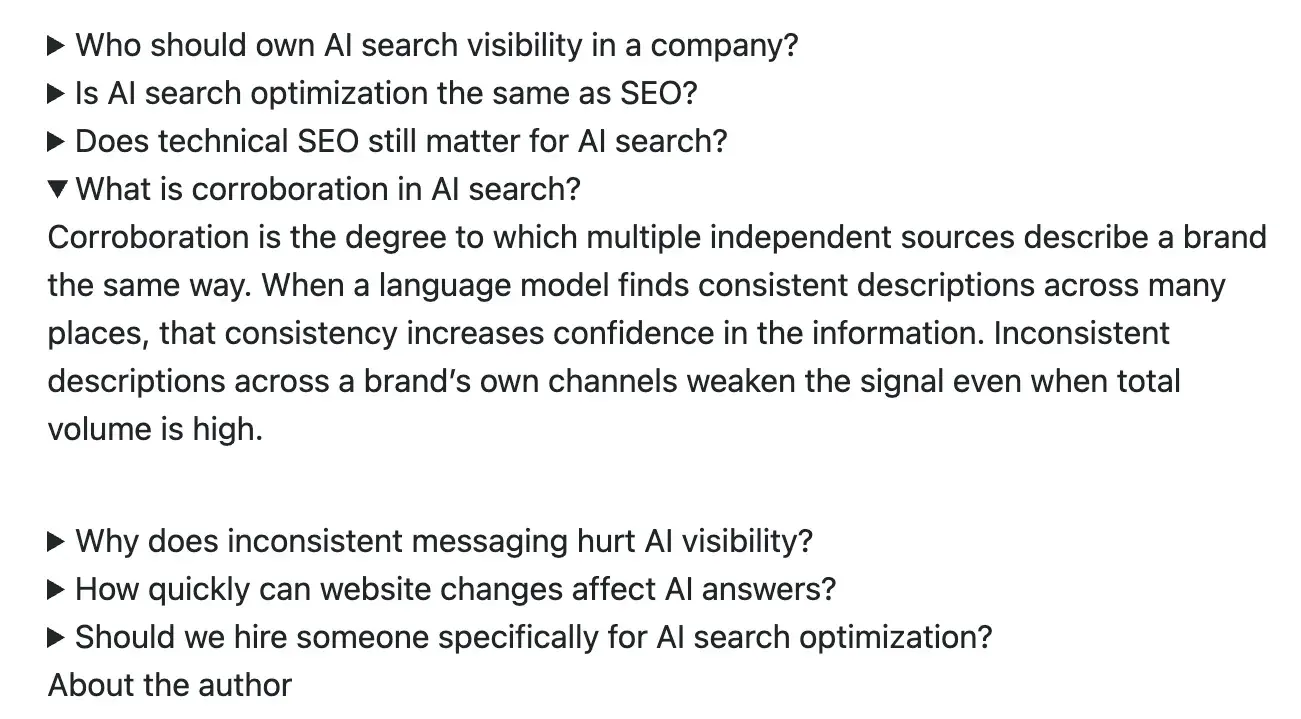
Consistency is the signal. Brands should adopt one canonical description for their organization and their experts and repeat it across all platforms—from social media bios and author pages to third-party industry publications.
The "Off-Site" Factor
On-page work makes you eligible for citation; off-site mentions make you credible. AI systems monitor third-party sites, podcasts, and communities to gauge authority. Notably, platforms like Reddit hold significant weight due to partnerships with major AI developers. However, authenticity is the gatekeeper. As SEO strategist Beth Chernes warns, "If you sound like an AI on Reddit, you will be banned. You must show up as a person."
Technical AI Optimization: The Crawlability Imperative
Technical AEO is fundamentally about ensuring that the content is easily parsed.

- JavaScript Rendering: Many crawlers struggle with content hidden behind heavy client-side JavaScript. If your primary answer disappears when you disable JavaScript in your browser, the AI crawler likely isn’t seeing it either.
- Structured Data: While not a "magic switch," schema markup (such as
FAQPageorOrganizationschema) helps machines disambiguate content. Use it to clarify the relationship between questions and answers, not as a shortcut to replace high-quality substance.
Debunking AI Search Myths
As the field matures, several myths have emerged that distract from effective strategy:
- The
llms.txtMyth: Google has stated that it does not require new machine-readable files for AI features. Time is better spent on content quality than on files that engines currently ignore. - The "Chop Everything" Myth: You do not need to shred your content into one-sentence fragments. Clean headings and logical flow are sufficient for modern AI systems.
- The "Manufactured Mentions" Myth: Spammy link schemes are easily flagged. Only earned, genuine mentions across credible channels contribute to durable entity authority.
Measuring Success: Moving Beyond Rankings
Because rankings no longer tell the full story, brands need a new scoreboard. Key performance indicators (KPIs) should focus on citation volume, share of answer, and AI-referred conversion rates.
A practical approach involves using tools like AI search graders to establish a monthly baseline. When HubSpot implemented these AEO strategies, they reported a 1,600% increase in qualified leads from AI and a 411% improvement in brand citations within two years.
Conclusion: Optimizing for the Future
The shift toward AI-powered search is not a temporary trend; it is the fundamental restructuring of the internet’s information architecture. While the mechanics of RAG and query fan-out are complex, the strategy for brands is clear: prioritize clarity, structure, and entity consistency.
By focusing on "extractability"—making it easy for an AI to retrieve, trust, and cite your content—you stop competing for a spot in a list and start becoming the answer itself. In this new search environment, the most successful brands will be those that provide the most value, the fastest, to the machine.