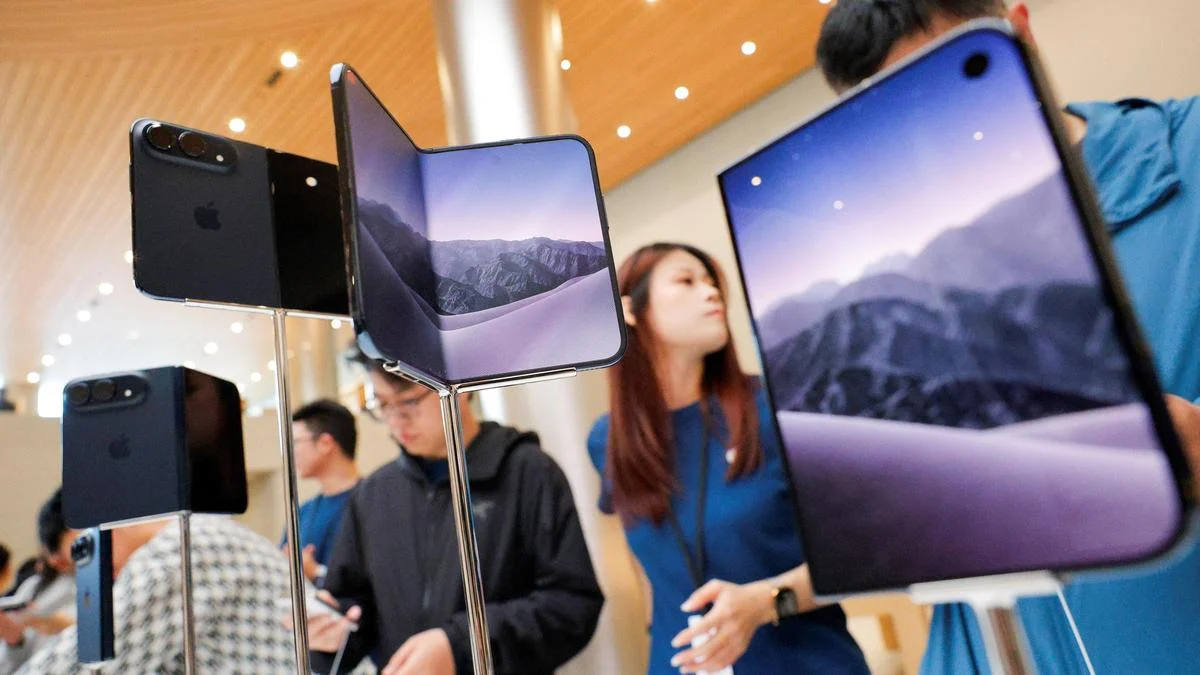
CUPERTINO, CA – In what is being described as the most significant hardware pivot since the introduction of the original iPhone in 2007, Apple Inc. officially commenced sales of the iPhone Duo on Friday. The device, a "passport-shaped" folding smartphone, represents the tech giant’s long-awaited entry into the foldable market—a sector currently dominated by rivals Samsung Electronics and Huawei Technologies.
As the first units reached consumers in Australia and Asia, the launch serves as a high-stakes litmus test for both the company’s engineering prowess and the leadership of newly minted CEO John Ternus. Market analysts are now closely watching to see if Apple can transform a niche luxury category into a mainstream standard, effectively reinventing the mobile experience for a second time.
Main Facts: A Luxury Launch Amid "Extraordinary" Demand
The iPhone Duo’s debut was marked by a blend of consumer fervor and logistical scarcity. Within minutes of pre-orders opening last week, Apple’s shipping estimates for the device slipped into late January, signaling that demand had significantly outpaced initial production runs. Apple has characterized the consumer response as "nothing short of extraordinary," a sentiment echoed by the scenes at flagship retail locations.
In Sydney, Australia—the first global market to open sales due to time zone differences—long queues formed outside Apple’s central retail hub well before the 8:00 a.m. opening. Among the first to emerge with the device was Simon Krishnan, a 48-year-old engineer, who spent A$3,899 ($2,734) on a 512GB model.
"This is a bit of a luxury item for me, because it’s so expensive," Krishnan noted. "But I just think, you know what? Life’s too short."
Krishnan’s sentiment highlights the Duo’s positioning. Unlike the standard iPhone 15 or 16 series, which cater to a broad demographic, the Duo is being marketed as a premium, experimental luxury. Priced significantly higher than its conventional counterparts, the Duo aims to capture the "prosumer" market—those willing to pay a premium for cutting-edge form factors despite the inherent "first-generation" risks.
Chronology: From Hardware Chief to CEO’s First Gambit
The timeline of the Duo’s release is as much a story of corporate transition as it is of technological innovation. The device was unveiled by John Ternus, Apple’s former hardware chief, who ascended to the role of CEO in September. In a move that surprised many industry insiders, Ternus introduced the Duo just one week after taking the helm, effectively tying his nascent legacy to the success of this folding experiment.

- September: John Ternus succeeds the previous administration as CEO. Within seven days, he hosts a keynote revealing the iPhone Duo, marking a departure from the incremental updates of previous years.
- Late September: Pre-orders go live globally. Initial stock is depleted within thirty minutes, pushing delivery dates into the first quarter of the following year.
- The Launch Friday: Retail stores in Australia, the UK, and the US begin limited walk-in sales, while markets like China and Japan remain restricted to online order pickups only.
- Post-Launch: The tech community begins a rigorous evaluation of the device, weighing its mechanical achievements against its functional shortcomings.
The speed with which Ternus moved to launch the Duo suggests a strategic urgency to prove that Apple can still innovate under new leadership. For years, critics have argued that Apple was "late" to the foldable party, allowing Samsung’s Galaxy Z Fold and Z Flip series to mature through multiple iterations. Ternus’s rapid-fire launch signals a belief that Apple’s version of the technology is finally "ready" for the mass market.
Supporting Data: Engineering Triumphs and Functional Trade-offs
Technical evaluations of the iPhone Duo suggest a device of extremes. On one hand, Apple appears to have solved the "crease" problem that has plagued the foldable industry since its inception. Early reviews have lauded the Duo’s hinge mechanism, describing it as "sturdy" and "barely visible."
The Hinge and Display
The screen technology, a proprietary flexible OLED, manages to lay nearly flat when unfolded, a feat that Francisco Jeronimo, Vice President at market researcher IDC, calls a "convincing case for this form factor." However, this engineering marvel comes at a cost. To achieve the slim profile and the seamless hinge, Apple had to make several hardware compromises:
- Camera Limitations: Unlike the iPhone Pro Max series, the Duo lacks a dedicated telephoto lens. The camera housing had to be thinned to accommodate the folding chassis, resulting in a photographic experience that some reviewers find underwhelming for a $2,000+ device.
- Biometrics: In a surprising move, Apple has omitted FaceID—a staple of the iPhone since 2017. Users must adjust to a different authentication method (likely a side-mounted TouchID sensor), which tech commentator Marques Brownlee (MKBHD) described as a significant "learning curve."
- Software Optimization: While Apple’s native apps (Mail, Safari, Calendar) have been optimized for the Duo’s "passport" aspect ratio, many third-party applications still display in a letterboxed or stretched format.
Critical Reception
The critical community remains divided. John Gruber, the influential author of Daring Fireball, offered a cautious take: "It’s been a lot of fun trying the Duo out for a week, but it feels like I’ve gotten to use an extraordinarily polished prototype—not a finished product that I’d want to buy and carry."
Similarly, MKBHD noted that while the phone is "really fun," it is likely a "no" for the average user who relies on quick, one-handed tasks like texting and social media browsing. The Duo, in its folded state, is thicker and less ergonomic than a standard iPhone, making the "litany of quick tasks" more cumbersome.
Official Responses and Global Logistics
Apple’s official stance remains one of cautious optimism. In a statement to Reuters, the company acknowledged the supply-demand imbalance but remained vague on when production would scale to meet the backlog.
The availability strategy has been notably fragmented:

- Walk-in Availability: Limited to the US, Australia, Canada, Mexico, and parts of Europe and Britain.
- Online-Only Markets: China, France, Hong Kong, India, and Japan. In these regions, the Duo is unavailable for spontaneous purchase, a move likely designed to prevent chaotic scenes at retail stores and to manage extremely thin inventories.
In the China-governed territory of Macau, the launch took on a different character. As one of the few regions where the Duo was available for walk-in customers only, social media was flooded with images of fans lining up hours in advance. This localized frenzy suggests that in certain high-status markets, the "luxury" appeal of the Duo outweighs the practical concerns raised by Western reviewers.
Implications: Reshaping the Smartphone Hegemony
The long-term implications of the iPhone Duo launch extend far beyond Apple’s quarterly earnings. According to IDC, Apple’s entry into the foldable space is expected to act as a catalyst for the entire industry.
Market Forecasts
IDC predicts a rapid ascent for Apple in this new category:
- By 2026: Apple is expected to capture 44% of the foldable market’s total value while accounting for roughly 31% of unit shipments. This indicates that Apple will continue to command a price premium over Samsung and Huawei.
- By 2027: IDC forecasts that Apple will become the global market leader in foldables, both in terms of units shipped and total revenue.
The "Apple Effect"
"Foldables have been an established category for years, but adoption has remained relatively limited compared with conventional smartphones," said Francisco Jeronimo of IDC. "Apple’s entry could bring the format to a much broader audience."
The "Apple Effect"—the phenomenon where a technology only gains mainstream acceptance once Apple adopts it—is the primary hope for the foldable industry. For years, foldables have been viewed as "fragile" or "gimmicky." If the Duo can prove its durability over the next twelve months, it could trigger a mass migration of users away from the "black slab" design that has dominated the industry for nearly two decades.
The Ternus Era
For CEO John Ternus, the Duo represents a "burning of the ships." By launching such a radical product so early in his tenure, he has signaled that his leadership will not be defined by playing it safe. The Duo is a high-risk, high-reward gamble. If the hinge holds and the software matures, Ternus will be credited with ushering in the second age of the smartphone. If the device suffers from the mechanical failures that plagued early Samsung foldables, it could be a costly stain on his early record.
As the first weekend of sales concludes, the verdict on the iPhone Duo remains a work in progress. It is a device that is simultaneously a "polished prototype" and a "luxury icon." For now, Apple fans seem more than willing to pay the price of admission to see the future—even if that future is currently backordered until January.