In the realm of DIY engineering, few holidays provide as fertile a ground for innovation as Halloween. While many enthusiasts settle for traditional latex masks or standard face paint, Sebastian Staacks—the creative force behind the technical blog There Oughta Be—has elevated the concept of the “costume” into a sophisticated exercise in digital projection and wearable electronics. His latest project, a shapeshifting LED mask, effectively brings a “hood full of pixels” to life, allowing the wearer to cycle through a limitless library of digital faces with the click of a button.
The Genesis of the Pixelated Visage: Main Facts
The core of Staacks’ creation lies in the marriage of high-density LED hardware and low-power microcontroller efficiency. The mask is constructed primarily from two 128×64 LED matrices, which provide the high-resolution surface necessary to display recognizable facial features. These panels are driven by a Raspberry Pi Pico 2 W—a choice that provides the necessary processing power to handle real-time image rendering while maintaining the low-power profile required for a battery-operated wearable.
Structurally, the mask is an intricate assembly of 3D-printed brackets, industrial-grade magnets, and strategic zip ties, all concealed beneath a minimalist black hood. The hood serves a dual purpose: it hides the technical underpinnings and the wiring loom, while simultaneously framing the LEDs to create the illusion that the light is emanating from an ethereal, void-like space.
The result is a device capable of “shapeshifting” on command. By switching presets, Staacks can transition from a robotic aesthetic to a spectral visage or a minimalist abstract representation of a face. Despite the technical complexity, the project remains remarkably compact, fitting comfortably on the wearer’s head—though it does present unique ergonomic challenges, such as a narrow field of vision and the proximity of high-current electronics to the skin.
The Engineering Journey: A Chronology of Development
The development of the mask was not an overnight success but a deliberate, iterative process driven by the requirements of a specific deadline: his uncle’s Halloween party.
Phase 1: Conceptualization and Prototyping
The initial challenge was determining how to display fluid, recognizable animations on a curved or semi-flexible surface. Staacks experimented with various matrix configurations before settling on the 128×64 setup, which offered the best balance of pixel density and weight. During this phase, the primary hurdle was the physical housing; standard masks could not accommodate the rigid LED boards. Consequently, Staacks turned to 3D printing to create custom mounting brackets that would allow the panels to sit at the correct angle relative to the wearer’s eyes.
Phase 2: System Integration
Once the hardware was secured, the focus shifted to the Raspberry Pi Pico 2 W. Programming the display required a deep dive into frame-buffer management to ensure that transitions between different "faces" were fluid rather than jittery. The choice of the Pico 2 W was strategic, as its integrated wireless capabilities allowed for remote debugging and potential future integration with mobile applications, though the primary control logic remained tethered to the companion staff.

Phase 3: The Peripheral Ecosystem
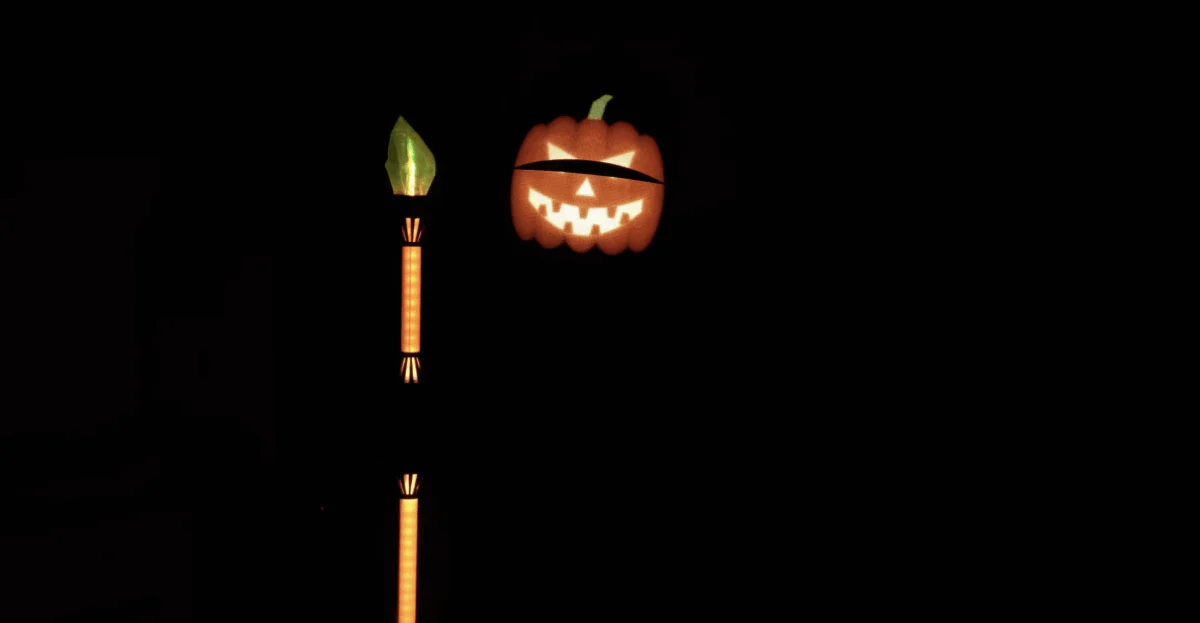
Realizing that a mask alone lacked a “user interface,” Staacks developed an intelligent staff. This device serves as the central command unit. By incorporating an accelerometer and tactile controls, the staff allows the wearer to trigger animations and soundscapes without fumbling with hidden buttons on the mask itself.
Phase 4: Final Assembly and Field Testing
The final weeks were spent on "ruggedizing" the assembly. This involved cable management and ensuring that the 3A power draw was safely distributed. Testing the mask in low-light environments revealed that the brightness of the LEDs had to be carefully calibrated to prevent light bleed from blinding the wearer or washing out the visual effect for onlookers.
Supporting Data: The Technical Specifications
For those interested in the engineering rigor behind the mask, the project relies on a specific set of hardware components and power management strategies:
- Microcontroller: Raspberry Pi Pico 2 W (Dual-core ARM Cortex-M33, 150 MHz).
- Display: Dual 128×64 LED Matrix panels.
- Power Supply: 5V USB Power Bank (high-current output required to maintain a steady 3A draw).
- User Interface: Accelerometer-equipped 3D-printed staff with tactile inputs.
- Audio Integration: Bluetooth-enabled belt-mounted speaker, synchronized via the Pico’s I2C protocol.
- Thermal Management: Passive cooling through the open-frame design of the 3D-printed brackets.
The power consumption is perhaps the most critical technical constraint. Operating at 3A is significant for a wearable device, requiring a power bank capable of sustaining a high discharge rate without voltage sag. Staacks addressed this by utilizing a high-capacity power bank mounted securely to the belt, routed via flexible cabling through the costume.
Official Responses and Community Impact
Since the publication of his blog post, the project has garnered significant attention within the maker community. The reception on platforms such as the Make: community and independent forums has been overwhelmingly positive, with many citing it as a gold standard for wearable holiday tech.
In his own write-up, Staacks remains candid about the project’s limitations. He notes, "The minor downsides include a narrow slit to see through, and 3A of electricity millimeters away from his face." This transparency is a hallmark of the maker ethos—the admission that true innovation often involves a trade-off between aesthetic performance and practical comfort.
Community members on platforms like Discord have already begun analyzing the code repository provided by Staacks, with many planning "forks" of the project. These include suggestions for using flexible LED strips to wrap the entire head or integrating eye-tracking cameras to make the LED eyes follow bystanders—a testament to the project’s modular and extensible design.

Implications for the Future of Wearable Tech
The success of the "Hood Full of Pixels" signals a broader shift in Halloween costume design. We are moving away from static, pre-packaged store-bought costumes toward "living" hardware that can be updated, modified, and personalized through code.
1. The Democratization of Advanced Visual Effects
Previously, high-quality LED projection masks were the domain of film studios with significant budgets. By utilizing accessible hardware like the Raspberry Pi Pico and off-the-shelf LED matrices, Staacks has demonstrated that these cinematic effects are now within reach of the hobbyist.
2. The Rise of "Smart" Cosplay
The integration of an accelerometer-equipped staff as a control interface introduces a new layer of interactivity. The costume is no longer just a visual display; it is a performance piece. As microcontrollers become more powerful and power efficiency improves, we can expect future costumes to feature real-time generative AI, where the mask reacts to the wearer’s facial expressions or the ambient environment.
3. Safety and Design Constraints
The project also serves as a case study in safety. The proximity of high-current electronics to the human face remains a significant engineering hurdle. As these projects move toward more mainstream adoption, industry standards for wearable thermal management and battery safety will become increasingly relevant.
Conclusion
Sebastian Staacks’ shapeshifting LED mask is more than just a clever Halloween gag; it is a testament to the ingenuity of the modern maker movement. By combining hardware, software, and a touch of theatrical flair, he has created a device that effectively bridges the gap between digital art and wearable tech.
For the intermediate maker, the project offers a roadmap to explore the intersection of IoT and costume design. Whether you are looking to replicate the mask exactly or use the principles of pixel-based expression to create your own unique character, the resources provided in his documentation serve as a masterclass in modular engineering. As Halloween continues to evolve, we can look forward to a future where our costumes are as dynamic, responsive, and complex as the technology that powers them.