In the realm of DIY engineering and kinetic art, few objects possess the enduring allure of the clock. It is a functional necessity transformed into a canvas for mechanical expression—a device that measures the very medium of our existence. While many hobbyists are content with a standard digital display, makers like Moritz Von Sivers are pushing the boundaries of how we perceive time, turning the simple act of reading a clock into a hypnotic, physics-defying experience.
Von Sivers, a seasoned creator known for his intricate servo-driven word clocks and mesmerizing lenticular displays, has returned with a project that bridges the gap between high-end optics and home-built electronics. His latest creation, a diffraction grating clock, is not merely a timepiece; it is an exploration of the electromagnetic spectrum, a celebration of light, and a masterclass in creative engineering.
Main Facts: The Physics of the Display
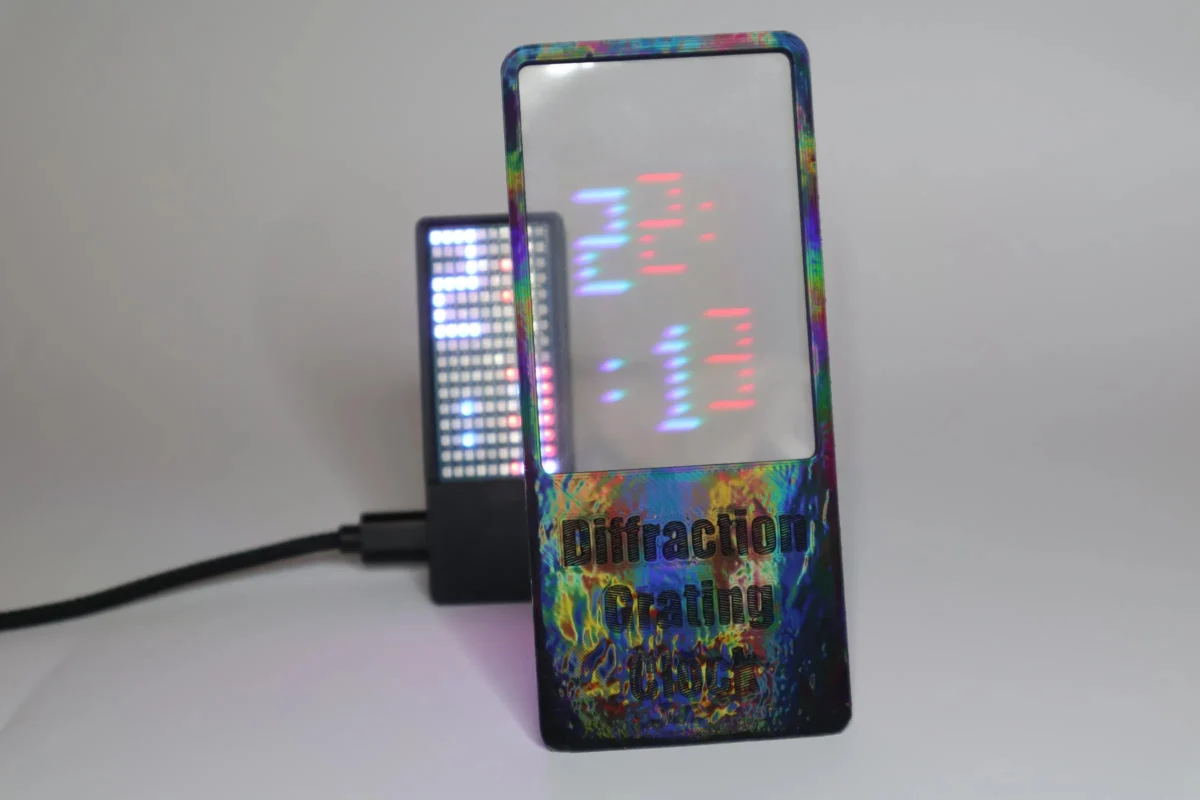
At the core of Von Sivers’ latest invention lies a deceptively simple yet profoundly elegant optical principle: diffraction. The clock features a dual-color LED matrix that displays hours and minutes in red and blue, respectively. However, rather than displaying them side-by-side on a flat screen, the device utilizes a diffraction grating—a structured optical component that splits light into its constituent wavelengths—to physically separate the information in space.
Because red light possesses a longer wavelength than blue light, it is refracted at a wider angle when passing through the grating. By precisely calculating the distance between the LED matrix and the diffraction screen, Von Sivers has engineered a system where the "red" minutes and "blue" hours appear at distinct, offset positions to the viewer’s eye. The result is a crisp, clean separation of data that seems to float in the air, creating a ghostly, prismatic effect that is as beautiful as it is functional.
Beyond the optics, the build quality is indicative of the "maker" ethos. The project involves intricate assembly, including the clever transfer of diffraction patterns onto the clock’s housing—a technique that involves adhering a diffraction film to the 3D printer bed to imprint the texture directly onto the part. This ensures that the aesthetic finish is not just a sticker, but an integral part of the structure itself.
Chronology: A History of Kinetic Innovation
The journey to this specific clock is part of a longer narrative of artistic evolution. Moritz Von Sivers has spent years developing a portfolio that centers on the intersection of light, motion, and time.
- The Early Years: Von Sivers began his foray into horology with servo-driven word clocks. These early projects focused on the mechanics of motion, using physical gears and motors to manipulate physical letters or panels to spell out the time.
- The Lenticular Phase: Recognizing the potential for hidden messages and shifting visuals, he transitioned into lenticular designs. By layering angled lenses over static imagery, he created clocks that changed their display depending on the viewer’s perspective, introducing the element of "interaction" that would become a staple of his work.
- The Diffraction Breakthrough: The current project represents his most ambitious optical endeavor to date. Entered into the annual Instructables Colors of the Rainbow Contest, the clock serves as a culmination of his previous technical learnings. It synthesizes his knowledge of LED programming, mechanical assembly, and optical physics into a single, cohesive unit.
Supporting Data and Technical Implementation
To understand the complexity of the project, one must look at the technical specifications provided in his open-source documentation. The clock relies on an Arduino-based architecture to manage the timing, ensuring that the synchronization between the LED pulse and the display is precise.

The Optical Geometry
The efficacy of the clock depends on the "grating equation," which dictates the angle of diffraction based on the grating constant (the number of lines per millimeter on the film). Von Sivers had to calibrate the depth of the housing specifically to ensure that the red and blue wavelengths separated exactly to the intended degree. If the housing were too shallow, the colors would overlap; too deep, and the light would become too diffuse to be legible.
Material Science
The use of diffraction film is a highlight of the build. By adhering this film to the 3D printing bed, Von Sivers effectively "embossed" the diffraction properties onto the physical parts of the clock case. This creates a shimmering, rainbow-like texture on the enclosure itself, which complements the internal display. It is a level of attention to detail that elevates the project from a simple electronics kit to a piece of fine art.
Official Perspectives and Community Impact
The response from the DIY community has been overwhelmingly positive, reflecting a broader trend of makers moving toward "art-forward" engineering.
"The beauty of this project is that it hides the complexity behind a layer of pure wonder," noted one prominent member of the Instructables community. "Most people will look at this and see magic; only the maker knows the math required to pull it off."
Von Sivers himself has emphasized that the goal of his work is to make science "visceral." By utilizing the property of diffraction—a concept often relegated to dry physics textbooks—to create a functional home object, he is effectively demystifying complex optics.
Furthermore, the integration with the broader maker community through platforms like Discord and Instructables ensures that this project is not a closed loop. By sharing his schematics, code, and 3D files, Von Sivers has invited others to iterate on his design. This open-source philosophy is the engine that drives modern innovation; today it is a clock, but tomorrow, a student or hobbyist might take the same diffraction principles and apply them to a piece of medical equipment or a novel communication device.
Implications: The Future of Kinetic Art
The success of the diffraction grating clock signals a shift in what is expected from the "smart home" aesthetic. We are moving away from the sterile, flat-screen designs of the 2010s toward devices that incorporate organic, light-based, and kinetic elements.

The Rise of "Interactive Physics"
We are entering an era where consumers and makers alike are craving tactile, physical responses to digital data. A screen that shows a "number" is boring; a screen that uses light refraction to "bend" the time into a spectrum of color is an experience. This project suggests that the future of UI (User Interface) design may not be limited to pixels on a screen, but rather how those pixels interact with the physical environment.
Potential Applications
While Von Sivers’ application is purely artistic, the implications for the technology are vast:
- Privacy Displays: As mentioned in his documentation, this technology could be used to create "secret" displays that are only readable from specific angles, effectively creating a hardware-level privacy screen.
- Educational Tools: Physics classrooms could adopt these methods to demonstrate wave-particle duality and diffraction in a way that is engaging and visually arresting.
- Holographic Simulation: By stacking multiple diffraction gratings, it is theoretically possible to create complex, multi-layered "floating" images, which could revolutionize budget-friendly augmented reality interfaces.
Conclusion: A Timeless Pursuit
Moritz Von Sivers’ latest clock is a reminder that the tools of creation are more accessible than ever, and that the only true limitation is the creator’s curiosity. By turning his living room into a laboratory for optical physics, he has reminded the maker community that utility does not have to come at the expense of beauty.
As we look toward the future of DIY electronics, we can expect to see more creators following in his footsteps—abandoning the standard and embracing the strange. Whether it is through the bending of light, the manipulation of motion, or the fusion of disparate scientific principles, the next generation of clocks will be more than just devices that track our hours; they will be the prisms through which we view our own creativity.
For those inspired to undertake their own build, the comprehensive guide provided by Von Sivers on Instructables offers a roadmap. It is a challenging project, certainly, but one that promises a reward far greater than the sum of its parts: a unique, mesmerizing piece of art that will keep time for years to come.