
By Editorial Desk
October 8, 2026
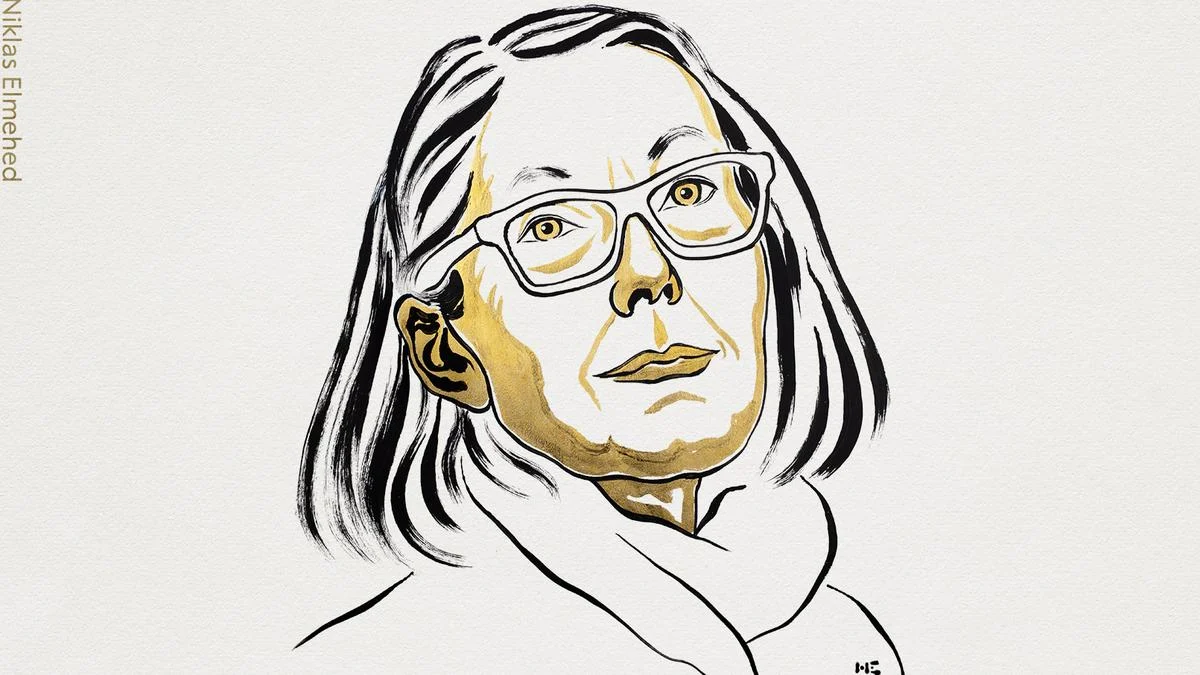
In a decision that has sent ripples of intellectual exhilaration through the global literary community, the Swedish Academy announced on Thursday that the 2026 Nobel Prize in Literature has been awarded to the Canadian poet, essayist, and classicist Anne Carson. The Academy recognized her for a "bold and inventive oeuvre that, in playful dialogue with the classical tradition, has created new forms for contemporary literature."
Carson, a figure long considered a titan of modern letters and a perennial favorite in betting markets, was reportedly caught entirely off-guard by the announcement. Speaking from a remote location in Iceland, the 76-year-old laureate shared a brief, ethereal moment with the permanent secretary of the Swedish Academy, Ingrid Carlberg.
"We didn’t have so much time to speak," Carlberg revealed to the press. "All she had time to tell me was that she is for the moment in Iceland, where she’s listening to the wind. She was taken by surprise but was very happy. I could hear that in her voice."
A Career Defined by Classical Subversion
Born in Toronto in 1950, Anne Carson has carved a unique path in the landscape of 21st-century literature. Her work is defined by an uncanny ability to bridge the ancient and the avant-garde. A scholar of the highest order, she earned her PhD in Classics in 1981, and her doctoral thesis—titled Odi et Amo Ergo Sum—foreshadowed the thematic preoccupation that would define her career: the friction between intellectual rigor and raw, unvarnished human emotion.
Carson’s writing is rarely contained by the traditional boundaries of genre. She treats the page not merely as a surface for text, but as a space for structural experimentation. Whether through the long, wandering form of the poem or the sharp, aphoristic precision of the essay, Carson consistently interrogates the etymology of language, treating the origins of words as the DNA of her creative process.
Major Works and Critical Milestones
The Academy’s citation specifically highlighted the "literary sketch" as a central pillar of her methodology. Among her most celebrated works is The Beauty of the Husband: A Fictional Essay in 29 Tangos (2001). The book, which functions as a blistering, sardonic exploration of a crumbling marriage, uses the romanticism of John Keats as a counterpoint to the brutal reality of infidelity and domestic disillusionment. By juxtaposing Keats’s sublime aestheticism with the grit of a failing relationship, Carson produced a work that is simultaneously a tragedy and a technical marvel.

Earlier, in 1995, her collection Glass, Irony, and God introduced the literary world to "The Glass Essay," a work that redefined the limits of the long poem. The text serves as a masterclass in how to blur the lines between autobiography, literary criticism, and myth.
Perhaps her most profoundly moving achievement, however, is Nox (2010), an elegy for her late brother. Printed on a single, continuous sheet of paper folded accordion-style into a box, Nox is a tactile experience as much as a linguistic one. The Academy described it as an "unforgettable work," noting that it serves as a testament to her ability to turn grief into an object of structural beauty.
The Intersection of Philology and Poetry
What sets Carson apart from her contemporaries is her identity as a "poet-philologist." She approaches language with the precision of a surgeon and the intuition of a mystic. Her work often functions as an excavation, digging into the roots of Ancient Greek and Latin to find new ways to articulate the anxieties of the modern era.
In the classroom, where she has spent decades teaching at various universities, her influence has been seismic. She has mentored a generation of writers who view the rigid distinctions between fiction, poetry, and nonfiction as obsolete. For Carson, the "literary sketch"—a term she often uses to describe her fragmentary, incomplete, yet deeply resonant pieces—is the ultimate form of truth-telling. It acknowledges that memory, love, and grief are never linear; they are shattered, layered, and perpetually in flux.
2026 Nobel Week: A Confluence of Science and Art
The awarding of the Nobel Prize in Literature to Anne Carson comes at the tail end of a week characterized by breakthroughs in both the hard sciences and human expression. The Nobel committee has been lauded for the diversity of its 2026 selections, which have bridged the gap between fundamental research and societal impact.
Chronology of the 2026 Nobel Announcements
- October 5: The week opened with the Nobel Prize in Physiology or Medicine, awarded to Karl Deisseroth, Peter Hegemann, and Georg Nagel for their pioneering work in optogenetics. Their discovery allows for the precise control of nerve cells using light, a technique that has revolutionized neurobiology.
- October 6: The Nobel Prize in Physics went to Belgian-American particle physicist Francis Halzen. His contribution to the construction of the IceCube neutrino observatory at the South Pole—and his subsequent discovery of high-energy cosmic neutrinos—has fundamentally altered our understanding of the high-energy universe.
- October 7: The Nobel Prize in Chemistry was awarded to Henri Kagan and Kenso Soai for their work in asymmetric synthesis, effectively "untangling" mirror-image molecules. This discovery is a cornerstone of modern pharmacology, responsible for the development of countless life-saving medications.
- October 8: The announcement of the Literature Prize capped the scientific focus, reminding the global public that the "greatest benefit to humankind," as Alfred Nobel dictated in his will, extends beyond the laboratory to the realm of the human spirit.
Implications for the Future of Literature
The selection of Anne Carson sends a clear signal from the Swedish Academy: literature is evolving. By choosing an author whose work defies categorization, the Academy is acknowledging that the traditional novel is no longer the sole vehicle for profound storytelling.
Carson’s victory is also a victory for the "difficult" text. She does not write for the casual reader; she writes for the seeker. Her work demands participation, patience, and a willingness to sit with ambiguity. In an era often dominated by ephemeral digital content and rapid-fire consumption, honoring a poet who demands silence, reflection, and a deep engagement with the history of language is a defiant, optimistic gesture.

As the literary world turns its gaze toward the upcoming Nobel Peace Prize (to be announced October 9) and the Economics Prize (October 12), the conversation around Carson continues to intensify. Critics are already debating which of her works will see the most significant resurgence in interest.
The Nobel laureate will receive 12 million Swedish kronor (approximately $1.2 million). The formal presentation will take place on December 10, the anniversary of Alfred Nobel’s death, in Stockholm.
Conclusion: The Wind in Iceland
There is a fitting irony in the fact that, at the moment of her greatest professional recognition, Anne Carson was in Iceland "listening to the wind." It is a scene straight from one of her own essays—a quiet, solitary figure standing at the edge of the world, attuned to the elemental forces that have always powered her verse.
As we reflect on her legacy, we are reminded of her own words regarding the pursuit of meaning: that we are always, in some way, trying to translate the untranslatable. Whether she is translating the ghosts of antiquity or the silence of a North Atlantic gale, Anne Carson has proven that while words may be fragile, they are the only tools we have to map the infinite.
The 2026 Nobel Prize in Literature is not merely an acknowledgment of a body of work; it is an affirmation of a lifetime spent in the service of beauty, truth, and the endless, inventive possibilities of the written word.