
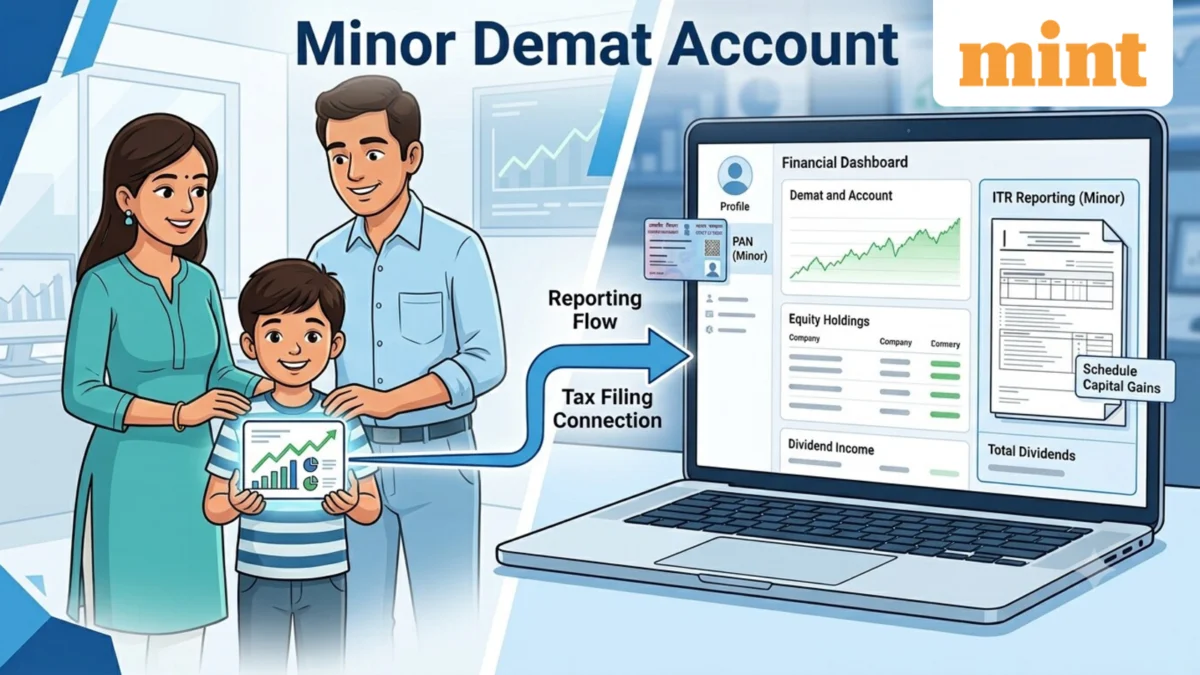
In an era where financial literacy is increasingly emphasized, many parents are proactively opening demat accounts for their minor children. The objective is clear: to instill the habit of long-term investing, build a corpus for future education, or simply leverage the power of compounding over two decades. However, while opening the account is a straightforward digital process, the tax implications—governed by the Income Tax Act, 1961—can be surprisingly complex.
For many parents, the intersection of SEBI’s operational guidelines and the Income Tax Department’s "clubbing provisions" creates a significant knowledge gap. Misunderstanding these rules can lead to inaccurate Income Tax Return (ITR) filings, triggering scrutiny from tax authorities. This guide breaks down the nuances of managing a minor’s investment portfolio and ensures your compliance is airtight.
The Core Concept: Ownership vs. Taxability
Under the regulations set by the Securities and Exchange Board of India (SEBI), a minor—defined as any individual under the age of 18—is permitted to hold a demat account. However, since a minor cannot legally enter into a contract, the account must be operated by a natural guardian, typically the father or the mother.
Crucially, while the demat account is held in the child’s name and utilizes the child’s unique Permanent Account Number (PAN), the tax liability does not necessarily rest with the child. "A demat account is held in the child’s name, with the parent operating it using the child’s own PAN," explains Isha Sekhri, Founder of Isha Sekhri & Associates LLP. "It is legally the child’s investment, but for tax purposes, it is ‘clubbed’ with the income of the parent."
This mechanism, known as the Clubbing of Income (Section 64 of the Income Tax Act), ensures that individuals cannot split their income among family members to lower their overall tax liability by taking advantage of multiple basic exemption limits.
Does a Minor Need to File an ITR?
A common misconception is that a child with a demat account must file their own ITR. In reality, the answer is a resounding no. Because the income generated from the child’s investments is clubbed with the income of the parent, there is no requirement for the minor to file a separate tax return.
Instead, the responsibility shifts entirely to the parent. The parent must include the child’s income in their own ITR. It is important to note that you cannot use ITR-1 (Sahaj) for this purpose. ITR-1 is designed for individuals with simple income sources (salary, one house property, and other sources). Because the reporting of a minor’s clubbed income requires specific disclosures, parents are typically required to file ITR-2 (if they have no business income) or ITR-3 (if they are engaged in business or profession), specifically utilizing Schedule SPI (Specified Persons Income).
Determining Which Parent Reports the Income
If both parents are earning, a logical question arises: whose ITR should reflect the child’s income? According to the Income Tax Act, the income of a minor child is to be clubbed with the income of the parent whose total income (excluding the minor’s income) is higher.
Key considerations for this process:
- The Higher Earner: If the father’s total income is ₹15 lakh and the mother’s is ₹12 lakh, the child’s investment income must be reported in the father’s ITR.
- Consistency: Once the income is included in the return of one parent, it must continue to be reported by that same parent in subsequent years. A shift is only permissible if the Assessing Officer (AO) grants specific approval, typically in cases of divorce, legal separation, or a significant change in financial circumstances.
- The "Majority" Threshold: The clubbing provision applies strictly while the child is a minor. The moment the child turns 18 during the financial year, the income earned after the birthday is treated as the child’s own income, and they become responsible for filing their own tax return if their income exceeds the basic exemption limit.
Taxation of Capital Gains and Dividends
While the income is "clubbed" into the parent’s tax return, the nature of the income does not change. This is a vital distinction for tax calculation.

- Dividends: Dividends received on shares held in the minor’s account are added to the parent’s total income and taxed according to the parent’s applicable slab rate.
- Short-Term Capital Gains (STCG): Gains from the sale of equity shares or equity-oriented mutual funds held for less than 12 months are taxed at a flat rate of 20%.
- Long-Term Capital Gains (LTCG): For assets held for more than 12 months, the gains are taxed at 12.5% for amounts exceeding the ₹1.25 lakh threshold.
The Exemption Trap: Parents often ask if the ₹1.25 lakh LTCG exemption is available separately for the child. The answer is no. The ₹1.25 lakh exemption applies to the parent’s aggregate eligible LTCG, which includes the minor’s clubbed LTCG. It is not a per-person benefit.
The "Gift" Mechanism and Disclosure Requirements
Parents frequently transfer funds to their child’s demat account to facilitate investments. Tax experts clarify that such transfers are treated as "gifts from a relative." Under the Income Tax Act, gifts received from relatives are tax-exempt in the hands of the recipient.
However, proper documentation is essential. "Parents should maintain a clear bank trail showing the transfer of funds from their account to the child’s account," advises Sekhri.
Furthermore, if a parent’s total income exceeds ₹1 crore, they are required to disclose their assets and liabilities in Schedule AL of their ITR. In such cases, investments held in the minor’s name must be included as part of the parent’s total assets, even if the investments are legally in the child’s name.
Strategic Implications: Losses and Reconciliations
One of the often-overlooked benefits of clubbing is the treatment of losses. If the minor’s investment portfolio incurs a loss (e.g., selling a stock at a lower price than the purchase price), this loss can be clubbed and set off against the parent’s income, potentially reducing the parent’s overall tax liability.
Best Practices for Filing:
- Reconciliation: Before filing, log into the Income Tax e-filing portal and check the Annual Information Statement (AIS) and Taxpayer Information Summary (TIS) for both the child’s PAN and your own.
- Form 26AS: Cross-reference dividend payments and capital gains reflected in Form 26AS with your broker’s tax statement.
- Record Keeping: Maintain a folder of all contract notes and tax certificates provided by the brokerage firm for the minor’s account.
Conclusion: A Proactive Approach
Opening a demat account for your child is a powerful step toward financial independence for the next generation. However, the regulatory burden remains with the parent. By ensuring that the child’s income is accurately captured under the correct parent’s PAN and reported in the appropriate ITR schedules, you avoid the headache of notices from the tax department.
As with all personal finance matters, the rules can evolve. If you are dealing with significant capital gains or complex investment structures (such as international stocks or high-frequency trading), it is highly advisable to consult with a Chartered Accountant (CA). Ensuring compliance today will allow your child to step into their financial majority with a clean record and a robust investment portfolio.
Disclaimer: This article is for informational and educational purposes only and does not constitute professional tax advice. Tax laws are subject to frequent changes. Please consult a qualified tax expert or a Chartered Accountant before making financial decisions or filing your ITR.