A Limited-Time Opportunity Sparks Significant Interest, But a Hidden Peril Looms
A wave of excitement is currently rippling through the non-resident Indian (NRI) community regarding a financial product that promises amplified returns: leveraged Foreign Currency Non-Resident (FCNR) deposits. Banks, recognizing the burgeoning interest and the finite nature of this opportunity, are actively engaging with NRI investors, and vice versa, to capitalize on a window that closes on September 30, 2026. While the prospect of enhanced gains is undeniably attractive, a crucial, often overlooked, risk in certain extreme scenarios could lead to significant capital erosion, a concern that appears to be absent from mainstream discussions.
This article delves into the mechanics of leveraged FCNR deposits, explores the potential pitfalls, and provides a comprehensive overview of this sophisticated financial instrument, aiming to equip potential investors with a more complete understanding before making any decisions.
Understanding Leveraged FCNR Deposits: A Double-Edged Sword
At its core, a leveraged FCNR deposit involves an NRI investor placing funds in an FCNR deposit account, typically denominated in a foreign currency like USD, GBP, or EUR. This deposit then serves as collateral for a loan taken by the investor, also in a foreign currency. The key to the "leverage" lies in the fact that the investor is using borrowed funds to amplify their investment in the FCNR deposit.
The Mechanics:
The typical structure involves the following steps:
- FCNR Deposit Placement: An NRI investor deposits a sum of foreign currency (e.g., USD 100,000) into an FCNR account with a bank. This deposit earns a predetermined interest rate, often fixed for the tenure of the deposit. FCNR deposits are attractive due to their tax-free interest income in India and the ability to repatriate funds freely.
- Loan Against Deposit: The bank then extends a loan to the investor, also denominated in the same foreign currency, against the security of the FCNR deposit. The loan amount is usually a significant percentage of the deposit value, creating the leverage. For instance, a loan of USD 75,000 might be granted against the USD 100,000 deposit.
- Investment of Loan Proceeds: The borrowed funds (USD 75,000 in this example) are then typically invested in another asset or instrument, aiming to generate returns that exceed the cost of the loan and the interest earned on the FCNR deposit. This could be anything from equities, bonds, or even other fixed-income instruments.
- Interest Rate Swap (IRS) – A Common Feature: To manage the interest rate risk associated with both the deposit and the loan, banks often engage in an Interest Rate Swap (IRS). This means the bank might enter into an agreement with another financial institution to exchange fixed-rate payments for floating-rate payments, or vice versa, to effectively offer the investor a fixed-rate loan, even if market rates fluctuate.
The Promise of Amplified Returns:
The allure of leveraged FCNR deposits stems from the potential for significantly enhanced returns. If the investment made with the borrowed funds yields a return higher than the combined cost of the FCNR deposit interest and the loan interest, the investor profits from the difference. The leverage amplifies this profit margin.
For example, if the FCNR deposit earns 4% interest, the loan is at 5% interest, and the borrowed funds are invested to yield 8%, the net gain on the borrowed capital is 3%. When combined with the return on the investor’s own capital (the initial deposit), the overall return on the investor’s initial investment can be considerably higher than if they had invested only their own funds.
The Looming Shadow: An Undiscussed Catastrophe Scenario
Despite the enticing upside, a critical and potentially devastating risk in specific, albeit extreme, circumstances remains largely unaddressed in public discourse. This risk materializes when the investment made with the borrowed funds falters significantly, and simultaneously, prevailing interest rates in the market move adversely.
A Morbid Scenario Unveiled:
Let’s consider a hypothetical, yet plausible, scenario to illustrate this hidden peril:
Imagine an NRI investor deposits USD 100,000 into a 5-year FCNR deposit, securing a fixed interest rate of 4% per annum. The bank, in turn, offers a loan of USD 75,000 against this deposit, also at a fixed rate of 5% per annum, secured by the FCNR deposit. To manage its own interest rate exposure, the bank enters into an IRS. The investor, armed with the USD 75,000 loan, invests these funds in an instrument that aims for a higher return, say an equity-linked fund.
Now, let’s introduce adverse market movements:
- Investment Downturn: The investment in the equity-linked fund suffers a severe decline. Instead of appreciating, its value plummets.
- Interest Rate Spike: Concurrently, global interest rates rise sharply. This has a dual impact.
The critical juncture arises when the FCNR deposit tenure matures or if the investor needs to unwind the position prematurely. In a scenario where the investment has lost value and market interest rates have increased significantly, the investor faces a double whammy:
- Capital Loss on Investment: The USD 75,000 invested has depreciated in value. Let’s assume it is now worth only USD 50,000.
- Increased Cost of Unwinding: The bank, having likely offered a fixed-rate loan based on an IRS, might find itself in a position where unwinding that swap due to the investor’s early withdrawal or maturity, coupled with higher prevailing market rates, incurs a substantial cost. This cost, often passed on to the investor, can be significant.
The Devastating Outcome:
In this morbid scenario, the investor’s initial USD 100,000 deposit is now obligated to be repaid. However, the investment made with the borrowed funds has lost value, yielding only USD 50,000. The investor still owes the bank the principal loan amount of USD 75,000, plus accrued interest.
Furthermore, the bank might pass on the cost of unwinding the IRS. If this cost amounts to, say, USD 10,000, the investor now faces a total liability. To meet their obligations, the investor would have to liquidate their depreciated investment of USD 50,000 and then also dip into their initial capital.
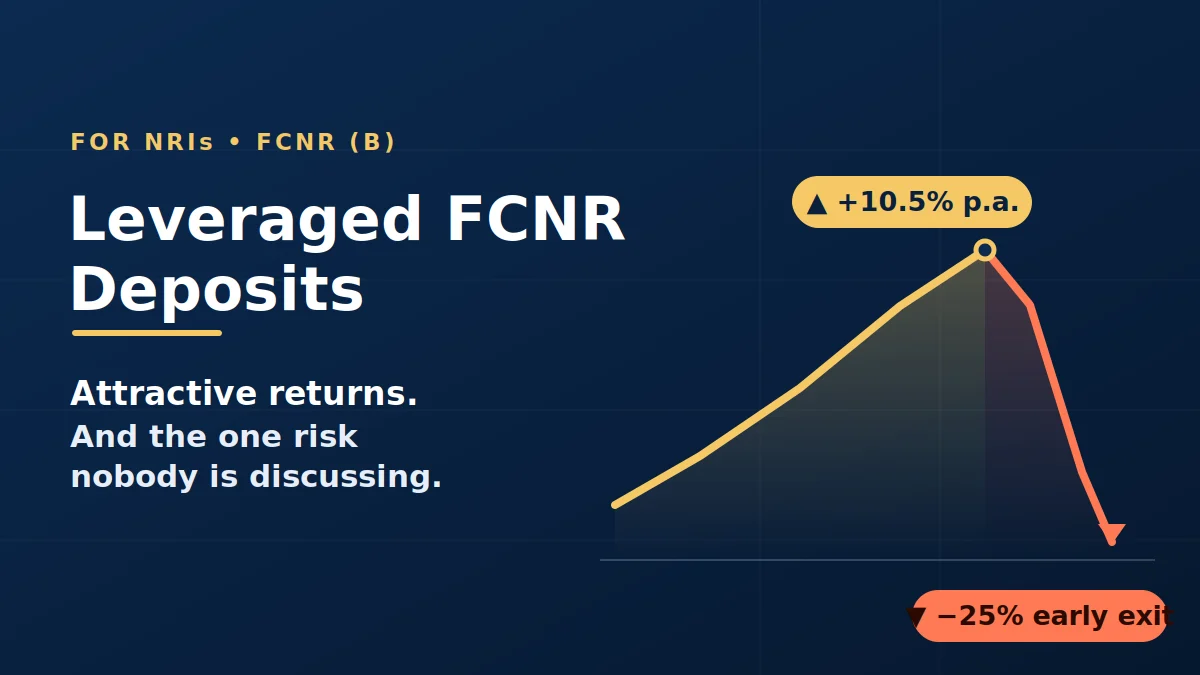
The stark reality is that the investor might receive back only approximately USD 75,000 from their initial USD 100,000 investment. This represents a substantial capital loss of USD 25,000, or 25%, on their initial capital. This is a significant erosion of capital, and this is calculated on a relatively modest initial investment. Imagine the impact if the investor had deployed a larger sum.
The bank’s contractual obligation is to return the principal and interest on the FCNR deposit. However, the loan agreement and the terms of the IRS unwind can lead to the investor being responsible for more than just the principal and interest on their loan. The costs associated with managing the bank’s own risk, particularly in volatile interest rate environments, can be substantial and are often borne by the customer in such edge cases.
The Urgency and the Timeline: A Narrow Window of Opportunity
The current financial climate, with its specific interest rate differentials and the perceived stability of certain foreign currencies, has created a favorable environment for leveraged FCNR deposits. Banks are keen to leverage these conditions and attract NRI capital. The deadline of September 30, 2026, underscores the temporal nature of this offering. This limited window is a significant driver of the current excitement, prompting both banks and investors to act decisively.
Why Now?
Several factors contribute to the current surge in interest:
- Attractive Interest Rate Differentials: In certain periods, the interest rates offered on FCNR deposits in foreign currencies can be competitive, while borrowing costs in those same currencies might be relatively low.
- Currency Exchange Rate Expectations: Some investors might have a positive outlook on the currency in which they plan to invest, anticipating appreciation against their home currency.
- Tax Advantages: FCNR deposits offer tax-free interest income in India, making them a preferred choice for NRIs seeking to optimize their returns.
- Banking Sector Initiatives: Banks are actively promoting these products as part of their strategy to tap into the substantial NRI deposit base.
The ticking clock of the September 30, 2026, deadline creates a sense of urgency, encouraging potential investors to explore and commit to these instruments before the opportunity potentially disappears or becomes less attractive.
Navigating the Complexities: Due Diligence is Paramount
The inherent complexity of leveraged products, coupled with the potential for significant capital loss in adverse scenarios, necessitates a thorough understanding and rigorous due diligence. Investors must move beyond the promise of amplified returns and delve into the intricacies of the product structure, particularly concerning its behavior in "corner cases."
Key Questions for Investors:
Before considering a leveraged FCNR deposit, potential investors should seek clear and comprehensive answers to the following:
- Detailed breakdown of all costs: Beyond the explicit interest rates on the deposit and the loan, what are the associated charges? This includes processing fees, administrative charges, and critically, the potential costs of unwinding any interest rate swaps.
- Scenario analysis: Request detailed projections from the bank illustrating how the investment would perform under various adverse market conditions, including significant currency depreciation, substantial drops in the underlying investment’s value, and sharp increases in interest rates.
- Early withdrawal clauses: Understand the penalties and costs associated with withdrawing the deposit or repaying the loan before the maturity date. This is particularly crucial if the investor anticipates needing access to funds unexpectedly.
- Bank’s role in IRS management: Clarify the bank’s responsibilities and risks associated with the Interest Rate Swap. How are these risks mitigated, and how are any unwinding costs passed on to the customer?
- Credit risk of the underlying investment: If the loan proceeds are to be invested in a specific instrument, understand the creditworthiness and risk profile of that instrument.
- Currency risk: Assess the potential impact of adverse currency movements on the overall return.
The Importance of Professional Advice:
Given the sophisticated nature of these products, it is highly advisable for NRIs to consult with independent financial advisors who specialize in international investments and have a deep understanding of NRI banking products. These advisors can offer an unbiased perspective, help in evaluating the risks against the potential rewards, and ensure that the investment aligns with the investor’s overall financial goals and risk tolerance.
A Disclaimer on Uncertainty and Responsibility
It is crucial to acknowledge that this analysis is based on an interpretation of the product structure and potential market dynamics. There might be nuances in the product offerings or specific contractual clauses that are not fully captured. The author readily admits to potential gaps in understanding and encourages readers to verify all information directly with their financial institutions.
The responsibility for understanding and managing the risks associated with any investment lies squarely with the investor. The allure of amplified returns should never overshadow the imperative of capital preservation, especially when dealing with instruments that carry inherent leverage.
Conclusion: Informed Decisions in a Dynamic Financial Landscape
Leveraged FCNR deposits present a compelling opportunity for NRIs seeking to maximize their returns. However, the potential for significant capital erosion in extreme market conditions cannot be understated. The limited window until September 30, 2026, adds a layer of urgency, but this should not lead to hasty decisions.
Investors are strongly urged to engage in thorough due diligence, seek professional advice, and critically assess all associated risks before committing to such a product. The promise of wealth creation should always be balanced with a robust understanding of potential financial perils, ensuring that decisions are not only driven by aspiration but also by prudence and a clear-eyed assessment of the risks involved. The well-being of one’s financial future, and by extension, that of their family, depends on making informed and well-researched investment choices.
Disclaimer: The information provided in this article is for educational purposes only and does not constitute investment advice. Registration with SEBI, membership of BASL, and certification from NISM do not guarantee the performance of any financial intermediary or assure returns to investors. Investments in the securities market are subject to market risks. Investors are advised to read all related documents carefully before investing. The views expressed herein may be biased and may not focus on aspects considered important by all investors. Financial goals, risk profiles, and life stages vary, and investment decisions should not be based solely on this content. There is no one-size-fits-all investment solution. Investors must understand product terms and conditions, consider their risk profile, requirements, and suitability before investing or adopting any investment approach.