WASHINGTON, D.C. — In a move that has sent shockwaves through the global technology sector and redefined the landscape of high-skilled immigration, the United States government announced on Thursday, October 8, 2026, the immediate suspension of several of the world’s largest Information Technology (IT) and software firms from the Permanent Labour Certification (PERM) program.
The decision, announced during a high-profile press conference at the Eisenhower Executive Office Building, targets both traditional offshore outsourcing giants and domestic American tech titans. The list of suspended entities includes Cognizant, Infosys, Tata Consultancy Services (TCS), Wipro, HCLTech, and Capgemini, alongside Silicon Valley stalwarts Microsoft and Adobe.
The PERM program is the essential first step for most employment-based green cards, requiring employers to prove that there are no qualified U.S. workers available for a specific position before hiring or sponsoring a foreign national. By suspending these firms, the U.S. Department of Labour (DOL) has effectively frozen the path to permanent residency for tens of thousands of H-1B visa holders currently employed by these organizations.
The Announcement: A Hardline Stance on "American Jobs"
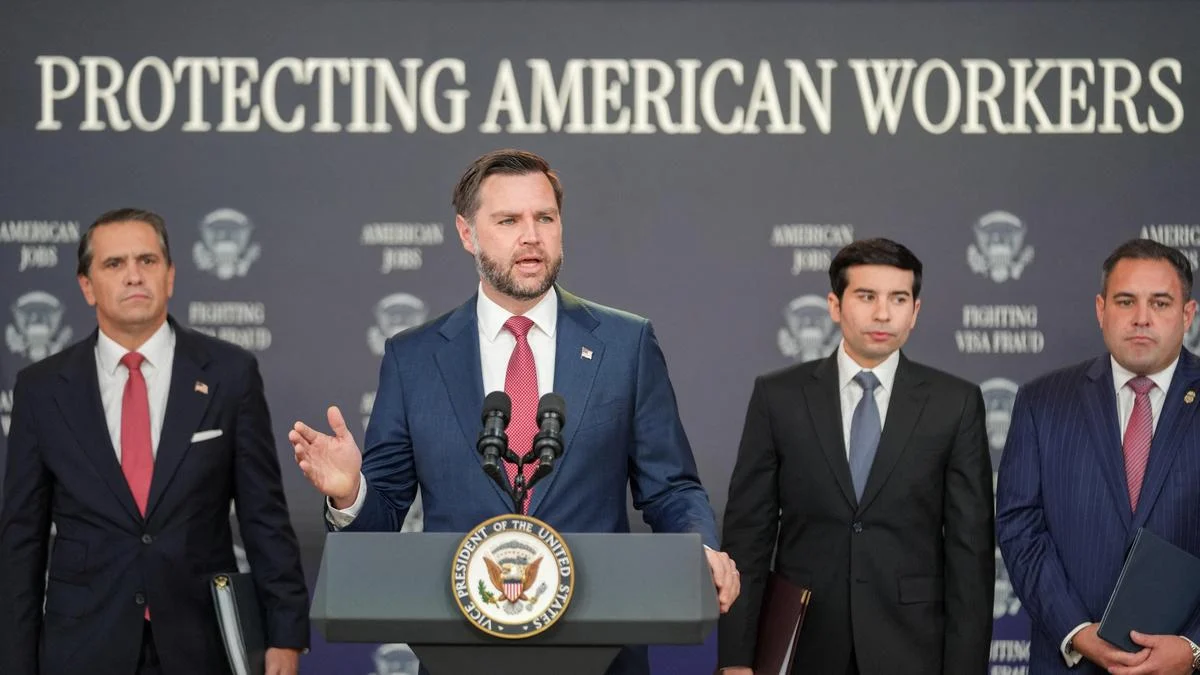
The announcement was delivered by U.S. Labour Secretary Keith Sonderling, who was accompanied by Vice-President J.D. Vance. The presence of the Vice-President, who also serves as the head of the newly formed U.S. Anti-Fraud Task Force, underscored the administration’s commitment to a protectionist "America First" labor policy.
"I am hereby suspending from the Permanent Labour Certification Programme some of the largest IT outsourcing firms in the world," Secretary Sonderling stated, specifically naming the Indian-centric firms before adding the surprising inclusion of Microsoft and Adobe. "We will not accept any new or process any pending permanent labour certification applications involving these companies."
The administration’s rhetoric focused heavily on the displacement of domestic talent. Secretary Sonderling argued that the sheer volume of foreign labor requested by these firms over the last decade and a half has systematically disadvantaged American graduates and mid-career professionals.
"Since 2009, just these companies alone have requested almost three million foreign workers," Sonderling revealed. "They’ve received over 230,000 H-1B visa approvals and over 100,000 permanent labour certifications. That’s hundreds of thousands of jobs that were taken from American workers."
Chronology: The Road to the 2026 Crackdown
The suspension is the culmination of a multi-year shift in U.S. immigration policy that began gaining significant momentum in early 2025.
- January 2025: The administration signaled a tightening of "Specialty Occupation" definitions for H-1B visas, aiming to restrict the entry of entry-level programmers.
- June 2025: The U.S. Anti-Fraud Task Force was established under the leadership of Vice-President J.D. Vance, with a specific mandate to audit "body shops" and large-scale visa sponsors.
- March 2026: The Department of Labour initiated a massive audit of PERM applications, citing "statistical anomalies" in how companies were reporting the unavailability of domestic workers.
- August 2026: Reports began to surface of a "silent freeze" at the DOL, with processing times for the companies in question stretching to unprecedented lengths.
- October 8, 2026: The formal suspension was announced, citing long-term labor market distortion and alleged systemic circumvention of the requirement to recruit American workers first.
Supporting Data: The Magnitude of the Impact
The scale of the companies involved suggests that the suspension will have immediate and far-reaching economic consequences. The firms targeted represent the backbone of the global IT services industry and a significant portion of the "Big Tech" ecosystem in the United States.
According to data presented by the Department of Labour, the "Big Six" outsourcing firms (Cognizant, Infosys, Tata, Wipro, HCL, and Capgemini) have historically accounted for a disproportionate share of the H-1B lottery cap. Critics have long argued that these firms use a "high-volume, low-cost" model that depresses wages in the tech sector.
However, the inclusion of Microsoft and Adobe marks a departure from previous crackdowns that largely spared product-based American companies.
Key Statistics Cited by the DOL:
- Total Foreign Worker Requests (2009–2026): ~3 Million (among the 8 firms).
- H-1B Approvals: 230,000+.
- Permanent Labour Certifications (Green Card Stage 1): 100,000+.
- Estimated Pending Applications Affected: Approximately 45,000 to 60,000 PERM filings currently in the pipeline are expected to be frozen indefinitely.
Economic analysts suggest that these figures represent not just numbers, but the core engineering and maintenance capacity of many Fortune 500 companies that rely on these IT firms for their digital infrastructure.

Official Responses and Industry Backlash
The reaction from the targeted companies and industry advocacy groups was swift and overwhelmingly negative.
A spokesperson for NASSCOM (The National Association of Software and Service Companies) issued a statement calling the move "arbitrary and damaging to the bilateral trade relationship between the U.S. and India." The statement argued that these firms provide essential skills that are in short supply in the American labor market, particularly in emerging fields like AI and cybersecurity.
Microsoft released a brief statement via its corporate headquarters in Redmond: "We are disappointed by this unilateral action. We have always complied with U.S. labor laws and have consistently invested in the American workforce. We believe this move will hinder innovation and weaken the United States’ competitive edge in the global technology race."
Vice-President J.D. Vance, speaking at the press conference, countered these claims. "For too long, the ‘skills gap’ has been used as a convenient excuse to bypass the American worker in favor of cheaper, tied labor," Vance said. "If these companies want access to the greatest market in the world, they must prioritize the citizens of this country. The era of the endless labor arbitrage is over."
Legal experts expect a flurry of lawsuits. "This is a massive executive overreach," said Sarah Thompson, an immigration attorney specializing in corporate law. "The DOL has the authority to deny individual applications for cause, but a blanket suspension of specific companies without a formal adjudicatory process is likely to be challenged in federal court immediately."
Implications: A New Era of Global Talent Competition
The implications of the October 8th announcement extend far beyond the legal departments of the affected firms.
1. The Human Cost and "Reverse Brain Drain"
For the thousands of foreign workers currently in the U.S. on H-1B visas, the suspension is a personal catastrophe. Many have lived in the U.S. for a decade or more, waiting for green cards while raising families and buying homes. Without the ability to progress through the PERM process, their path to permanent residency is blocked, potentially forcing a "reverse brain drain" where high-skilled talent departs for Canada, the UK, or returns to India and Europe.
2. Disruption of IT Operations
Many American corporations—from banks to healthcare providers—outsource their IT operations to the firms listed. If these firms cannot retain their key personnel due to visa uncertainty, the stability of critical American digital infrastructure could be at risk. Project timelines for digital transformation and AI integration are expected to slip as firms scramble to find alternative staffing solutions.
3. Geopolitical Tensions
The suspension of major Indian firms like TCS and Infosys is expected to strain U.S.-India relations. India has long lobbied for more flexible visa regimes for its tech professionals. This move may lead to retaliatory measures or a cooling of cooperation in other strategic areas, such as defense and trade.
4. Pressure on Domestic Salaries
In the short term, the removal of thousands of foreign workers from the labor pool may lead to a spike in salaries for American software engineers. While this fulfills the administration’s stated goal of benefiting domestic workers, economists warn it could also lead to increased operational costs for U.S. businesses, potentially fueling inflationary pressures within the tech sector.
5. The "Product vs. Service" Divide
By including Microsoft and Adobe, the administration has signaled that no company is "too big to fail" under the new labor enforcement regime. This suggests a move toward a more holistic protectionism that does not distinguish between the business models of outsourcing firms and domestic innovators.
Conclusion
The suspension of these eight IT giants from the Permanent Labour Certification Programme represents the most significant intervention in the U.S. high-skilled labor market in decades. As the U.S. Anti-Fraud Task Force continues its work, the tech industry must now grapple with a reality where the "Green Card" is no longer a guaranteed path for the global talent it has relied upon for over twenty years.
With legal battles looming and the global tech community in a state of high alert, the events of October 8, 2026, will likely be remembered as the day the "globalized" tech workforce model faced its most formidable challenge yet.