In the hyper-competitive landscape of Indian fintech, super.money—the UPI-focused payments arm incubated by e-commerce giant Flipkart—has emerged as a formidable challenger. According to recent regulatory filings submitted to the Ministry of Corporate Affairs (MCA), the company witnessed a staggering surge in its operating revenue for the 2026 fiscal year (FY26). However, this rapid scaling has come at a significant cost, as the firm’s bottom line reflects the aggressive spending required to capture market share in an industry dominated by incumbents like PhonePe, Google Pay, and Paytm.
The Financial Snapshot: Explosive Growth and Deepening Deficits
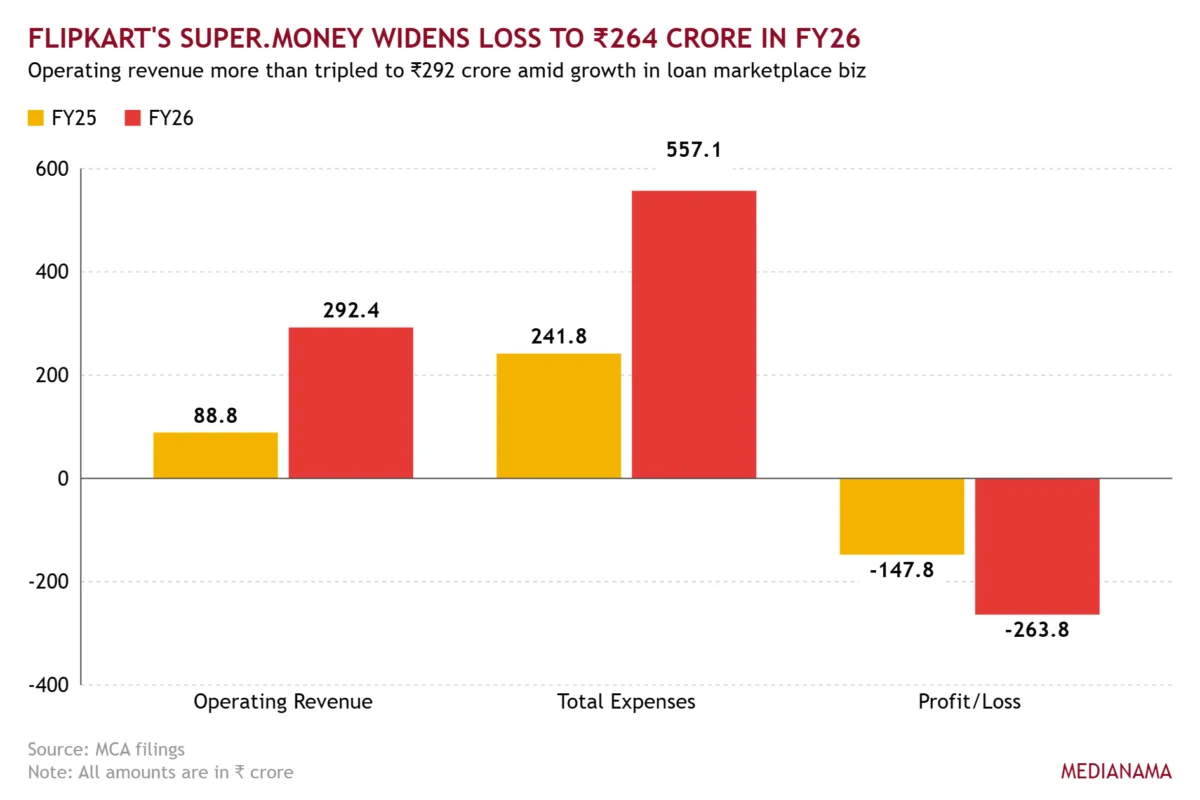
The fiscal year 2026 was a transformative period for super.money. The company reported an operating revenue of Rs 292.4 crore, a more than three-fold increase from the Rs 88.8 crore recorded in FY25. This growth trajectory is primarily attributed to the robust performance of its loan marketplace, which has become the company’s primary engine for monetization.
Despite this top-line acceleration, the company’s path to profitability remains steep. The filings reveal that super.money’s net loss widened by 78%, climbing to Rs 263.8 crore from Rs 147.8 crore in the previous year. This widening deficit is symptomatic of a "land-grab" strategy common in the Indian digital payments ecosystem, where firms prioritize user acquisition and transaction volume over immediate profitability.
Total expenses for the company ballooned by 130%, reaching Rs 557.1 crore in FY26, up from Rs 241.8 crore in FY25. As super.money continues to subsidize customer acquisition and invest in technological infrastructure, the challenge remains to convert its massive transaction volume into sustainable margins.
Chronology: From Launch to Market Leader
The rise of super.money is intrinsically linked to the broader restructuring of the Flipkart group. Following the separation of Flipkart from its former payments arm, PhonePe, the e-commerce giant faced an urgent need to reclaim control over its payments ecosystem to reduce dependency on third-party gateways and capture the lucrative financial services value chain.
- Mid-2024: Flipkart officially launched super.money in its beta version, positioning it as a dedicated UPI-first payments app designed to integrate seamlessly with the group’s broader e-commerce offerings.
- Late 2024–Early 2025: The app rapidly scaled, leveraging Flipkart’s massive user base and promotional capabilities. By early 2025, it had successfully established itself as one of India’s top five UPI applications by transaction volume.
- FY26 Operational Milestone: Data from the National Payments Corporation of India (NPCI) confirmed that super.money processed over 400 million transactions per month for five consecutive months through September 2026.
- March 2026: In a major strategic realignment, super.money was merged into Flipkart Internet, alongside other key subsidiaries like eKart, Myntra, and Cleartrip. This move was widely interpreted by analysts as a consolidation of assets to bolster Flipkart’s balance sheet ahead of a much-anticipated initial public offering (IPO).
Supporting Data: The Anatomy of Revenue
To understand how super.money functions, one must look at its dual-pillar business model: UPI-led payments and a high-margin credit marketplace.
The Credit Marketplace Dominance
The loan marketplace is the undisputed powerhouse of the company’s revenue. It contributed Rs 247.8 crore in FY26, accounting for approximately 85% of the firm’s total operating revenue. By acting as an intermediary between regulated financial institutions (banks and NBFCs) and retail consumers, super.money earns commission fees for lead generation, credit underwriting support, and loan distribution.
The Strategic Acquisition of BharatX
A pivotal moment in the company’s credit evolution was the acquisition of Y Combinator-backed fintech startup BharatX in 2025. This acquisition provided super.money with the proprietary technology necessary to offer sophisticated checkout financing. By integrating "Buy Now, Pay Later" (BNPL) and consumer durable loans directly into the UPI flow, the company has effectively transformed itself from a mere payment utility into a credit provider. This allows the app to extend credit not only on the Flipkart platform but also across various D2C (Direct-to-Consumer) ecosystems.
Other Operating Revenue
The remaining Rs 44.6 crore in revenue is classified under "other operating income." While the specific components remain opaque in the current financial statements, it is widely believed that this segment includes platform service fees, integration charges, and secondary financial service offerings that the company has been testing throughout the year.

Official Stance and Market Speculation
While the company has remained tight-lipped regarding its future roadmap, industry insiders point toward a broader ambition. Reports suggest that super.money is actively exploring a foray into stock broking and wealth management. By leveraging the data generated through its UPI transactions and credit history, the firm is uniquely positioned to offer personalized investment products.
The integration into Flipkart Internet has shielded the company from the standalone scrutiny that a startup might face, but it has also placed it under the broader mandate of the Flipkart Group’s financial health. With the group reporting a consolidated net loss of Rs 8,468 crore against a massive revenue base of Rs 1.45 lakh crore in FY26, the pressure on all subsidiaries—including super.money—to demonstrate a path toward unit economics and eventual profitability is higher than ever.
Implications: The Future of the "Super-App" Strategy
The financial performance of super.money serves as a microcosm for the challenges facing the Indian digital economy. The company’s trajectory raises several critical implications for the sector:
1. The Cost of UPI Ubiquity
UPI, while transformative for the Indian economy, offers thin margins for payment apps. Transaction volumes are massive, but the lack of Merchant Discount Rate (MDR) on standard UPI payments means that apps cannot rely on payments alone to achieve profitability. super.money’s pivot to credit is not optional; it is a survival mechanism. The company must continue to deepen its credit offerings to offset the high costs of customer acquisition.
2. Credit as the Primary Monetization Tool
The fact that 85% of revenue is derived from the loan marketplace validates the thesis that "payments is the entry, credit is the profit." By becoming a distribution channel for NBFCs, super.money is bypassing the traditional bank-branch model and putting credit directly into the hands of the digital-first consumer. However, this carries risks; as the credit portfolio grows, the company must manage the quality of the loans distributed to ensure that defaults do not erode their hard-won gains.
3. The IPO Catalyst
The merger with Flipkart Internet is perhaps the most significant structural change for super.money. By folding the app into the parent entity, the Flipkart Group is presenting a unified financial services front to potential public market investors. The company is no longer a standalone fintech experiment but a critical component of a massive, diversified digital commerce conglomerate. Whether this leads to a more disciplined focus on profitability or a continued "burn-to-grow" model will likely be determined by the timelines of the Flipkart IPO.
4. Competitive Moats and Differentiation
In a market saturated with UPI players, super.money’s primary differentiator is its deep integration into the Flipkart supply chain. By providing credit at the point of sale on the country’s largest e-commerce platform, it enjoys a "captured" audience that pure-play payment apps struggle to access. As it looks toward potential ventures in stock broking and insurance, the company is effectively trying to build a comprehensive financial super-app that mirrors the strategy of global peers like Ant Group or Grab.
Conclusion
super.money has succeeded in its initial phase: it has moved from a cold start to processing hundreds of millions of transactions, establishing itself as a credible player in the Indian fintech landscape. The FY26 numbers demonstrate a company in the thick of a high-stakes transition. While the widening losses are a clear reflection of the capital-intensive nature of this growth, the 212% revenue increase indicates that the market is responding to its product suite.
As the company moves into the next fiscal year, the focus will likely shift from pure user acquisition to "value extraction"—improving the yield on its loan book, refining its credit risk models, and potentially launching new wealth management products. The success of super.money will ultimately depend on whether it can leverage its position within the Flipkart ecosystem to build a sustainable, profitable financial services business before the public markets demand a shift from growth to dividends. For now, it remains a high-growth, high-burn entity that sits at the very heart of India’s digital financial revolution.