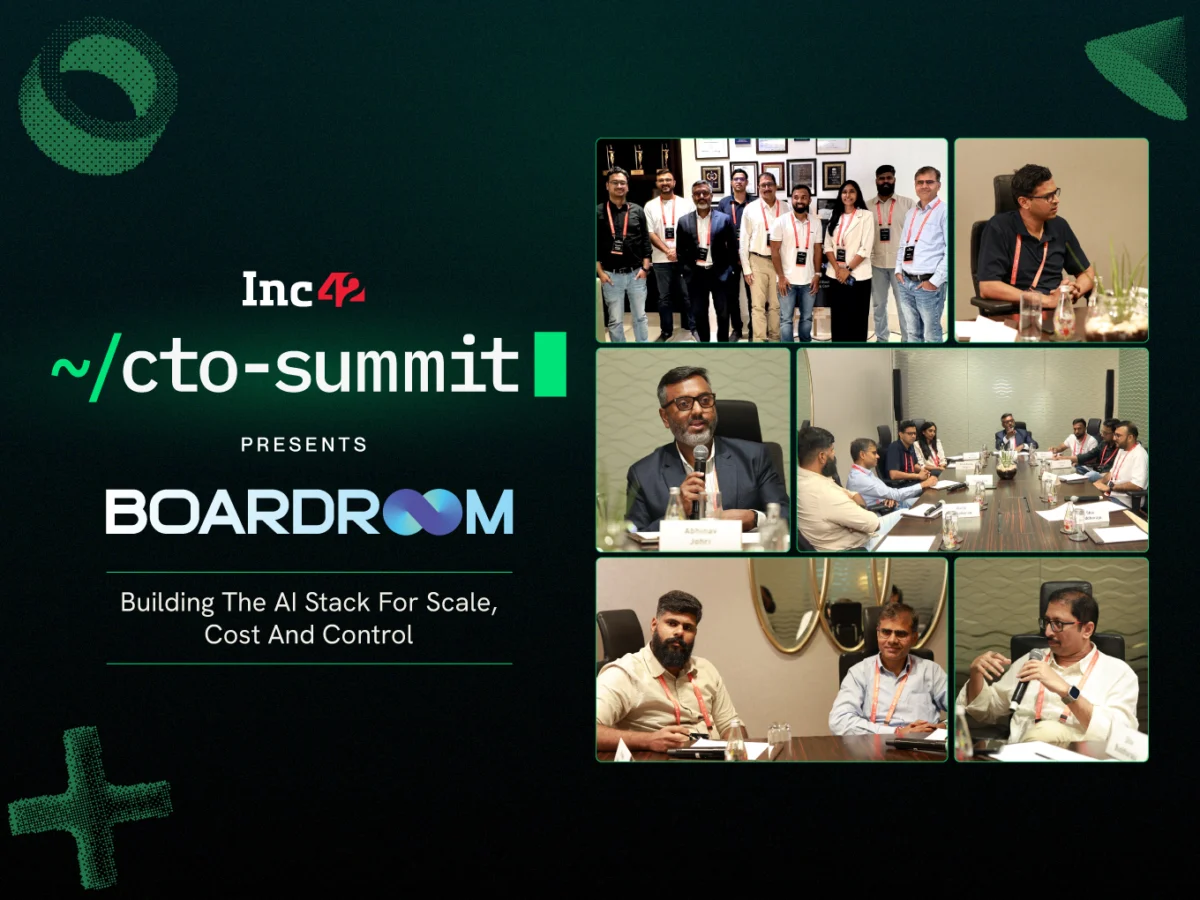
As artificial intelligence shifts from a frontier of experimental sandboxes to the bedrock of enterprise operations, Indian technology leaders are confronting a sobering reality: adoption is no longer about "if," but about "how much" and "at what cost." With a December 2025 government report citing that 87% of Indian enterprises are now actively utilizing AI, the conversation has pivoted from the thrill of innovation to the rigors of architecture, unit economics, and competitive survival.
This shift was the central theme of the second roundtable held on the sidelines of Inc42’s inaugural CTO Summit 2026. Moderated by Abhinav Johri, Partner of Technology Consulting at EY India, the session convened a panel of industry veterans to dissect the "build vs. buy vs. rent" dilemma that defines the current AI maturity curve.
The Strategic Dilemma: What to Own, What to Rent
For the modern CTO, the proliferation of Large Language Models (LLMs) and foundation models has democratized access to high-level intelligence. However, this accessibility has created a paradox: if every competitor has access to the same frontier models, where does the sustainable competitive advantage reside?
The "Build-Buy-Rent" Framework
The consensus at the summit was that technology leaders must transcend traditional procurement frameworks. The discussion centered on a three-tier classification:
- Own: The proprietary data, business logic, and deeply ingrained operational workflows.
- Rent: The rapidly evolving "intelligence" layer—the foundation models that provide the reasoning capabilities.
- Buy: The off-the-shelf tooling and infrastructure that handles commoditized functions.
Sumanth Rai of Netradyne offered a pragmatic perspective on the "renting" model. "Unless regulatory mandates require us to run our own localized models, we are significantly better off renting intelligence," Rai argued. "The leadership board for frontier models changes almost weekly. Investing heavily in an in-house model today could leave you holding obsolete technology by the time it reaches production. For most enterprises, agility and the ability to swap models are far more valuable than ownership."
Chronology: The Evolution of AI Integration
To understand the current state of play, one must look at the rapid maturation of AI deployment in the Indian startup and enterprise ecosystem:
- 2023 – The Exploration Phase: Characterized by "AI-washing" and small-scale experiments with LLM wrappers. The focus was on novelty rather than business impact.
- 2024 – The Integration Phase: Companies began integrating AI into existing software stacks. The focus shifted to RAG (Retrieval-Augmented Generation) and fine-tuning models on specific company datasets.
- 2025 – The Economic Reality Phase: The current landscape. Companies are auditing their AI stacks for ROI. The "AI Tax"—the cost of inference and compute—is being weighed against contribution margins.
- 2026 (Present) – The Maturity Phase: The focus is now on "AI-Native" workflows, where the business model is built around AI, and economic sustainability is the primary filter for product development.
Supporting Data: The Indian AI Adoption Index
The 2025 government backgrounder, which highlighted the 87% adoption rate, serves as a benchmark for the current market saturation. However, the data hides a critical nuance: while adoption is high, "meaningful impact" is unevenly distributed.
Enterprises that have successfully integrated AI share common traits:
- Domain-Centricity: They do not apply AI to every problem; they apply it where the cost of human error is high and the volume of data is immense.
- Contextual Moats: As articulated by the panel, the technology (the model) is a utility, but the context (the proprietary data) is the asset.
- Unit Economics Focus: Companies are increasingly calculating the "Cost-per-Interaction" of AI, ensuring it does not exceed the value of the task it replaces.
Building an Edge: The Supremacy of Context
A recurring theme throughout the summit was that while AI models are interchangeable, the domain context is not.
"I feel that founders and tech leaders need to know their specific domain really well to not only see the existing gaps but also use AI to fill in those gaps in a way that was never done before," noted the leadership at Matters.ai.
This sentiment was echoed by the team at SeedlingLabs, who argued that proprietary data is the ultimate "moat." In a world where frontier models offer parity, the differentiator is the unique, historical, and proprietary data a company holds. Whether it is a decade of financial transactions or a proprietary clinical diagnostic pipeline, this context must be owned.
For companies like CoinSwitch & Lemonn, the stakes are even higher. Dealing with customer funds means that accuracy is non-negotiable. "When you’re dealing with customer money, all operations become very critical, and accuracy can’t be compromised," the leadership emphasized. "You must build on top of your 10-year-old context, not just with some new technology in isolation."
Official Perspectives: The Economics of Scaling
Perhaps the most significant contribution of the 2026 CTO Summit was the shift toward AI Economics.
The Financial Filter
At BigHaat, the approach to AI is strictly utilitarian. Decisions are not made based on the sophistication of the model, but on its impact on the contribution margin. "Whether it is fulfilment, RTOs (Return to Origin), users or technology costs, we need to understand the economics before we scale," noted the panelist from BigHaat.
This sentiment was mirrored by the team at Gravitas, who apply a "sustainability test" to every AI feature. By analyzing the cost of converting healthcare clinical charts into ICD and CPT codes, they identified that AI was only viable if it outperformed the existing BPO-led models in both accuracy and unit cost. If the AI model is faster but twice as expensive as a human process, it is rejected at the product development stage.
Productivity as a Metric
At Vahan.ai, the success of AI is measured through a simple, brutal metric: placements per telecaller. By automating the mundane aspects of recruitment and outreach, they have effectively increased the "human throughput." The goal is not to replace the human, but to increase the value generated by every human hour.
Implications for the Future
The path forward for Indian enterprises is clear: the era of "AI for the sake of AI" is over. As we move through 2026 and toward 2027, several key implications emerge for the CTO:
- Model Agnosticism: CTOs should avoid vendor lock-in. Designing architectures that allow for the "swapping" of models—moving from GPT to Claude to Llama or proprietary alternatives—will be a critical survival skill.
- The Rise of "Small" Models: Enterprises will likely pivot toward smaller, cheaper, and more efficient domain-specific models that are faster and cheaper to run than massive, general-purpose frontier models.
- Governance and Ethics: As AI touches more critical business infrastructure, the demand for "Explainable AI" (XAI) will grow. Companies will need to prove why an AI model made a specific financial or clinical decision.
- Talent Reskilling: The value of a "Prompt Engineer" is waning, while the value of a "Domain Engineer"—someone who understands both the business logic and the underlying AI architecture—is skyrocketing.
Conclusion
The CTO Summit 2026 highlighted that while the technology is changing at a breakneck pace, the fundamentals of business remain constant. AI is a tool, not a strategy. The winners in the coming decade will be those who resist the urge to build everything in-house, who prioritize the protection of their proprietary data context, and who treat every AI deployment as a rigorous economic calculation rather than a technical experiment. As the industry matures, the focus will remain on building systems that don’t just "work," but that build long-term, defensible value in an increasingly automated world.