
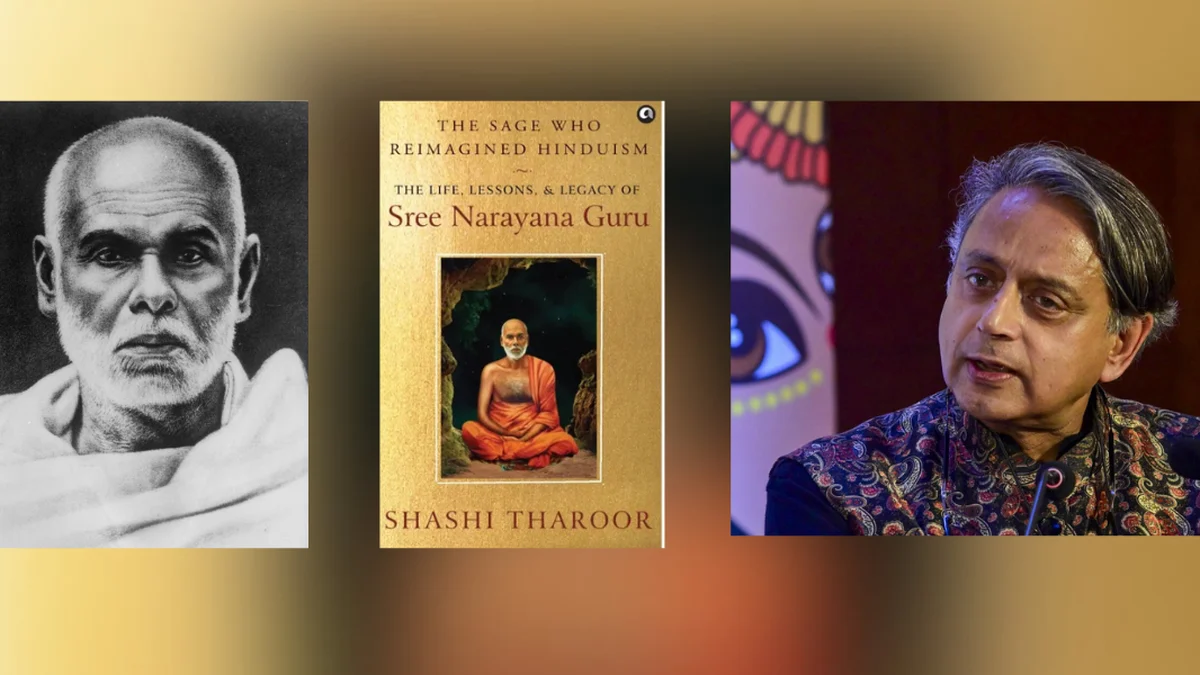
In the pantheon of Indian social reformers who fundamentally altered the country’s trajectory, Sree Narayana Guru stands as a figure of singular importance. While his influence has long been the bedrock of Kerala’s social fabric, his national stature has often been overshadowed by more localized narratives or assimilated into regional histories. Shashi Tharoor’s latest work, The Sage Who Reimagined Hinduism, serves as a vital bridge, bringing the life and philosophy of this 19th-century visionary to a contemporary, pan-Indian audience. By situating the Guru not merely as a mystic, but as a pragmatic architect of social justice, Tharoor invites us to confront the persistent challenges of caste and inequality that continue to define the Indian experience.
The Man and the Movement: A Chronology of Transformation
To understand Sree Narayana Guru, one must look at the restrictive, feudal landscape of 19th-century Kerala. Born in 1856 in the village of Chempazhanthy, the Guru emerged from the Ezhava community—a group subjected to the indignities of the caste system, which relegated them to the lower rungs of the social order.
- 1888: The Aruvippuram Consecration: This was the watershed moment of his life. In an era where the consecration of deities was a strict monopoly of the Brahmin priesthood, the Guru installed a Shiva idol at Aruvippuram. This act was not merely a religious gesture; it was a radical assertion of spiritual self-determination. It signaled to the oppressed that the sacred was not the exclusive property of the elite.
- 1903: Founding the SNDP: The establishment of the Sree Narayana Dharma Paripalana (SNDP) Yogam marked the transition from individual reform to institutionalized social upliftment. The organization became the vehicle for the Guru’s message of "One Caste, One Religion, One God for Man."
- 1920s: The Vaikom Satyagraha: A critical juncture in his influence, the movement for temple entry access highlighted the philosophical friction between the Guru’s vision of total equality and the more reformist, moderate approach championed by figures like Mahatma Gandhi.
- 1928: The Passing of the Guru: His death left behind a legacy that would go on to shape the political and social trajectory of Kerala, influencing literacy, social equity, and the state’s eventual development model.
A Practical Reformer: Challenging the Theological Hegemony
Tharoor’s biography performs an essential service by dismantling the image of the Guru as a detached, ascetic mystic. Instead, he highlights the Guru’s "practical" approach to reform. Narayana Guru understood that social emancipation was a three-pronged endeavor: spiritual liberation, educational advancement, and organizational strength.
By preaching "One Caste, One Religion, One God for Man," the Guru did not seek to invent a new religion but to strip Hinduism of its exclusionary, Brahmanical justifications. He targeted the religious roots of inequality. Unlike B.R. Ambedkar, who would later conclude that the caste system was so deeply embedded in Hindu scripture that it necessitated a total departure from the faith, Narayana Guru sought to "democratize" Hinduism from within. He provided his followers with an alternative, humanistic interpretation of the tradition, arguing that true piety is reflected in the well-being of one’s fellow human beings.
Situating the Guru in the National Anti-Caste Struggle
The significance of Sree Narayana Guru is amplified when viewed alongside the broader, national anti-caste movement. The 19th and early 20th centuries were a crucible of social churning: Jotirao Phule’s Sarvajanik Satya Dharma in Maharashtra, Harichand Thakur’s Matua movement in Bengal, and the various Adi movements across northern India all shared a common objective: to reclaim the dignity of the oppressed by engaging with, reinterpreting, or challenging the religious doctrines that sustained their subjugation.
However, a critical distinction remains: while these movements were unified in their goal of ending caste discrimination, they employed vastly different methodologies. Narayana Guru’s path was one of spiritual reformism, which, while revolutionary, operated within the bounds of a revamped Hindu framework. The inherent tension in this strategy—that one can reform a system of hierarchy from within—remains a subject of intense academic and political debate.
Supporting Data: The Complementary Currents of Reform
The impact of the Guru cannot be isolated from other contemporaneous movements. A notable omission in many historical accounts, which Tharoor’s work touches upon, is the role of Ayyankali. If Narayana Guru provided the intellectual and spiritual framework for equality among the Ezhavas, Ayyankali’s movement among the Pulayars focused on the material and civic aspects of emancipation—access to roads, schools, and public employment.

These two figures represented "complementary currents." While the Guru fought the battle of the mind and the soul, Ayyankali fought the battle of the street and the classroom. Together, they forged a dual-pronged assault on the status quo that arguably makes Kerala’s social history unique in the Indian context. Their efforts collectively dismantled the rigid structures that had held the state’s population in check for centuries.
Implications for Contemporary India
The relevance of The Sage Who Reimagined Hinduism extends well beyond historical interest. In a modern India where identity politics are increasingly weaponized for exclusionary purposes, the Guru’s message of universalism is a potent antidote. His philosophy—that spirituality must be rooted in human dignity—serves as a reminder that the goal of any social movement should be the elevation of the individual, not the consolidation of power.
However, we must also address the limitations of such movements. A recurring theme in the history of anti-caste activism is the tendency for these movements, despite their universalist rhetoric, to remain anchored within specific caste bases. The SNDP, while monumental in its impact, largely remained a pillar for the Ezhava community. This raises the question: can a movement for equality be truly universal if it is organized along the very lines of the identity it seeks to dismantle? Tharoor’s biography is an excellent starting point for this discussion, though some critics might argue it leans toward celebration where a more forensic, critical analysis of these historical contradictions might be necessary.
Official Responses and Public Discourse
Public figures and scholars have hailed Tharoor’s work as a "timely introduction." In the political sphere, the legacy of Sree Narayana Guru remains a hotly contested territory. Various political parties in Kerala continue to invoke his name, demonstrating that his influence is far from being a relic of the past. By re-engaging with his writings and his life, Tharoor has provided a template for how India might reconsider its history of social reform.
The book is not merely a biography; it is a challenge to the reader. It asks: in an era of digital fragmentation and rising religious intolerance, what does it mean to be a "reformer"? Does true change come from the top down, through policy, or from the bottom up, through the fundamental restructuring of human consciousness?
Conclusion: A Legacy Reclaimed
Shashi Tharoor has succeeded in producing the most accessible and intellectually rigorous account of Sree Narayana Guru available to English-language readers today. While the book might leave some questions regarding the ultimate efficacy of internal religious reform unanswered, it performs the invaluable service of re-centering a titan of Indian thought.
For those who wish to understand the soul of modern Kerala and the broader, often unfinished, struggle for equality in India, The Sage Who Reimagined Hinduism is essential reading. The Guru’s life remains a testament to the idea that, regardless of the structures of power that seek to divide us, the pursuit of human dignity remains a sacred, and fundamentally human, endeavor. In recovering this legacy, we are not just looking back at a sage; we are looking forward at the potential for a more equitable future.