
In the hyper-competitive landscape of Indian direct-to-consumer (D2C) fashion, few names carry the resonance of Bewakoof. Founded in 2012 by Prabhkiran Singh, the brand carved out a niche by catering to the irreverent, style-conscious sensibilities of India’s Gen Z and millennial demographics. However, the company’s latest financial report for the fiscal year ending March 2026 (FY26) reveals a complex narrative: one of aggressive top-line growth overshadowed by a widening bottom-line deficit.
As the brand navigates a transitional period marked by leadership changes and shifting market dynamics, the FY26 data provides a critical window into the operational health of one of Aditya Birla Fashion and Retail’s (ABFRL) key strategic assets.
The Financial Snapshot: Growth at a Cost
Bewakoof’s FY26 financial disclosures paint a picture of a company prioritizing market share and revenue scale over immediate profitability. While the brand succeeded in driving significant consumer interest, the cost of this expansion weighed heavily on its balance sheet.
Key Performance Indicators
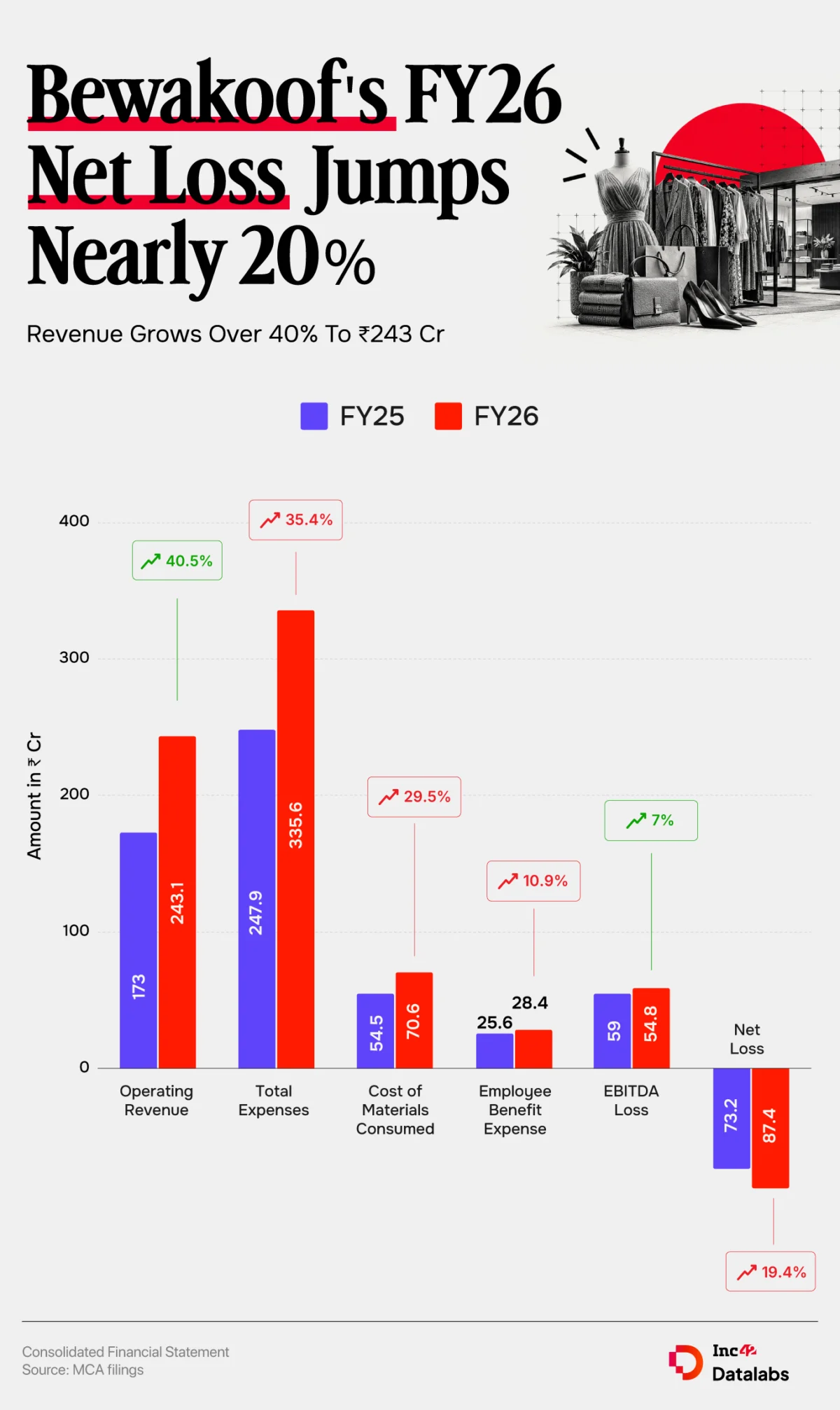
- Operating Revenue: The company reported a robust revenue from operations of ₹243.1 Cr, representing a 40.6% year-on-year (YoY) increase from the ₹173 Cr reported in FY25.
- Net Loss: In a departure from its previous trajectory of narrowing losses, Bewakoof’s net loss expanded by 19.4%, climbing to ₹87.4 Cr from ₹73.2 Cr in the prior fiscal year.
- EBITDA Performance: On a brighter note, the company’s operating efficiency showed signs of resilience. Its EBITDA loss narrowed by 7.2%, settling at ₹54.8 Cr compared to ₹59 Cr in FY25, suggesting that the core business operations are beginning to stabilize despite the broader net loss.
- Expenditure: Total expenses surged by 35.4%, reaching ₹335.6 Cr, driven by increased investments in inventory and operational scaling.
A Chronological Journey: From Startup to Corporate Subsidiary
To understand Bewakoof’s current standing, it is essential to view its trajectory through the lens of its evolution over the past decade.
2012–2022: The Independent Rise
Born in the early days of India’s e-commerce boom, Bewakoof emerged as a disruptor. By leveraging social media marketing and a design-led approach to basics—such as graphic tees and lifestyle accessories—the brand became a household name among urban youth. Its lean, digital-first model allowed it to bypass traditional retail bottlenecks.
2022–2023: The Strategic Pivot
The landscape changed significantly in late 2022 when Aditya Birla Fashion and Retail (ABFRL), through its digital-first subsidiary TMRW, identified Bewakoof as a cornerstone for its roll-up strategy. In a deal valued at approximately ₹200 Cr, ABFRL acquired a majority stake, integrating the startup into a larger ecosystem designed to scale D2C brands. The acquisition was finalized in February 2023, ushering in a new era of corporate oversight and professionalized growth targets.
2024–2026: The Struggle for Balance
The period following the acquisition has been defined by the dual pressures of scaling operations under a conglomerate umbrella while managing the inherent volatility of the fashion retail sector. While FY25 saw the brand successfully narrow its losses by 29%, the FY26 results indicate that the "growth-at-all-costs" mindset has returned, perhaps in response to heightened competition from rivals like The Souled Store, Snitch, and MyDesignation.
Dissecting the Expenditure: Where the Money Went
Bewakoof’s total expenditure of ₹335.6 Cr offers a roadmap of its operational priorities. A detailed look at the line items reveals the intensive capital requirements of modern D2C fashion.
1. The Inventory Burden
The cost of materials consumed saw a 29.6% uptick, rising to ₹70.6 Cr. More significantly, the "Purchases of Stock-in-Trade"—essentially finished goods purchased for resale—soared by 67.4% to ₹63.6 Cr. This suggests that the brand is aggressively expanding its product catalog and inventory depth to capture a wider share of the consumer wallet.
2. Operational and Marketing Spend
"Other Expenses," which encompass marketing, promotional campaigns, and general administrative costs, remained the largest chunk of the expenditure at ₹146.6 Cr—a 20.9% YoY increase. In an era where digital customer acquisition costs (CAC) are rising, this reflects the heavy investment required to maintain brand visibility against aggressive incumbents.
3. Human Capital
Employee benefit expenses grew by 10.6% to ₹28.4 Cr. While this is a modest increase compared to revenue growth, it indicates a stable investment in the workforce, likely focused on design, supply chain management, and digital infrastructure.

4. Depreciation and Amortization
A notable shift occurred in depreciation costs, which more than doubled to ₹16.6 Cr from ₹6.1 Cr in the previous year. This indicates significant capital expenditure in assets, likely related to supply chain logistics, technological upgrades, or warehouse infrastructure required to support the increased scale of operations.
The Leadership Vacuum and Future Outlook
The financial performance of FY26 coincides with a critical leadership transition. Founder Prabhkiran Singh, the architect of Bewakoof’s brand identity, announced his decision to step down from his role at the end of March 2026.
The Implications of Leadership Change
The departure of a founder often triggers a period of uncertainty for stakeholders. For a brand as personality-driven as Bewakoof, the transition to new, potentially corporate-led management raises questions:
- Brand DNA: Will the brand retain its signature "irreverent" voice, or will it shift toward a more conservative, corporate aesthetic?
- Strategic Direction: Will the parent company, TMRW/ABFRL, push for further austerity to turn the tide on losses, or will they continue to bankroll expansion?
As of the date of this report, the company has remained quiet regarding the specifics of its succession plan, leaving the market to speculate on whether an internal promotion or an external industry veteran will take the helm.
Competitive Landscape and Market Context
Bewakoof does not exist in a vacuum. It faces intense pressure from:
- The Souled Store: A dominant player in the pop-culture merchandise space that has been aggressively expanding its physical retail footprint.
- Snitch: A fast-fashion challenger that has gained rapid traction by mimicking international runway trends for the Indian market at accessible price points.
- Market Saturation: With quick-commerce and marketplace giants like Myntra and Amazon offering their own "house brands," the margins for independent D2C players are being squeezed from all sides.
The fact that Bewakoof’s EBITDA loss narrowed suggests that the business model is inherently viable; the challenge lies in the "Operating Leverage." The company is currently spending significantly on growth, but it has yet to prove that this growth can scale at a pace that outruns its mounting operational expenses.
Conclusion: Is the "Bewakoof" Model Sustainable?
The FY26 performance of Bewakoof is a classic case study in the challenges of scaling a D2C brand in India. The 40.6% revenue growth is a testament to the enduring appeal of the brand among its core demographic. However, the 19.4% jump in net losses serves as a cautionary tale for the broader D2C ecosystem.
Investors and analysts will be watching the next fiscal year closely. The critical test for the brand will be its ability to optimize its "Other Expenses" and achieve better inventory turnover. If the brand can maintain its revenue growth while moderating the rapid climb in depreciation and marketing costs, it may well find the path to profitability.
For now, Bewakoof stands at a crossroads. With a new leadership team set to take the reins and a massive parent organization providing the financial backing, the brand has the resources to pivot. Whether it chooses to focus on sustainable, bottom-line-driven growth or continues its high-octane expansion strategy will define its trajectory for the next decade.
One thing remains certain: in the volatile world of Indian fashion retail, "Bewakoof" continues to be a brand that refuses to be ignored, even as it grapples with the cold, hard realities of the balance sheet.