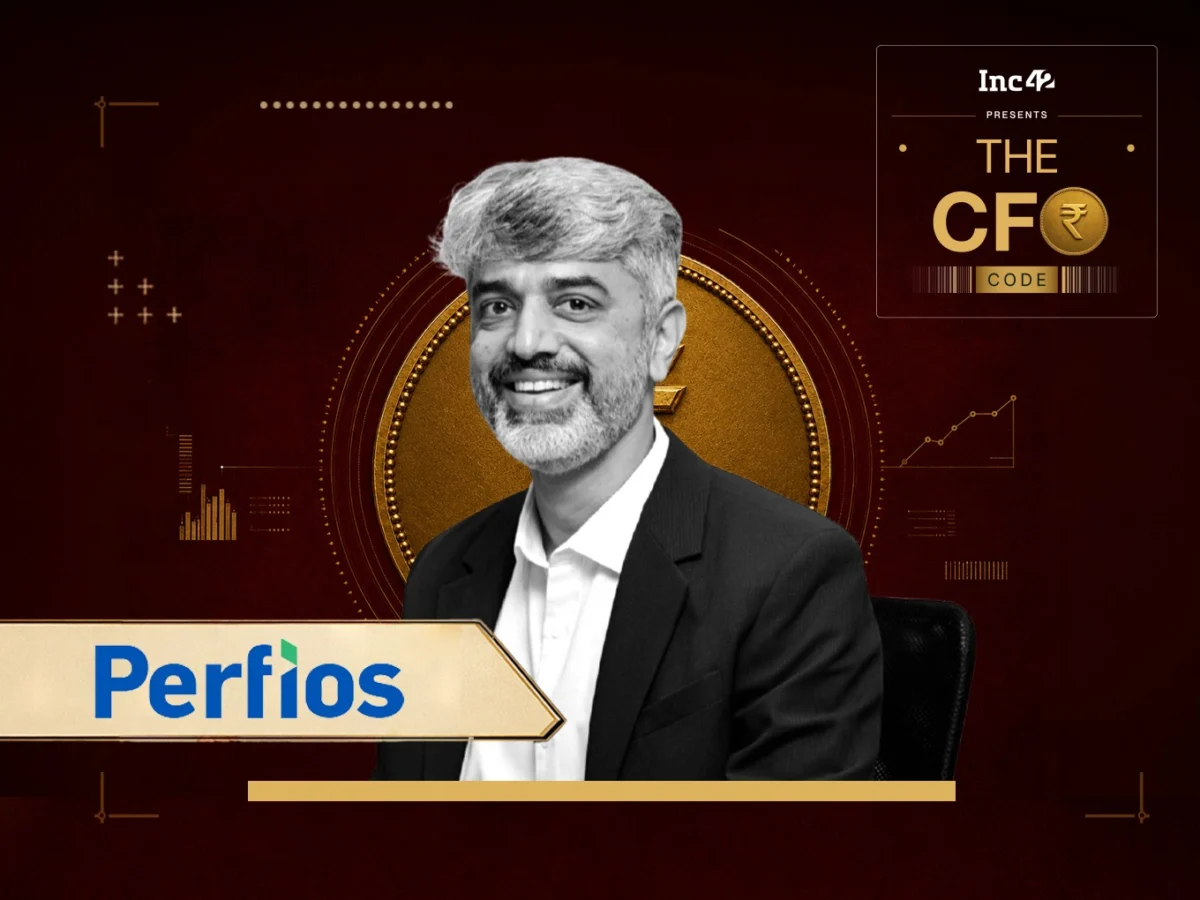
In the modern corporate ecosystem, the title "Chief Financial Officer" has undergone a seismic shift. No longer confined to the back-office silos of balance sheet reconciliation and regulatory compliance, today’s CFO acts as the primary architect of enterprise value. At the helm of this evolution is Prashant Mahagaonkar, Group CFO of the fintech powerhouse Perfios.
In the concluding edition of The CFO Code—a deep-dive series by Inc42—Mahagaonkar reflects on a 25-year odyssey that has seen him transition from traditional auditing to becoming the strategic heartbeat of a high-growth, B2B SaaS giant. As Perfios continues to scale across global markets, serving over 1,000 financial institutions, Mahagaonkar’s role has become a masterclass in balancing founder ambition with the cold, hard reality of financial discipline.
A Career Forged in Complexity: A Chronological Journey
Mahagaonkar’s path to the C-suite was anything but linear. His professional narrative serves as a blueprint for how finance leaders must diversify their experiences to navigate the volatile currents of modern business.
The Foundation (1999–2010)
Starting his career in 1999 at Tata Motors, Mahagaonkar cut his teeth on traditional audit and compliance. However, he quickly realized that a career spent solely in the "rear-view mirror" of financial reporting would not satisfy his desire for strategic influence. His transition to Givaudan India in 2002 served as a pivotal turning point. Here, he observed how a Swiss multinational managed complex financial systems across diverse geographical markets—an experience that defined his philosophy on scalable infrastructure.
The Pivot to M&A and Scale
His tenure at Essilor India marked a shift from operational finance to the high-stakes world of Mergers and Acquisitions (M&A). This pivot proved crucial when he joined Amba Research. Tasked with managing capital raises and navigating cross-border investor relations, he successfully guided the company through its eventual acquisition by Moody’s.
The Hyper-Growth Phase
Perhaps his most influential stint occurred at CitiusTech, where he served as the company’s first CFO. Working in lockstep with the founder-CEO, he helped orchestrate a monumental revenue scaling exercise, taking the company from $60 million to $500 million. It was here that Mahagaonkar mastered the delicate art of the "founder-finance relationship"—learning to temper aggressive entrepreneurial risk-taking with institutional financial rigor.
Walking the Tightrope: Risk, Reward, and the "Art of the Possible"
For Mahagaonkar, the primary tension in any growing firm lies between the CEO’s drive for market expansion and the CFO’s mandate to protect the balance sheet.
"The solution is rarely to take the most conservative, ‘no’-based position," Mahagaonkar explains. Instead, he advocates for creating a "playbook" that defines the boundaries of risk. By establishing clear guardrails—what the company will agree to and where it must draw the line—the finance team can enable the business to move faster. He describes this as the "Art of the Possible," a framework where compliance and growth are not adversarial, but symbiotic.
Mastering M&A: Beyond the Paperwork
Since joining Perfios in July 2025, Mahagaonkar has been tasked with integrating a series of strategic acquisitions, including an Enterprise Fraud Risk Management (eFRM) unit and a collections firm. Each acquisition presented a unique challenge: How do you weave disparate business models into a single, cohesive entity without stifling the innovation that made them attractive in the first place?
The Integration Mandate
Integration, according to Mahagaonkar, is a three-pronged challenge:

- Systemic Integration: Harmonizing information security, contract management, and statutory compliance.
- Financial Alignment: Bringing smaller, less-structured entities up to the rigorous reporting standards of a private-equity-backed giant.
- Human Capital Integration: The most overlooked aspect of M&A. Mahagaonkar emphasizes that if a CFO fails to address redundant roles and cultural friction, they are effectively leaking shareholder value.
"You need to be in the room for the people discussions," he notes. "You cannot build a unified organization if the finance department treats M&A as a purely arithmetic exercise."
AI and Capital Allocation: The New CFO Scanner
Perhaps the most significant change in Mahagaonkar’s tenure is the rise of AI as a primary investment category. With product lifecycles shrinking from two years to as little as six months, the margin for error in capital allocation has evaporated.
The ROI Matrix for Innovation
Mahagaonkar is a vocal proponent of skepticism when it comes to the "AI-everywhere" trend. At Perfios, he has implemented a rigorous ROI matrix to vet technology spend. The core philosophy is simple: Not every problem requires a generative AI solution.
- Automation vs. AI: Mahagaonkar argues that many companies rush to deploy complex AI models when simple, cost-effective automation would yield better results.
- The Decision Framework: Before authorizing a budget, his team evaluates:
- Does this improve productivity or just add complexity?
- Will this impact hiring requirements?
- Is there a non-AI alternative that achieves the same objective?
By forcing teams to justify AI spend against a clear productivity metric, Mahagaonkar ensures that Perfios invests in technology that creates tangible value rather than merely chasing industry buzzwords.
The CFO as the CEO’s Co-Pilot
Modern financial leadership requires a departure from historical data analysis toward "forward-looking judgment." Mahagaonkar estimates that 40% of his daily decisions are based on predictive insight rather than recorded ledger history.
"The CFO is no longer a backroom player; they are the CEO’s co-pilot," he says. However, he is careful to distinguish between being a co-pilot and the de facto CEO. The CFO’s duty is to provide the data-driven map, while the CEO drives the vehicle. The magic happens when the two are in alignment, allowing for aggressive, calculated maneuvering through market uncertainty.
Implications for the Future: What Next-Gen Leaders Need
As Mahagaonkar looks toward the next generation of finance talent, he observes a shift in the necessary "arsenal." The finance leaders of the past were defined by their ability to know the numbers better than anyone else. The leaders of the future, he argues, will be defined by their ability to synthesize four disparate pillars:
- Financial Acumen: The traditional baseline.
- Business Intuition: Deep understanding of the company’s product and market position.
- Technological Fluency: The ability to differentiate between hype and functional utility.
- People Leadership: The capacity to manage high-caliber, tech-savvy teams who often possess more specialized knowledge than their managers.
The Final Verdict
The takeaway from Mahagaonkar’s journey is clear: the modern CFO must be a polymath. They must be comfortable with the discomfort of uncertainty, capable of navigating the nuances of human culture as adeptly as the complexities of M&A contracts, and disciplined enough to reject technological trends that don’t move the needle.
For Perfios, this leadership style has provided a steady hand in an era of rapid digital transformation. For aspiring finance professionals, Mahagaonkar’s career stands as a compelling testament to the fact that while the numbers remain the language of business, it is the strategic voice of the CFO that tells the company’s future story.
As the curtain closes on Inc42’s "The CFO Code" series, the insights provided by leaders like Prashant Mahagaonkar highlight a vibrant, evolving landscape for India’s fintech sector—one where financial rigor and bold innovation are increasingly two sides of the same coin.