Paytm, once the undisputed titan of India’s digital wallet revolution, stands at a defining juncture in its corporate lifecycle. Having navigated the turbulence of regulatory crackdowns and a radical internal restructuring, the company has emerged as a leaner, profitable entity. However, the path forward is no longer a linear progression of digital payments. Instead, Paytm is orchestrating a complex pivot—balancing its heritage as a payments powerhouse with a burgeoning financial services distribution model, all while pinning its long-term scalability on a bold bet: Artificial Intelligence.
As the fintech landscape prepares for potential shifts in the Merchant Discount Rate (MDR) regime for Unified Payments Interface (UPI) transactions, Paytm’s strategic evolution offers a masterclass in corporate resilience and adaptation.
The Chronology of Transformation: From Wallets to Wealth
To understand Paytm’s present, one must trace its evolution from a singular payments product to a diversified financial ecosystem.
2010–2018: The Wallet Era
Paytm began as a digital wallet, effectively acting as the gateway for millions of Indians to enter the formal digital economy. This period was defined by aggressive user acquisition and the rapid adoption of QR-based payments, which cemented the brand’s ubiquity.
2019–2021: The UPI Surge
As UPI (Unified Payments Interface) became the national standard for real-time payments, Paytm successfully pivoted from a closed-loop wallet to an open-loop UPI participant. During this phase, payments dominated its revenue mix, accounting for approximately 71% of its operating revenue in FY21.
2022–2024: The Great Pivot and Regulatory Headwinds
The transition began in earnest two years ago. Faced with the inherent monetization challenges of a zero-MDR UPI regime, and compounded by the bruising regulatory intervention into Paytm Payments Bank, the company shifted its strategic focus toward loan distribution and credit products. This was a survival tactic that eventually morphed into its primary growth engine.

2025–Present: The Path to Profitability
The company’s recent performance marks a definitive turnaround. In FY26, Paytm reported a net profit of ₹552 Cr, a stark contrast to the ₹663 Cr loss recorded in FY25. With a 28% year-on-year growth in operating revenue in Q1 FY27, the company is demonstrating that its pivot toward financial services is yielding tangible fiscal rewards.
Supporting Data: A Shifting Revenue Composition
The transformation of Paytm’s business model is best reflected in its financial statements, which highlight a complete inversion of its revenue sources.
In FY21, financial services distribution contributed a meager 5% (₹128 Cr) to the company’s operating revenue. By FY26, this segment grew at a staggering 83% CAGR, reaching ₹2,594 Cr. It now accounts for 31% of the company’s total topline. Conversely, while payment services remain the largest contributor at 58%, their growth has been more modest, registering a 19% CAGR over the same period.
The merchant-centric model has been the bedrock of this recovery. In Q1 FY27, merchant Gross Merchandise Value (GMV) surged 31% YoY to ₹7.1 Lakh Cr. With 1.57 Cr subscription-based merchant storefronts, Paytm has successfully monetized the infrastructure it provided to small businesses—moving from simple transaction processing to subscription-based recurring income.
However, a critical void remains in the transparency of these disclosures. The company does not currently bifurcate revenue from hardware subscriptions (Soundbox and POS) against transaction processing fees. This lack of granularity leaves analysts and investors with questions regarding the sustainability of its operating leverage, especially as sales workforce costs rose 30% YoY in Q1 FY27 to ₹317 Cr.
The Financial Services Engine: Distribution Over Lending
Paytm’s current strategy in the lending sector is characterized by its role as a "distributor" rather than a lender. By facilitating credit for partner banks and NBFCs, Paytm avoids the capital-intensive nature of balance-sheet lending.

This model is designed to navigate the complexities of the current macroeconomic environment. As interest rates fluctuate, Paytm remains somewhat insulated from the direct impact of high capital costs. Instead, it earns fees and commissions for acting as a conduit between lenders and credit-starved consumers or merchants.
Despite this, the penetration remains relatively low. Only 7% of its subscription merchant base utilized Paytm’s lending products in Q4 FY26. To scale further, the company must address the "demand side" of the equation—not just finding lenders, but curating high-quality, profitable credit demand within its existing user base.
The AI Ambition: Paytm Intelligence (PI)
As the company looks toward FY28, Vijay Shekhar Sharma, CEO and Founder, has articulated a vision where Paytm transcends its current fintech label to become a leader in AI-driven business software.
The introduction of "Paytm Intelligence" (PI) signals a move toward creating an "agentic workforce" for small businesses. By leveraging AI in loan collections, customer retention, and business process automation, Paytm aims to provide value beyond simple payment facilitation.
The potential for this strategy is significant. If Paytm can successfully integrate AI to optimize merchant workflows, it could reduce its dependency on pure-play transaction-based revenue and build deeper "moats" around its merchant ecosystem. The company has explicitly stated that shareholders should expect AI-driven revenue to be reflected in disclosures under its commerce and cloud verticals by FY28.
Implications: The Crossroads of Policy and Competition
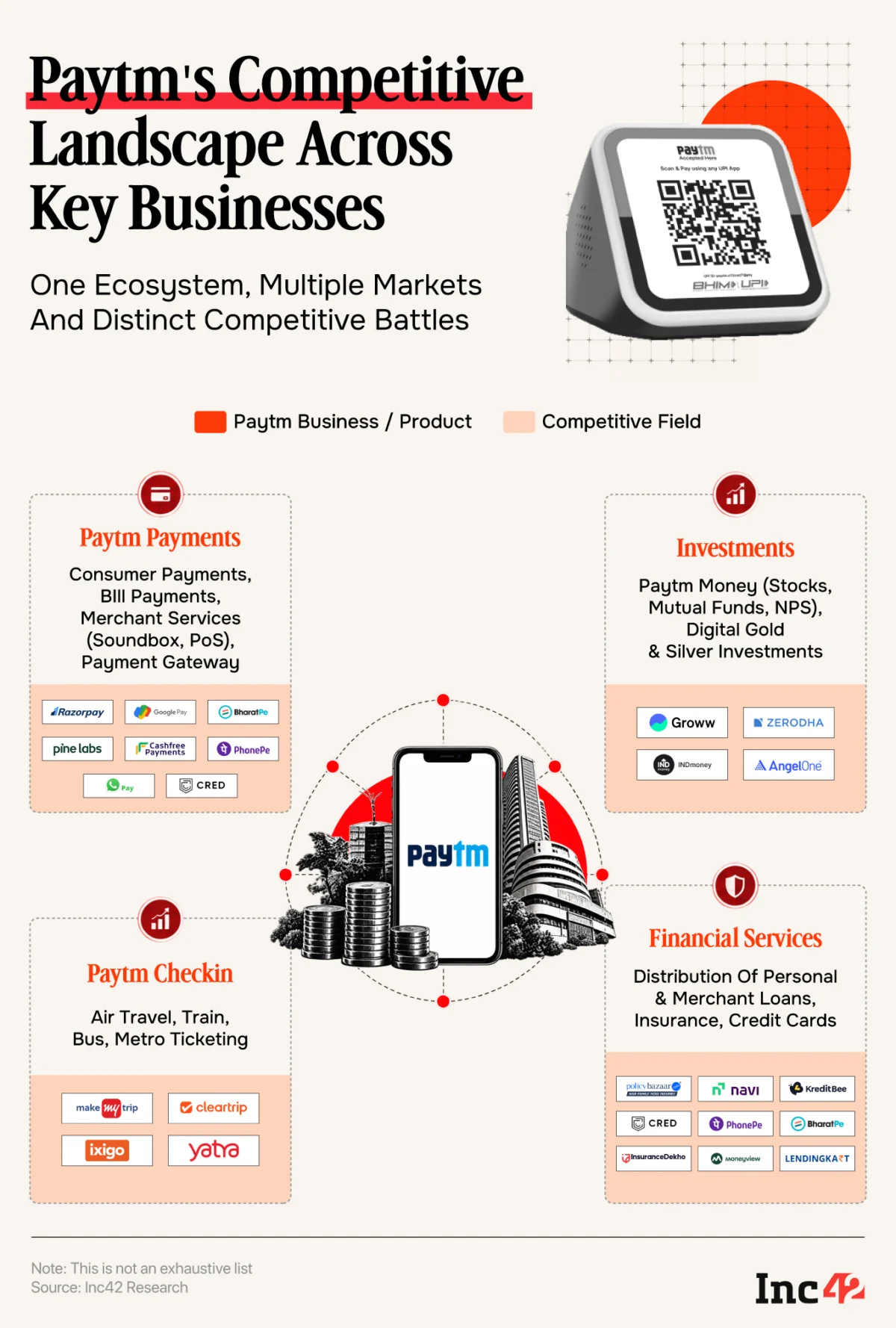
Paytm faces a multifaceted competitive environment. In the consumer UPI space, it significantly trails market leaders like PhonePe and Google Pay, holding roughly 8.03% of volume share as of August 2026. In the merchant ecosystem, it faces stiff competition from established players like Pine Labs, Razorpay, and BharatPe.

The looming debate over the implementation of a 0.4% MDR on certain high-value UPI transactions represents the "X-factor" for the industry. While its rollout has been deferred to January 2027, the potential introduction of these fees could dramatically alter the unit economics of the entire fintech sector.
For Paytm, the implication is twofold:
- The Opportunity: If MDR is introduced, the payments business could shift from a cost center to a profitable growth engine, potentially providing the capital necessary to accelerate its AI and financial services initiatives.
- The Risk: A premature or poorly executed MDR policy could dampen consumer transaction volumes, forcing the company to pivot yet again.
Conclusion: A Calculated Wait
Paytm’s current profitability affords it a luxury many of its competitors lack: time. By focusing on customer quality and high-engagement metrics rather than mere volume, the company has stabilized its core.
The strategy is clear: Use the existing merchant-first infrastructure as the foundation for a high-margin financial distribution business, while using the next 12 to 15 months to refine its AI-led software offerings. Whether Paytm is remembered as the company that digitized India’s payments or the firm that pioneered the AI-powered merchant ecosystem remains to be seen. However, its current trajectory suggests that the transition from a "Payments Company" to a "Financial and Intelligence Platform" is not just an ambition, but a deliberate, data-backed roadmap for long-term survival in an increasingly crowded market.
As the industry waits for the regulatory fog surrounding MDR to clear, Paytm is betting that its intelligence-driven services will be the differentiator that finally solves the monetization puzzle that has defined the last decade of Indian fintech.